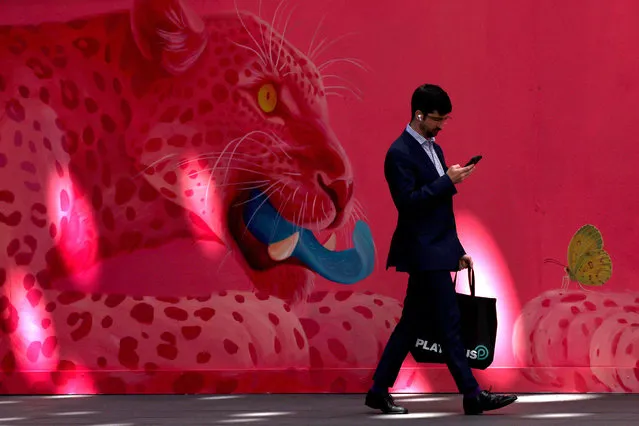
A pedestrian carries a shopping bag and looks at his phone while walking past a mural decorating a construction site in central Sydney on November 6, 2023. (Photo by David Gray/AFP Photo)
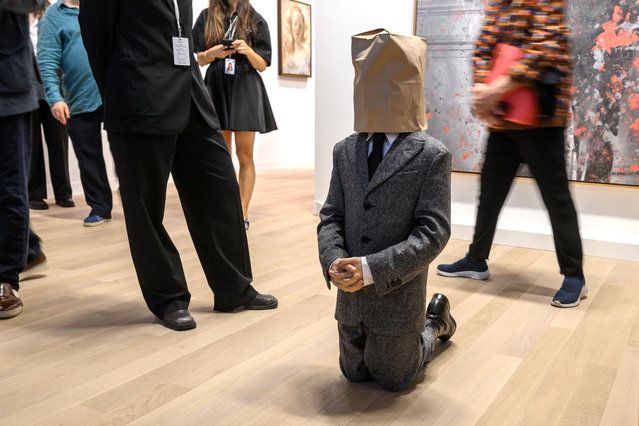
Visitors stand next to the artwork “No, 2021” by Italian visual artist Maurizio Cattelan displayed at the gallery Gagosian during the Art Basel fair for Modern and contemporary art, in Basel, on June 17, 2025. The fair will open to the public from June 19 to June 22, 2025, featuring over 290 leading galleries and more than 4,000 artists from five continents. (Photo by Fabrice Coffrini/AFP Photo)
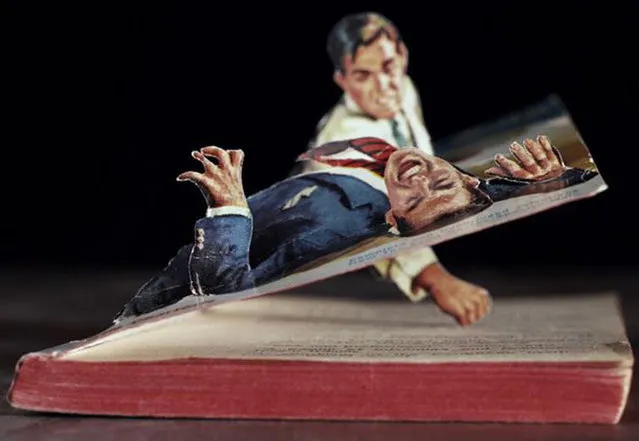
American photographer Thomas Allen constructs witty and clever dioramas using figures cut from the covers of old pulp paperbacks. Using salacious pulp art drawing’s of the ’40s and ’50s that covered books such as ” I Married a Dead Man” and ” Marihuana Girl’, Allen constructs one set of pictures up close while obscuring another, and in the process creates a different context. Each piece is given a brand new storyline, though never quite strays from their cheeky origins.
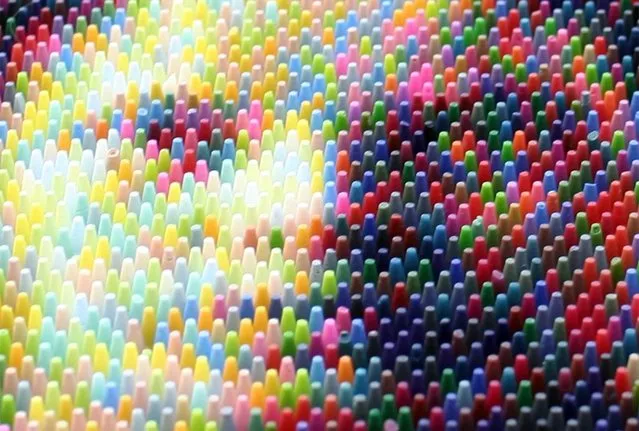
Christian Faur is an artist based in Granville, Ohio. Looking for a new technique, he experimented with painting with wax, but he didn’t feel the results were satisfactory.Then, at Christmas in 2005, his young daughter opened a box of 120 Crayola crayons he’d bought her, and everything clicked into place. Faur decided he would create pictures out of the crayons themselves, packing thousands of them together so they become like the colored pixels on a TV screen. He starts each work by scanning a photo into a computer and breaking the image down into colored blocks He then draws a grid that shows him exactly where to place each crayon The finished artworks are packed tightly into wooden frames. He actually makes the crayons himself, hand-casting each one in a mould.
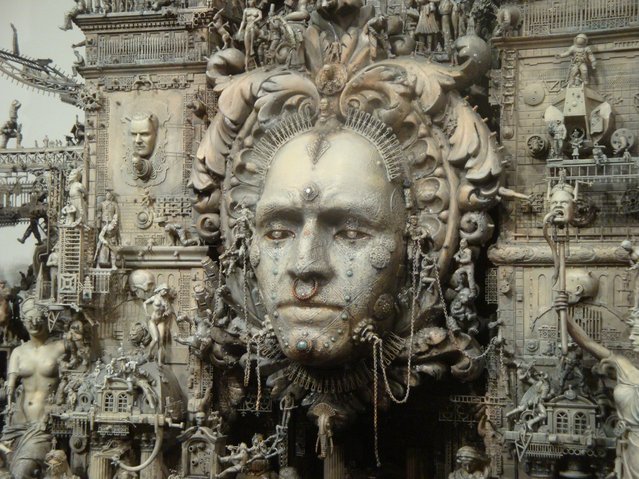
A post-industrial Rococo master, Kris Kuksi obsessively arranges characters and architecture in asymmetric compositions with an exquisite sense of drama. Instead of stones and shells he uses screaming plastic soldiers, miniature engine blocks, towering spires and assorted debris to form his landscapes.
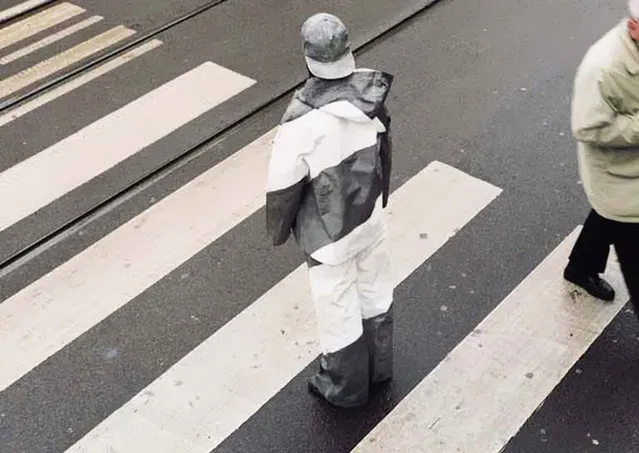
“The artist herself produces the camouflage suit. For each photo, for each environment of her choice, she designs a new suit, which again and again has to be made with the greatest precision, or the illusive effect will not work. By uniting the figure with the background, Desiree Palmen reaches a surprising visual effect that requests a special effort for the observing eye: it must disentangle what is flat and what is spatial.”
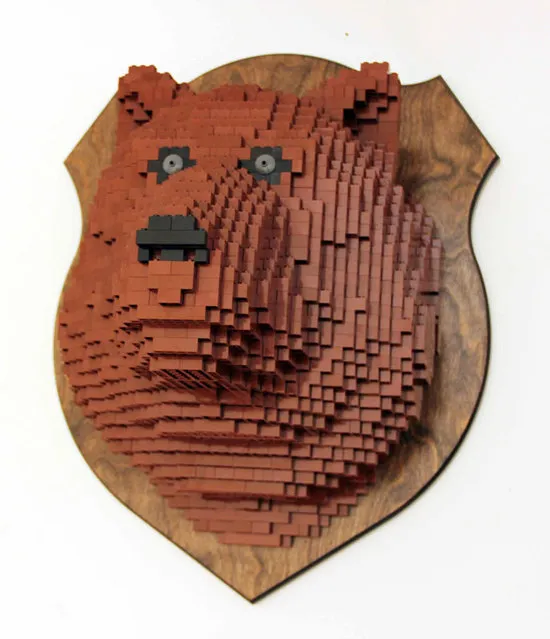
New York sculptor Nathan Sawaya has become renowned in the modern art world for his groundbreaking fusion of pop art and surrealism in pieces comprised solely of LEGO® bricks. His most recent work represents a new phase of artistic expression within this medium, as he explores themes of identity. All his new sculpture is in one way or another autobiographical, addressing the issue of self through symbolism to express his surrealistic ideology.