Loading...
Done
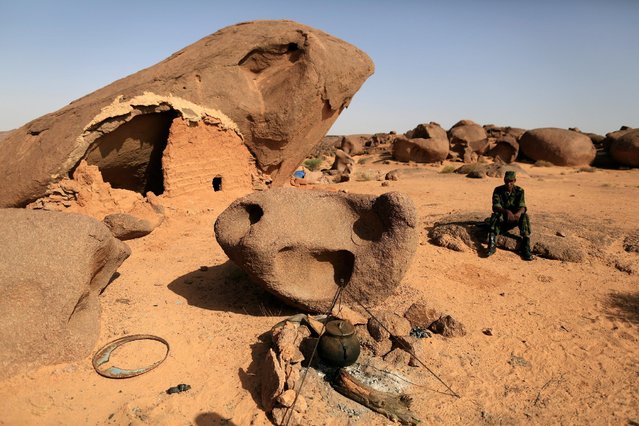
A Polisario fighter sits on a rock at a forward base on the outskirts of Tifariti, Western Sahara, September 9, 2016. At a rocky outpost in Western Sahara, a new generation of soldiers who have never known war are mobilising as tensions resurface in one of Africa's oldest disputes after a quarter century of uneasy peace. Young Sahrawi troops man new desert posts for the Polisario Front, which for more than 40 years has sought independence for the vast desert region - first in a guerrilla war against Morocco and then politically since a ceasefire deal in 1991. Now a standoff with Morocco, which controls the majority of Western Sahara, is renewing pressure for a diplomatic solution to ensure foot soldiers don't return to fighting as the last generation of commanders once did. The standoff since August has brought Moroccan and Polisario forces within 200 metres of each other in a narrow strip of land near the Mauritanian border. Rich in phosphate, Western Sahara has been contested since 1975 when Spanish colonial powers left. Morocco claimed the territory and fought the 16-year war with Polisario. (Photo by Zohra Bensemra/Reuters)

A Polisario fighter sits on a rock at a forward base on the outskirts of Tifariti, Western Sahara, September 9, 2016. At a rocky outpost in Western Sahara, a new generation of soldiers who have never known war are mobilising as tensions resurface in one of Africa's oldest disputes after a quarter century of uneasy peace. (Photo by Zohra Bensemra/Reuters)
Details
04 Nov 2016 12:09:00
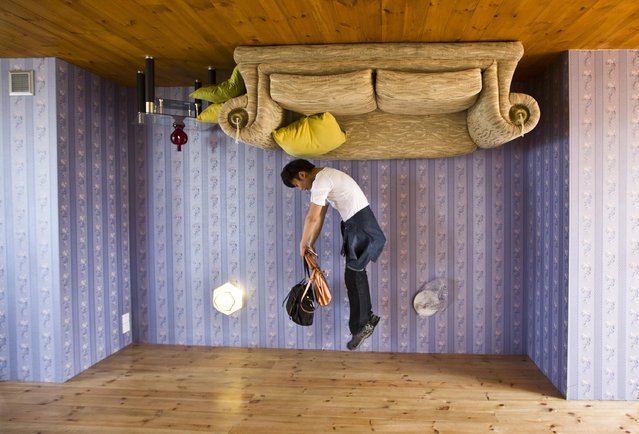
A tourist jumps inside an upside-down house at Fengjing Ancient Town, Jinshan District, south of Shanghai, May 1, 2014. The upside-down house was built as a tourist attraction using everyday household items and furniture. (Photo by Aly Song/Reuters)

A tourist jumps inside an upside-down house at Fengjing Ancient Town, Jinshan District, south of Shanghai, May 1, 2014. The upside-down house was built as a tourist attraction using everyday household items and furniture. (Photo by Aly Song/Reuters)
Details
02 May 2014 11:46:00
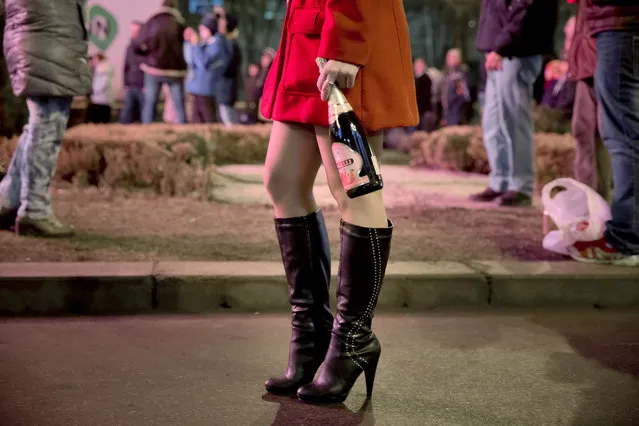
A woman holds a champagne bottle during New Year's celebrations in Bucharest, Romania, Wednesday, January 1, 2014. Tens of thousands of Romanians took to the streets of the Romanian capital to join parties and watch fireworks. (Photo by Vadim Ghirda/AP Photo)

A woman holds a champagne bottle during New Year's celebrations in Bucharest, Romania, Wednesday, January 1, 2014. Tens of thousands of Romanians took to the streets of the Romanian capital to join parties and watch fireworks. (Photo by Vadim Ghirda/AP Photo)
Details
01 Jan 2014 11:03:00
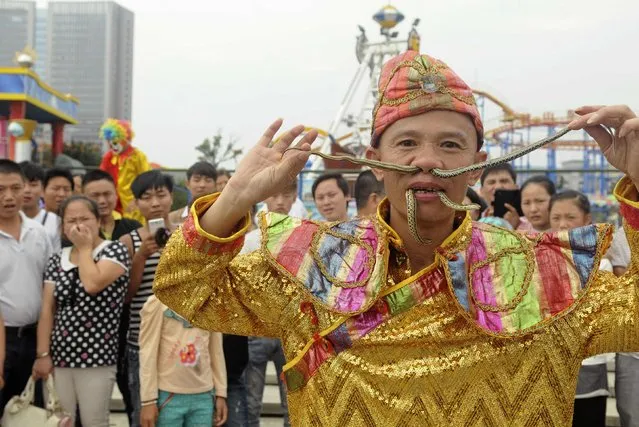
Visitors look on as a man (front) inserts two live snakes through his nose and mouth during a performance at an amusement park to celebrate the 65th anniversary of the founding of the People's Republic of China and the 7-day national day holiday, in Jinhua, Zhejiang province October 1, 2014. (Photo by Reuters/Stringer)

Visitors look on as a man (front) inserts two live snakes through his nose and mouth during a performance at an amusement park to celebrate the 65th anniversary of the founding of the People's Republic of China and the 7-day national day holiday, in Jinhua, Zhejiang province October 1, 2014. (Photo by Reuters/Stringer)
Details
04 Oct 2014 11:22:00
Russian trio Serebro

“Serebro (Серебро, Silver) are a Russian trio, formed in Moscow, Russia in 2006. Serebro is currently one of the most popular Russian bands. They are also famously known as the band who finished third in the Eurovision Song Contest 2007 in Helsinki with the song “Song #1”. On 30 July 2011, Serebro premiered their eighth single, “Mama Lover” at Europa Plus Live. It is their third official English language release after “Song #1” and “Like Mary Warner”. On 15 September 2011, the music video for “Mama Luba” (Russian version of “Mama Lover”) was released”. – Wikipedia

Photo: Russian trio «Serebro», 2008
Details
30 Sep 2011 11:56:00
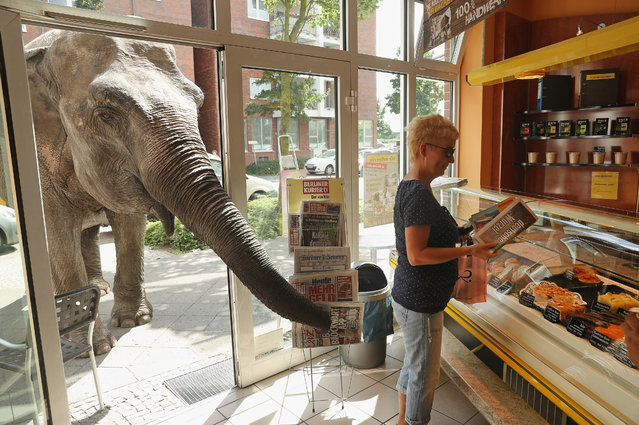
Maja, a 40-year-old elephant, extends her trunk into a bakery as a customer buys a newspaper while Maja took a stroll through the neighborhood with her minders from a nearby circus on July 1, 2016 in Berlin, Germany. (Photo by Sean Gallup/Getty Images)

Maja, a 40-year-old elephant, extends her trunk into a bakery as a customer buys a newspaper while Maja took a stroll through the neighborhood with her minders from a nearby circus on July 1, 2016 in Berlin, Germany. (Photo by Sean Gallup/Getty Images)
Details
29 Dec 2016 07:42:00
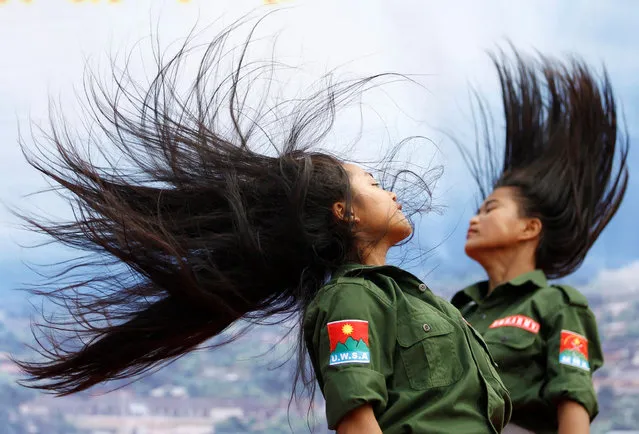
Ethnic Wa performer dressed as United Wa State Army (UWSA) soldiers perform a traditional dance in Mongmao, Wa territory in northeast Myanmar October 1, 2016. (Photo by Soe Zeya Tun/Reuters)

Ethnic Wa performer dressed as United Wa State Army (UWSA) soldiers perform a traditional dance in Mongmao, Wa territory in northeast Myanmar October 1, 2016. Wa State is an unrecognised state in Myanmar (Burma) and is currently subsumed under the official Wa Special Region 2 of northern Shan State. The Wa were once known as the “Wild Wa” by the British due to their practice of headhunting. (Photo by Soe Zeya Tun/Reuters)
Details
30 Dec 2016 10:18:00
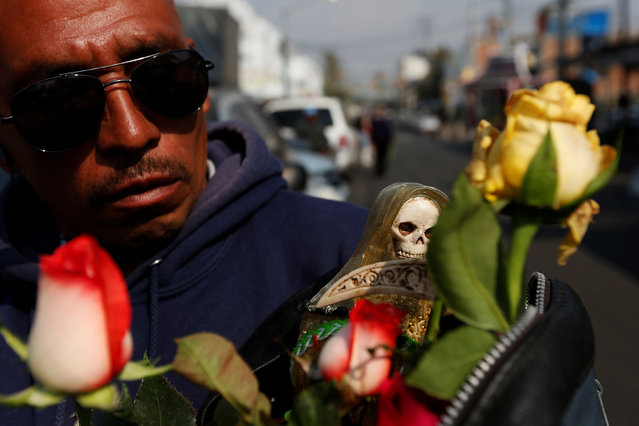
A man carries a figurine of Santa Muerte or The Saint of Death during the first prayer of the New Year in Mexico City, Mexico January 1, 2017. (Photo by Carlos Jasso/Reuters)

A man carries a figurine of Santa Muerte or The Saint of Death during the first prayer of the New Year in Mexico City, Mexico January 1, 2017. Nuestra Señora de la Santa Muerte is a female deity of Mexican folk religion, venerated primarily in Mexico and the Southwestern United States. (Photo by Carlos Jasso/Reuters)
Details
03 Jan 2017 11:23:00