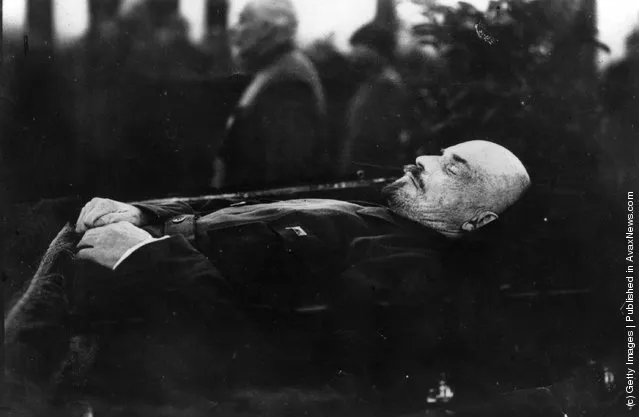
Photo: Vladimir Ilyich Lenin (1870 – 1924) lying in state in the Kremlin. (Photo by Hulton Archive/Getty Images). 1924
Important! For the same article in Russian language click here.
Something quite intriguing is happening within Russian-speaking internet during the last few – should you type a fully academic inquiry (at least, according to Russian academic requirements) in national search engines for "Lenin's mausoleum" – the first thing you get (even in top 10 searches) is website pages talking about black magic and occult. Website authors view this construction differently, but unconditionally agree on one thing: the mausoleum of the "leader of the world proletariat” – the essence of a magical artifact, a sort of “energy vampire”. It was built with a certain purpose: to drain the energy out of miserable Soviet citizens on one hand; and to poison the anthroposphere of one-sixth part of the earth with its vibes (the exact territory that was occupied by the former Soviet Union), depriving the Russian people of will to resist on the other hand. Complete nonsense? No doubt. Nevertheless, an intriguing one. Well, probably because some oddities do exist in mausoleum's history. These oddities are the thing we are going to discuss this time. First, let me refresh you memory on the subject.
A boy takes a picture of a car crash in Shenzhen, Guangdong province, August 4, 2014. Two passengers were sent to hospital but no death was reported as a result of the accident, according to local media. (Photo by Reuters/Stringer)
An officer reviews members of the honor guard as they line up before a welcoming ceremony for visiting Mozambique's President Filipe Jacinto Nyusi at the Great Hall of the People in Beijing, Wednesday, May 18, 2016. (Photo by Mark Schiefelbein/AP Photo)
West Berliners crowd in front of the Berlin Wall as they watch East German border guards demolish a section of the wall on November 11, 1989. (Photo by Gerard Malie/AFP Photo)
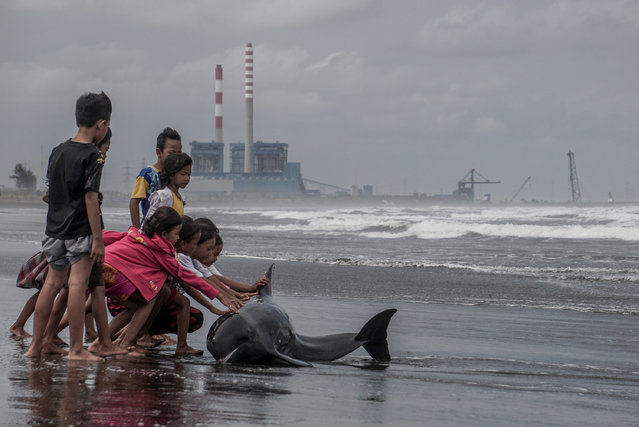
Children try to push an injured and weak dolphin back into the water after it washed ashore during bad weather and high tide on a beach in Cilacap, Central Java, Indonesia August 12, 2016 in this photo taken by Antara Foto. (Photo by Idhad Zakaria/Reuters/Antara Foto)
Five year old George holds an orange to feed the Owl butterflies at the Natural History Museum in London, Thursday, March 30, 2017. Hundreds of tropical butterflies were released to launch the Natural History Museum's Sensational Butterflies exhibition, starting for the public on March 31, 2017. (Photo by Frank Augstein/AP Photo)
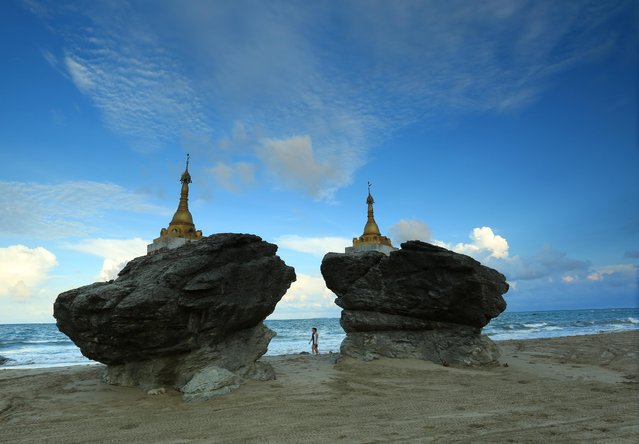
In this May 17, 2015, photo, two men walk past pagodas at Ngwe Saung beach, Pathein township, about 145 miles from Yangon, Myanmar. (Photo by Khin Maung Win/AP Photo)