A girl plays a jump rope game at a school housing residents displaced by gang violence in Port-au-Prince, Haiti, Wednesday, May 15, 2024. (Photo by Ramon Espinosa/AP Photo)
Indian actress Priyanka Chopra Jonas, American actress Anne Hathaway and American actress and singer Zendaya attend the “Bulgari Mediterranea High Jewelry” event at Palazzo Ducale on May 16, 2023 in Venice. (Photo by Pietro S. D'Aprano/Getty Images for Bulgari)
Cast members Chase Sui Wonders, Sarah Pidgeon, Gabriella Bechtel, also known as Gabbriette, and Madelyn Cline attend the premiere of the film “I Know What You Did Last Summer”, in Los Angeles on July 15, 2025. (Photo by Mario Anzuoni/Reuters)
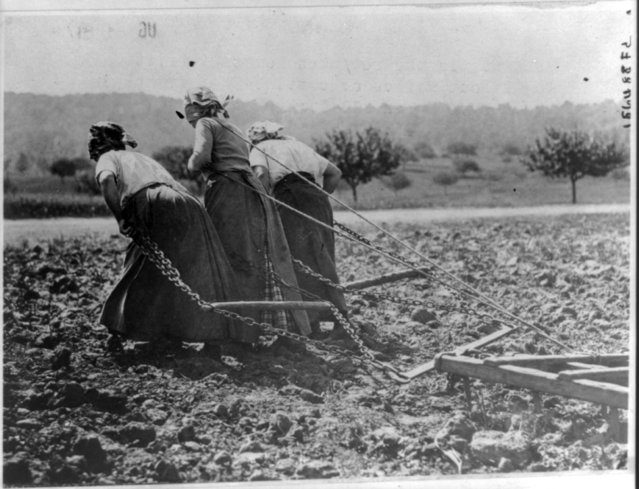
Peasants in the re-taken Somme District work in the fields, circa 1916- 1917, in this Library of Congress handout photo. For women 100 years ago, opportunities to work beyond the home and take part in political life were very limited. As the 20th century progressed, hard-won progress included gradually improved voting rights, while the upheaval of war pushed doors ajar as women worked as part of the war effort. U.S. Library of Congress archive photos show women's workplaces ranging from a flour mill in England to a coal mine in Belgium or Lincoln Motor Co.'s welding department in Detroit. International Women's Day is celebrated on March 8. (Photo by Reuters/Bain Collection/Library of Congress)
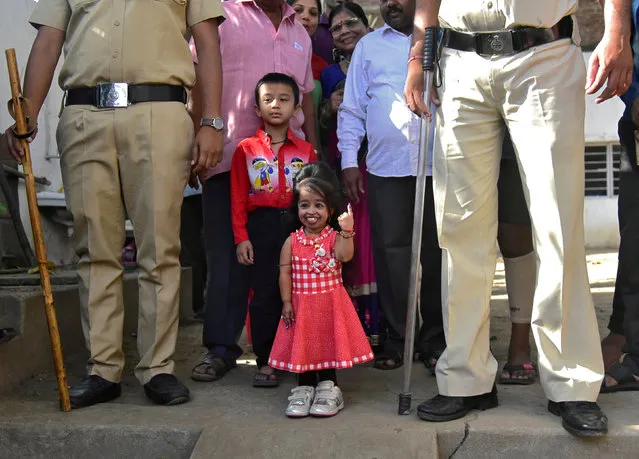
Jyoti Amge, 25, who holds the Guinness World Records title for the “Shortest Living Woman”, shows her ink-marked finger after casting her vote at a polling station during the first phase of the general election in Nagpur, India, April 11, 2019. (Photo by Reuters/Stringer)
A soldier beaten by the mob (C) is protected by plain chothes policemen after troops involved in the coup surrendered on the Bosphorus Bridge in Istanbul, Turkey July 16, 2016. (Photo by Murad Sezer/Reuters)
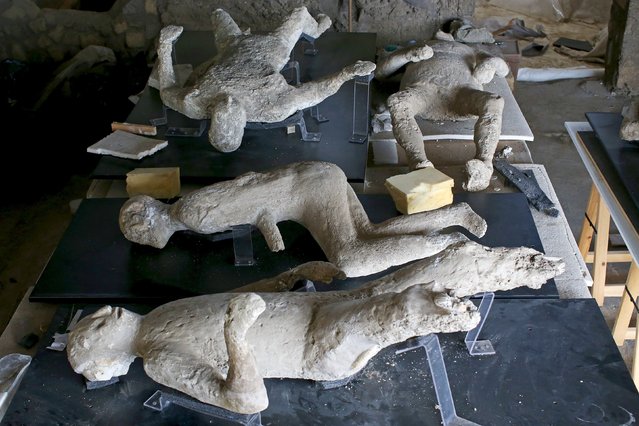
Plaster cast moulds of victims of the Mount Vesuvius eruption lie on a display table in a laboratory at Pompeii October 13, 2015. An expert team made up of archaeologists, radiologists, orthodontists and anthropologists began on September 2015 to use CAT scan technology (computerised axial tomography) to peer inside the plaster cast moulds of Pompeii's victims, in a study that has added more detail to previous findings. A 16-layer scan had to be used in order to penetrate the hardened plaster but the results showed up impressive skeletal remains and near perfect teeth. (Photo by Alessandro Bianchi/Reuters)