Loading...
Done
Thousands of heavy-duty trucks loaded with coal are lined up for up to 130 kilometres from the Mongolia-China border on a sole road in the Gobi desert, Mongolia, October 29, 2017. The journey can take more than a week. (Photo by Bazarsukh Rentsendorj/Reuters)

Thousands of heavy-duty trucks loaded with coal are lined up for up to 130 kilometres from the Mongolia-China border on a sole road in the Gobi desert, Mongolia, October 29, 2017. The journey can take more than a week. (Photo by Bazarsukh Rentsendorj/Reuters)
Details
10 Apr 2018 00:03:00
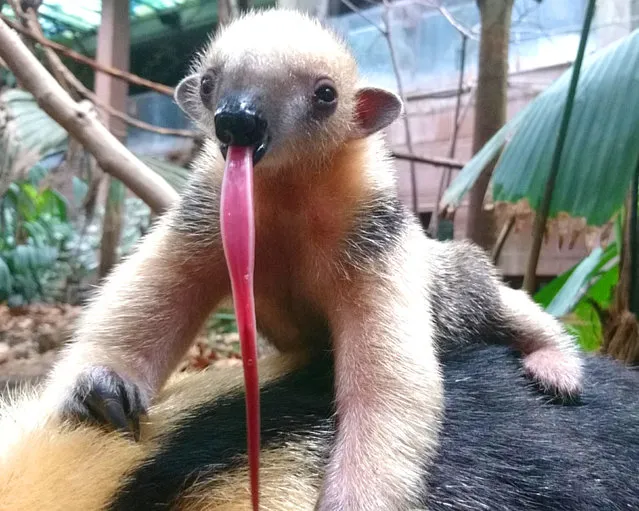
A baby tamandua, or anteater, named Poco sticks out its tongue on May 31, 2018. ZSL London Zoo is celebrating the creature’s surprise birth after they found a male to be the companion of its mother Ria last October. (Photo by ZSL London Zoo/PA Wire)

A baby tamandua, or anteater, named Poco sticks out its tongue on May 31, 2018. ZSL London Zoo is celebrating the creature’s surprise birth after they found a male to be the companion of its mother Ria last October. (Photo by ZSL London Zoo/PA Wire)
Details
03 Jun 2018 00:03:00
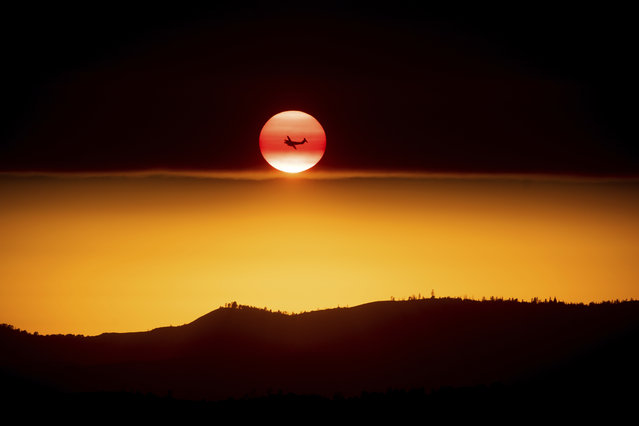
A plane battling the Ferguson Fire passes the setting sun in unincorporated Mariposa County Calif., near Yosemite National Park on Sunday, July 15, 2018. (Photo by Noah Berger/AP Photo)

A plane battling the Ferguson Fire passes the setting sun in unincorporated Mariposa County Calif., near Yosemite National Park on Sunday, July 15, 2018. (Photo by Noah Berger/AP Photo)
Details
18 Jul 2018 00:03:00
Children play on an uprooted tree along a beach in Mele, Vanuatu that was once lined with vegetation, now largely lost to storms, erosion and other environmental pressures on Saturday, July 19, 2025. (Photo by Annika Hammerschlag/AP Photo)

Children play on an uprooted tree along a beach in Mele, Vanuatu that was once lined with vegetation, now largely lost to storms, erosion and other environmental pressures on Saturday, July 19, 2025. (Photo by Annika Hammerschlag/AP Photo)
Details
22 Aug 2025 04:02:00
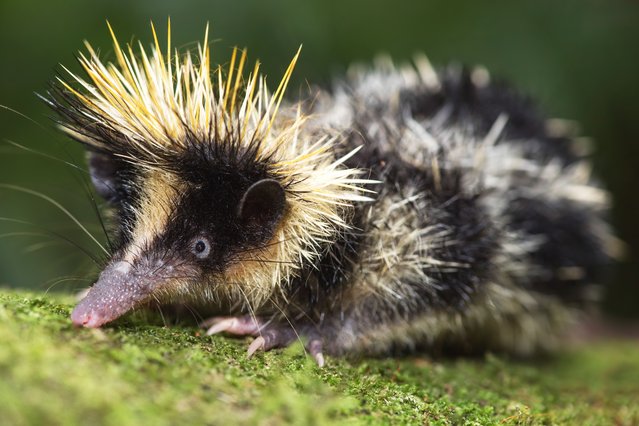
This spiky tenrec was spotted in Madagascar’s Mantadia National Park in the last decade of September 2025. Mostly nocturnal and rarely seen, it puffs out its spines when threatened. Spiky tenrecs are excellent swimmers — unlike most spiny mammals, some species of tenrec can forage in streams and rivers, using their spines for protection while hunting aquatic insects and small prey. (Photo by Dale Morris/Solent News & Photo Agency)

This spiky tenrec was spotted in Madagascar’s Mantadia National Park in the last decade of September 2025. Mostly nocturnal and rarely seen, it puffs out its spines when threatened. Spiky tenrecs are excellent swimmers — unlike most spiny mammals, some species of tenrec can forage in streams and rivers, using their spines for protection while hunting aquatic insects and small prey. (Photo by Dale Morris/Solent News & Photo Agency)
Details
05 Oct 2025 04:02:00


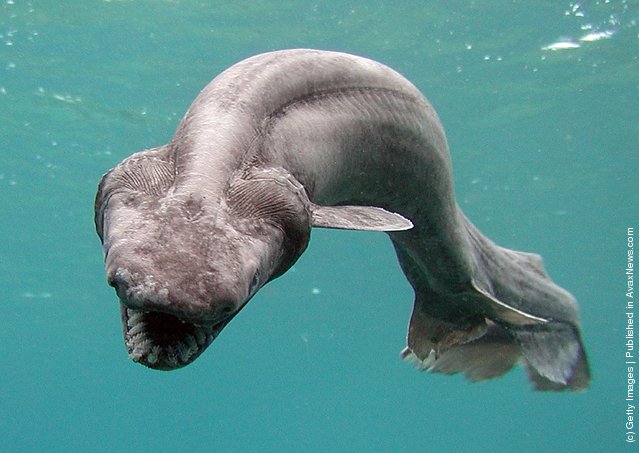
“The frilled shark (Chlamydoselachus anguineus) is one of two extant species of shark in the family Chlamydoselachidae, with a wide but patchy distribution in the Atlantic and Pacific Oceans. This uncommon species is found over the outer continental shelf and upper continental slope, generally near the bottom though there is evidence of substantial upward movements. It has been caught as deep as 1,570 m (5,150 ft), whereas in Suruga Bay, Japan it is most common at depths of 50–200 m (160–660 ft). Exhibiting several “primitive” features, the frilled shark has often been termed a «living fossil»”. – Wikipedia

Photo: A 1.6 meter long Frill shark swims in a tank after being found by a fisherman at a bay in Numazu, on January 21, 2007 in Numazu, Japan. The frill shark, also known as a Frilled shark usually lives in waters of a depth of 600 meters and so it is very rare that this shark is found alive at sea-level. It's body shape and the number of gill are similar to fossils of sharks which lived 350,000,000 years ago. (Photo by Awashima Marine Park/Getty Images)

Details
05 May 2011 10:01:00


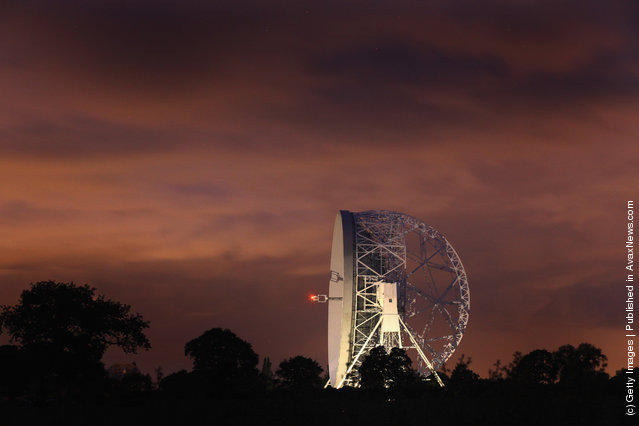
“The Lovell Telescope is a radio telescope at Jodrell Bank Observatory, near Goostrey, Cheshire in the north-west of England. When it was constructed in 1955, the telescope was the largest steerable dish radio telescope in the world at 76.2 m (250 ft) in diameter; it is now the third largest, after the Green Bank telescope in West Virginia, USA, and the Effelsberg telescope in Germany. It was originally known as the 250 ft (76 m) telescope or the Radio Telescope at Jodrell Bank, before becoming the Mark I telescope around 1961 when future telescopes (the Mark II, III, and IV) were being discussed. It was renamed to the Lovell Telescope in 1987 after Bernard Lovell, and became a Grade I listed building in 1988. The telescope forms part of the MERLIN and European VLBI Network arrays of radio telescopes”. – Wikipedia

Photo: The Lovell Telescope listens to the night sky for radio signals from space at Jodrell Bank on June 22, 2011 in Holmes Chapel, England. Jodrell Bank Centre for Astrophysics and it's world famous Lovell Telescope is on the shortlist of Britain's submission for Unesco World Heritage Site status. (Photo by Christopher Furlong/Getty Images)
Details
24 Jun 2011 09:34:00
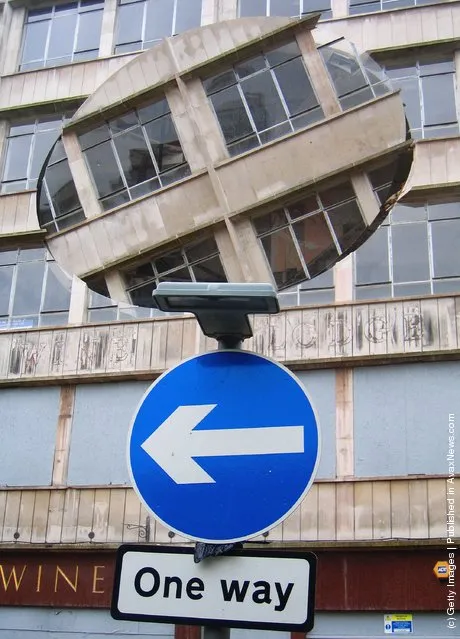
An installation by the artist Richard Wilson, entitled 'Turning the Place Over', is built into the condemned Cross Keys House in Moorfields as part of the Capital of Culture for 2008

“Richard Wilson (born May 24, 1953) is a sculptor, installation artist and musician. Wilson's work is characterised by architectural concerns with volume, illusionary spaces and auditory perception”. – Wikipedia

Photo: An installation by the artist Richard Wilson, entitled “Turning the Place Over”, is built into the condemned Cross Keys House in Moorfields as part of the Capital of Culture for 2008, on June 25, 2007 in Liverpool, England. The piece consists of an 8 metre ovoid cut from the building's facade that oscillates in three dimensions. (Photo by Jim Dyson/Getty Images)
Details
27 Mar 2012 10:31:00