Loading...
Done
Ornamental chicken breeding clubs have emerged in Indonesia, Thailand, North America and even European countries such as the UK and France. Malaysia is however the epicenter of this cultural phenomenon. (Photo by Ernest Goh/2013 Sony World Photography Awards)

Ornamental chicken breeding clubs have emerged in Indonesia, Thailand, North America and even European countries such as the UK and France. Malaysia is however the epicenter of this cultural phenomenon. These chickens are prized for their build, size, behavior and showmanship by their owners and competitions or beauty contests as they are often described are held almost every week in at least one village in Malaysia. Judges sit around a square table inspecting each chicken for a few minutes trying to determine a champion specimen in its own weight class based on its stance, temperament and physical assets like wings, tails and comb. The walk or strut by an ornamental chicken in a beauty contest, much like a runway model, constitutes a large part of the scoring system. (Photo by Ernest Goh/2013 Sony World Photography Awards)
Details
28 Apr 2013 08:32:00
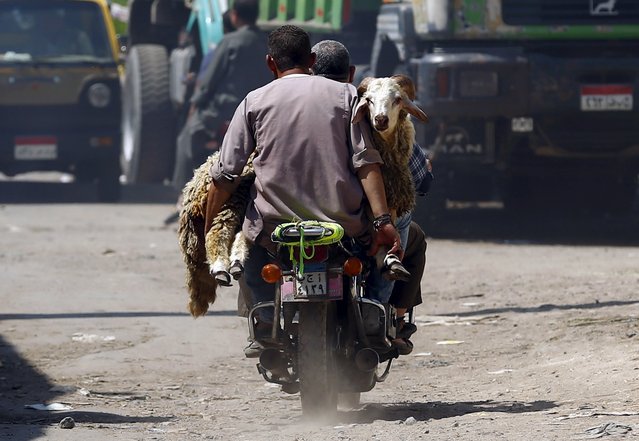
Men transport a sheep on their motorcycle after buying it at an old cattle market named “Al Emam Market” ahead of the Muslim festival Eid al-Adha in Cairo, Egypt, September 19, 2015. Muslims across the world are preparing to celebrate the annual festival of Eid al-Adha or the Festival of Sacrifice, which marks the end of the annual hajj pilgrimage, by slaughtering goats, sheep. (Photo by Amr Abdallah Dalsh/Reuters)

Men transport a sheep on their motorcycle after buying it at an old cattle market named “Al Emam Market” ahead of the Muslim festival Eid al-Adha in Cairo, Egypt, September 19, 2015. Muslims across the world are preparing to celebrate the annual festival of Eid al-Adha or the Festival of Sacrifice, which marks the end of the annual hajj pilgrimage, by slaughtering goats, sheep, cows and camels in commemoration of the Prophet Abraham's readiness to sacrifice his son to show obedience to Allah. (Photo by Amr Abdallah Dalsh/Reuters)
Details
22 Sep 2015 08:05:00
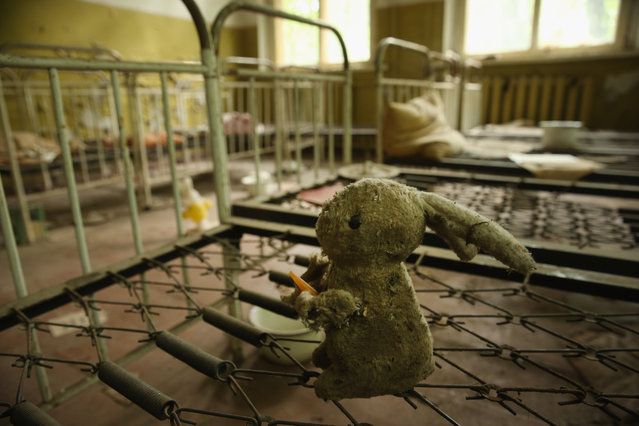
A stuffed rabbit doll sits among children's beds standing in the abandoned kindergarten of Kopachi village located inside the Chernobyl Exclusion Zone on September 29, 2015 near Chornobyl, Ukraine. Kopachi, a village that before 1986 had a population of 1,114, lies only a few kilometers south of the former Chernobyl nuclear power plant, where in 1986 workers inadvertantly caused reactor number four to explode, creating the worst nuclear accident in history. Radiation fallout was so high that authorities bulldozed and buried all of Kopachi's structures except for the kindergarten. (Photo by Sean Gallup/Getty Images)

A stuffed rabbit doll sits among children's beds standing in the abandoned kindergarten of Kopachi village located inside the Chernobyl Exclusion Zone on September 29, 2015 near Chornobyl, Ukraine. Kopachi, a village that before 1986 had a population of 1,114, lies only a few kilometers south of the former Chernobyl nuclear power plant, where in 1986 workers inadvertantly caused reactor number four to explode, creating the worst nuclear accident in history. (Photo by Sean Gallup/Getty Images)
Details
27 Apr 2016 09:28:00
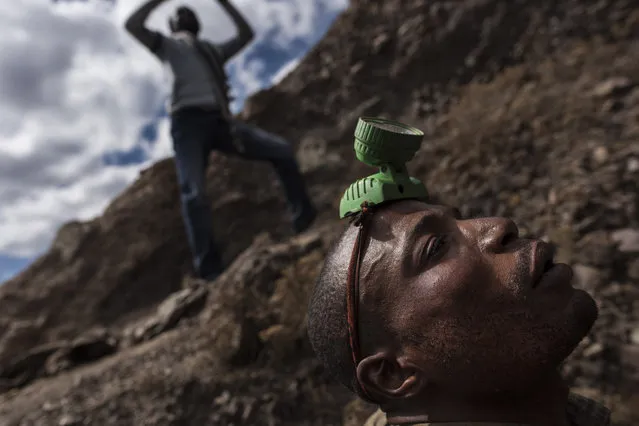
A “creuseur”, or digger, a plastic lantern on his head, readies to enter a copper and cobalt mine in Kawama, Democratic Republic of Congo on June 8, 2016. Cobalt is used in the batteries for electric cars and mobile phones. Working conditions are dangerous, often with no safety equipment or structural support for the tunnels. The diggers say they are paid on average US$2-3/day. (Photo by Michael Robinson Chavez/The Washington Post)

A “creuseur”, or digger, a plastic lantern on his head, readies to enter a copper and cobalt mine in Kawama, Democratic Republic of Congo on June 8, 2016. Cobalt is used in the batteries for electric cars and mobile phones. Working conditions are dangerous, often with no safety equipment or structural support for the tunnels. The diggers say they are paid on average US$2-3/day. (Photo by Michael Robinson Chavez/The Washington Post)
Details
30 Dec 2016 10:29:00
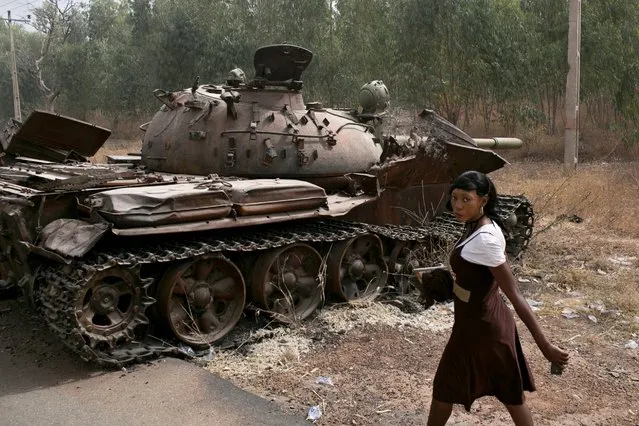
An abandoned tank left by Boko Haram, February 20, 2016, seen on the road to Michika, Nigeria – a town formerly occupied by the insurgents. On April 14, 2014, 300 schoolgirls in the Chibok village in Nigeria were kidnapped by the terrorist group, Boko Haram. Two years later, the majority of these girls are still missing. According to the Global Terrorism Index Report 2015, Boko Haram, which operates mainly in Nigeria, has become the most deadly terrorist group in the world. (Photo by Danielle Villasana)

An abandoned tank left by Boko Haram, February 20, 2016, seen on the road to Michika, Nigeria – a town formerly occupied by the insurgents. On April 14, 2014, 300 schoolgirls in the Chibok village in Nigeria were kidnapped by the terrorist group, Boko Haram. Two years later, the majority of these girls are still missing. According to the Global Terrorism Index Report 2015, Boko Haram, which operates mainly in Nigeria, has become the most deadly terrorist group in the world. (Photo by Danielle Villasana)
Details
22 Apr 2016 13:13:00
A view of traditional bolinhos de bacalhau (fried codfish balls) in Rio de Janeiro, Brazil, May 7, 2016. (Photo by Sergio Moraes/Reuters)

If the most popular foods of Rio de Janeiro have one thing in common, it is their informality. You can find fine restaurants in the city, but they do not set Rio apart from other places. What does set it apart, and what invariably brings its residents, known as "Cariocas," together is the unpretentious food they eat in bright, loud, crowded bars and restaurants, on busy street corners, or after a day at the beach. Here: A view of traditional bolinhos de bacalhau (fried codfish balls) in Rio de Janeiro, Brazil, May 7, 2016. (Photo by Sergio Moraes/Reuters)
Details
05 Aug 2016 13:20:00
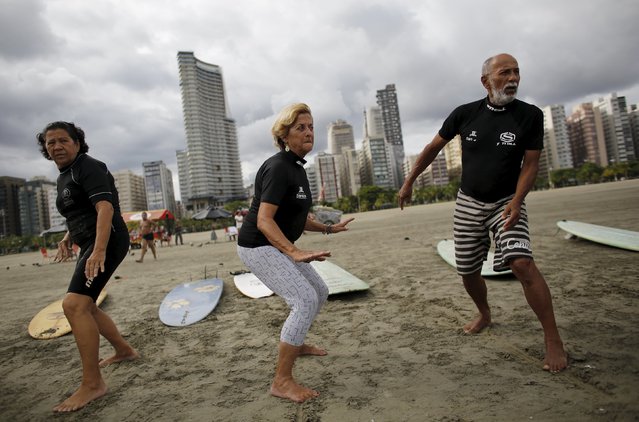
(L-R) Edmea Pereira, 69, Elsa Rodrigues, 61, and Osmidio Conde, 71, take part in their surf class in Santos, Sao Paulo state, Brazil, March 16, 2016. (Photo by Nacho Doce/Reuters)

(L-R) Edmea Pereira, 69, Elsa Rodrigues, 61, and Osmidio Conde, 71, take part in their surf class in Santos, Sao Paulo state, Brazil, March 16, 2016. When work is up, surf is up in Brazil, as a group of retired citizens take to the waves in keep-fit, keep-young sessions at a surf school in the city of Santos. The classes are run for free, three times a week at the Cisco Arana school, which aims to prove that age is just a number. (Photo by Nacho Doce/Reuters)
Details
19 Mar 2016 12:31:00
A hostage runs towards a police officer outside Lindt cafe, where other hostages are being held, in Martin Place in central Sydney December 15, 2014. Two more hostages have run out of the cafe at the center of a siege in Sydney, Australia's largest city, according to a Reuters witness at the site. (Photo by Jason Reed/Reuters)

A hostage runs towards a police officer outside Lindt cafe, where other hostages are being held, in Martin Place in central Sydney December 15, 2014. Two more hostages have run out of the cafe at the center of a siege in Sydney, Australia's largest city, according to a Reuters witness at the site. The two women were both wearing aprons indicating they were staff at the Lindt cafe where a gunman has been holding an unknown number of hostages for several hours. Three men had earlier run out of the cafe. (Photo by Jason Reed/Reuters)
Details
15 Dec 2014 11:49:00