Loading...
Done
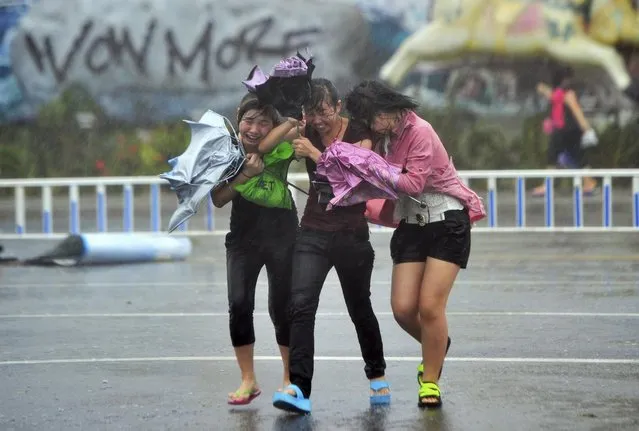
People cross a street against strong wind and heavy rainfall under the influence of Typhoon Haiyan, in Sanya, Hainan province November 10, 2013. One of the most powerful storms ever recorded killed at least 10,000 people in the central Philippines, a senior police official said on Sunday, with huge waves sweeping away entire coastal villages and devastating the region's main city. Despite weakening, the storm is likely to cause heavy rains, flooding, strong winds and mudslides as it makes its way north in the South China Sea. (Photo by Reuters/China Daily)

People cross a street against strong wind and heavy rainfall under the influence of Typhoon Haiyan, in Sanya, Hainan province November 10, 2013. One of the most powerful storms ever recorded killed at least 10,000 people in the central Philippines, a senior police official said on Sunday, with huge waves sweeping away entire coastal villages and devastating the region's main city. Despite weakening, the storm is likely to cause heavy rains, flooding, strong winds and mudslides as it makes its way north in the South China Sea. (Photo by Reuters/China Daily)
Details
16 Nov 2013 12:28:00
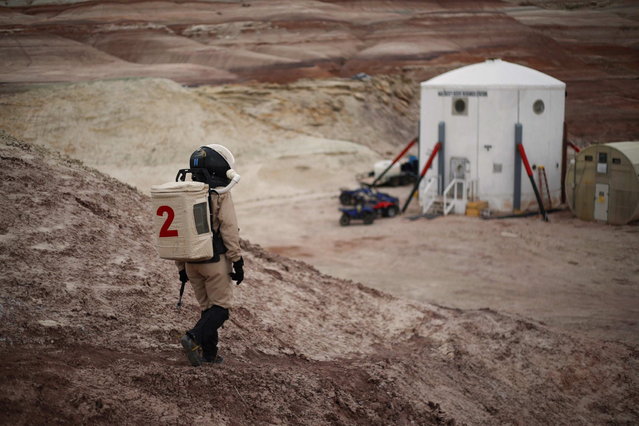
Csilla Orgel, a geologist of Crew 125 EuroMoonMars B mission, makes her way back to the Mars Desert Research Station (MDRS) in the Utah desert March 3, 2013. (Photo by Jim Urquhart/Reuters)

NASA says it could be another 20 years before humans touch down on Mars, but in a sense, the Mars Society has been exploring the red planet for more than a decade – in Utah. Photo: Csilla Orgel, a geologist of Crew 125 EuroMoonMars B mission, makes her way back to the Mars Desert Research Station (MDRS) in the Utah desert March 3, 2013. The MDRS aims to investigate the feasibility of a human exploration of Mars and uses the Utah desert's Mars-like terrain to simulate working conditions on the red planet. Scientists, students and enthusiasts work together developing field tactics and studying the terrain. All outdoor exploration is done wearing simulated spacesuits and carrying air supply packs and crews live together in a small communication base with limited amounts of electricity, food, oxygen and water. Everything needed to survive must be produced, fixed and replaced on site. (Photo by Jim Urquhart/Reuters)
Details
14 Mar 2013 12:11:00
Russian President Vladimir Putin visits the Byzantine and Christian museum in Athens, Friday, May 27, 2016. (Photo by Thanassis Stavrakis/AP Photo)

Russian President Vladimir Putin visits the Byzantine and Christian museum in Athens, Friday, May 27, 2016. Russia's president is due in financially struggling Greece Friday for a state visit that will include a trip to a 1,000-year-old, all-male Orthodox Christian sanctuary in the north of the country. (Photo by Thanassis Stavrakis/AP Photo)
Details
28 May 2016 11:55:00
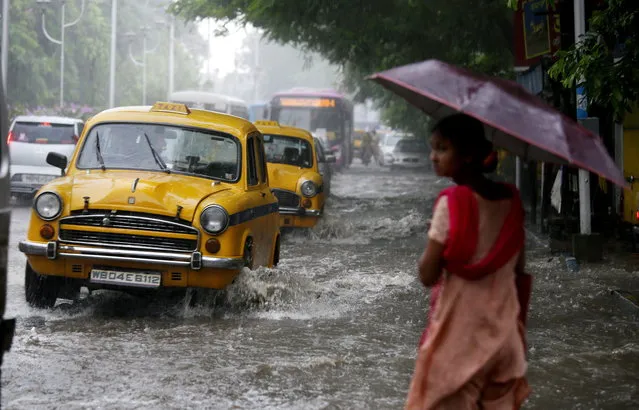
Indian commuters wade through floodwaters during the continuous rain shower in Calcutta, India, July 10, 2015. A monsoon shower hit the city and disrupted daily life. The Indian monsoon, takes place between May and September. (Photo by Piyal Adhikary/EPA)

Indian commuters wade through floodwaters during the continuous rain shower in Calcutta, India, July 10, 2015. A monsoon shower hit the city and disrupted daily life. The Indian monsoon, takes place between May and September. (Photo by Piyal Adhikary/EPA)
Details
11 Jul 2015 14:18:00
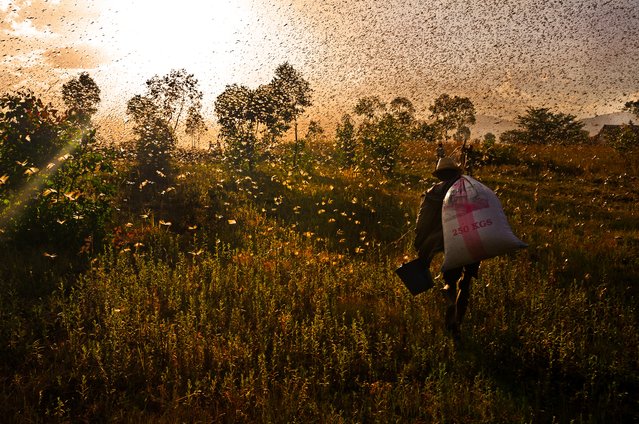
“Locusts & Men”. Oppression, interaction, collaboration. In the life cycle of nature nothing is lost, but the coexistence of different species is sometimes difficult. In Madagascar periodically returns the archaic antagonism between man and the migratory locust, in a circle of life where the two species are looking for space and food for their survival. Photo location: Madagascar, 2013. (Photo and caption by Michele Martinelli/National Geographic Photo Contest)

“Locusts & Men”. Oppression, interaction, collaboration. In the life cycle of nature nothing is lost, but the coexistence of different species is sometimes difficult. In Madagascar periodically returns the archaic antagonism between man and the migratory locust, in a circle of life where the two species are looking for space and food for their survival. At the end of the day a man walks home carrying on his shoulders the heavy bag which contains the locusts captured during the day. The insects provide nutritious meals for the man and his family. Photo location: Madagascar, 2013. (Photo and caption by Michele Martinelli/National Geographic Photo Contest)

ATTENTION! All pictures are presented in high resolution. To see Hi-Res images – just TWICE click on any picture. In other words, click small picture – opens the BIG picture. Click BIG picture – opens VERY BIG picture.
Details
03 Dec 2013 10:59:00
“A huge wasp measuring 2.5 inches in length, visiting the banana tree in my front yard”. (Photo and comment by John Matzick, USA/2013 Sony World Photography Awards

“A huge wasp measuring 2.5 inches in length, visiting the banana tree in my front yard”. (Photo and comment by John Matzick, USA/2013 Sony World Photography Awards via The Atlantic)


Details
07 Feb 2013 14:23:00
Dancers prepare before a performance in the backstage area of the Buick exhibition during the “Auto China 2014” Beijing International Automotive Exhibition in Beijing on April 21, 2014. Leading automakers have gathered in Beijing for the kickoff of China's biggest car show, but lackluster growth and environmental restrictions in the world's largest car market have thrown uncertainty into the mix. (Photo by AFP Photo)

Dancers prepare before a performance in the backstage area of the Buick exhibition during the “Auto China 2014” Beijing International Automotive Exhibition in Beijing on April 21, 2014. Leading automakers have gathered in Beijing for the kickoff of China's biggest car show, but lackluster growth and environmental restrictions in the world's largest car market have thrown uncertainty into the mix. (Photo by AFP Photo)
Details
26 Apr 2014 12:10:00
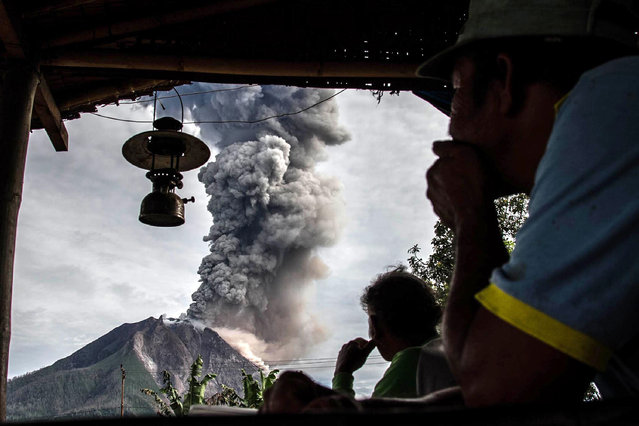
Villagers look on as Mount Sinabung volcano spews thick volcanic ash, as seen from Beganding village in Karo, North Sumatra province, on May 19, 2017. Sinabung roared back to life in 2010 for the first time in 400 years. After another period of inactivity, it erupted once more in 2013 and has remained highly active since. (Photo by Ivan Damanik/AFP Photo)

Villagers look on as Mount Sinabung volcano spews thick volcanic ash, as seen from Beganding village in Karo, North Sumatra province, on May 19, 2017. Sinabung roared back to life in 2010 for the first time in 400 years. After another period of inactivity, it erupted once more in 2013 and has remained highly active since. (Photo by Ivan Damanik/AFP Photo)
Details
20 May 2017 10:09:00