Loading...
Done
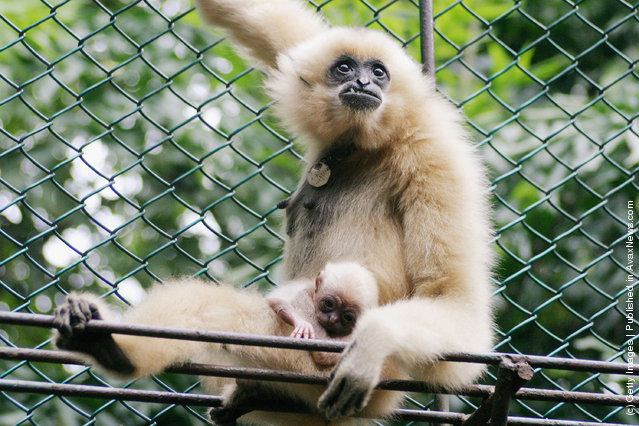
Newborn White-Cheeked Gibbon Nomascus

“Nomascus is the second most speciose genus of gibbons (family Hylobatidae). Originally this genus was a subgenus of Hylobates, and all individuals were considered one species, Hylobates concolor. Species within Nomascus are characterized by 52 chromosomes. Some species are all black, some light with a distinct black tuft of crown fur, and some by distinct, light-colored cheek patches. Nomascus is found from southern China (Yunnan) to southern Vietnam, and also on Hainan Island. One of the genus' species, Nomascus nasutus, has been deemed “the most critically endangered ape species in the world”. All of the species in this genus are endangered or critically endangered”. – Wikipedia

Photo: A newborn White-Cheeked Gibbon clings to its mother in the Nanning Zoo on April 12, 2004 in Nanning, Guangxi province, China. The White-Cheeked Gibbon's natural habitat is Southern China as well as Vietnam and Laos. They are classified as highly endangered and are on the brink of extinction due to poaching and reduction of natural rainforests. (Photo by Getty Images)
Details
12 Aug 2011 11:51:00
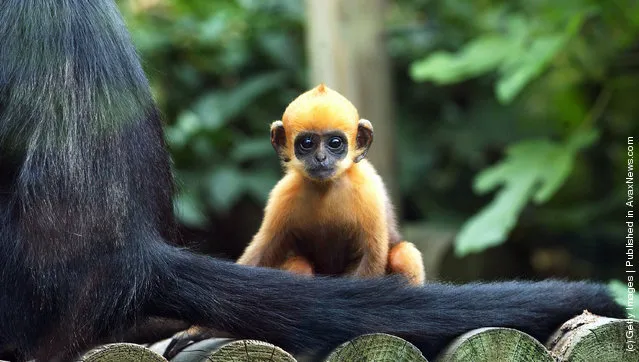
Baby Francois' Langur

“Francois' langur is one of several species of leaf monkeys. Over 50% of its diet is made up of young leaves. It will also consume fruits (17.2%), seeds, flowers, stems, roots, bark and occasionally minerals and insects off of rock surfaces and cliffs. This langur consumes its favorite food, young leaves, at the highest rate during the dry season, April through September, also known as the young leaf-lean period”. – Wikipedia

Photo: An endangered baby Francois' Langur monkey called Laa Laa settles in following her July 6 birth at London Zoo, Regent's Park on August 5, 2004 in London. The bright ginger youngster was born to glossy black parents Max and Shaneka and has the typical orange baby coat which is in stark contrast against the black of her parent's and older brother Grub's fur. (Photo by Steve Finn/Getty Images)
Details
22 Sep 2011 11:28:00
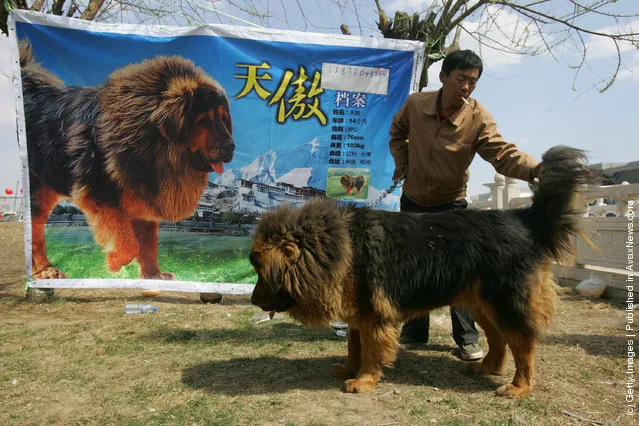
Tibetan Mastiff

“The Tibetan Mastiff also known as Do-khyi (variously translated as “home guard”, “door guard”, “dog which may be tied”, “dog which may be kept”), reflects its use as a guardian of herds, flocks, tents, villages, monasteries, and palaces, much as the old English ban-dog (also meaning tied dog) was a dog tied outside the home as a guardian. However, in nomad camps and in villages, the Do-khyi is traditionally allowed to run loose at night and woe be unto the stranger who walks abroad after dark”. – Wikipedia

Photo: A man displays a Tibetan Mastiff he raised during the Tibetan Mastiff exposition on April 7, 2007 in Langfang of Hebei Province, China. (Photo by China Photos/Getty Images)
Details
05 Oct 2011 14:27:00
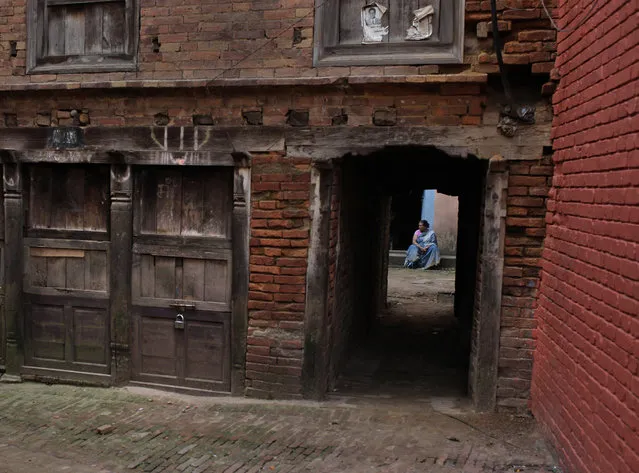
A Nepalese woman sits inside her house in an alley of Bhaktapur, 12 kilometers (7.5 miles) east of Kathmandu, Monday, May 25, 2015, one month after the deadly 7.8 magnitude earthquake hit Nepal. (Photo by Niranjan Shrestha/AP Photo)

A Nepalese woman sits inside her house in an alley of Bhaktapur, 12 kilometers (7.5 miles) east of Kathmandu, Monday, May 25, 2015, one month after the deadly 7.8 magnitude earthquake hit Nepal. Two powerful earthquakes devastated Nepal on April 25 and May 12, killing nearly 8,700 people and injuring 16,800 others. The quakes and aftershocks also triggered many landslides in the Himalayan nation, which boasts eight of the world's highest mountains gets about half a million tourists every year, with many coming to trek the Himalayan nation's scenic mountain trails. (Photo by Niranjan Shrestha/AP Photo)
Details
27 May 2015 00:06:00
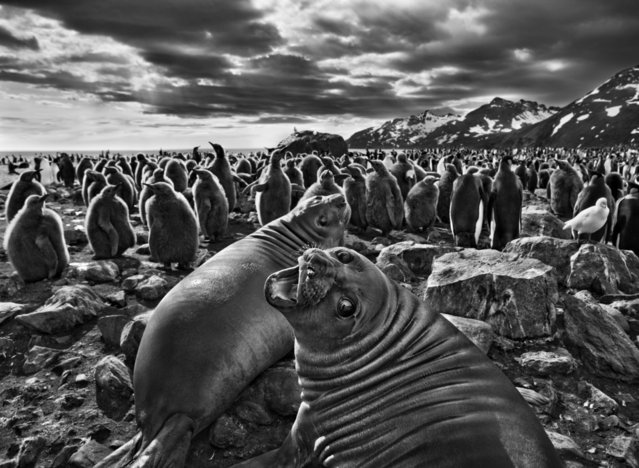
On South Georgia, a barren island in the far South Atlantic, a pair of southern elephant seal calves beckon before a colony of king penguins. “The male seals can grow to almost five tons,” says Salgado, “but these are just babies. This one looked at me with beautiful eyes”. (Photo by Sebastião Salgado/Amazonas/Contact Press Images)

Sebastião Salgado is a Brazilian documentary photographer living in Paris. He has produced several books, and his work has been exhibited extensively around the world. His latest work, «Genesis», premieres at The Natural History Museum in London on April 11, on view through September 8, 2013. Photo: On South Georgia, a barren island in the far South Atlantic, a pair of southern elephant seal calves beckon before a colony of king penguins. “The male seals can grow to almost five tons,” says Salgado, “but these are just babies. This one looked at me with beautiful eyes”. (Photo by Sebastião Salgado/Amazonas/Contact Press Images)
Details
30 Apr 2013 12:17:00
Actors take part in a re-enactment of the "Battle of Areces" that took place during the Spanish Civil War, in Grullos, north of Spain, September 14, 2013. The re-enactment of the historic 1937 battle was organised by the Frente del Nalon Association. (Photo by Eloy Alonso/Reuters)

“The Spanish Civil War (The Crusade among Nationalists, Fourth Carlist War among Carlists, The Rebellion or Uprising among Republicans) was a major conflict fought in Spain from 17 July 1936 to 1 April 1939. An estimated total of 500,000 people lost their lives as a consequence of the War”. – Wikipedia. Photo: Actors take part in a re-enactment of the “Battle of Areces” that took place during the Spanish Civil War, in Grullos, north of Spain, September 14, 2013. The re-enactment of the historic 1937 battle was organised by the Frente del Nalon Association. (Photo by Eloy Alonso/Reuters)
Details
17 Sep 2013 09:06:00


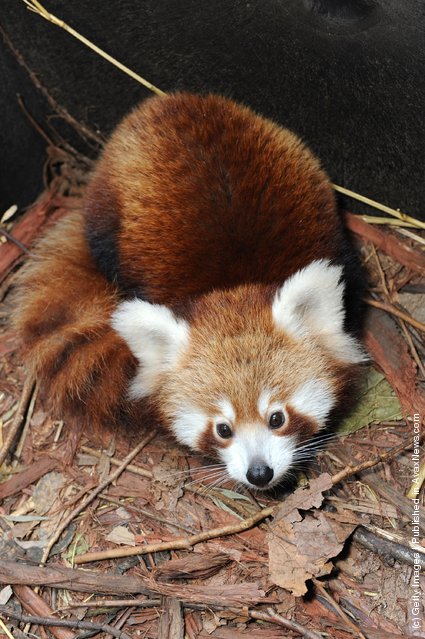
“The red panda (Ailurus fulgens, or shining-cat), is a small arboreal mammal native to the eastern Himalayas and southwestern China. It is the only species of the genus Ailurus. Slightly larger than a domestic cat, it has reddish-brown fur, a long, shaggy tail, and a waddling gait due to its shorter front legs. It feeds mainly on bamboo, but is omnivorous and may also eat eggs, birds, insects, and small mammals. It is a solitary animal, mainly active from dusk to dawn, and is largely sedentary during the day”. – Wikipedia

Photo: In this handout image provided by Taronga Zoo, Seba, a baby Red Panda, explores his new home at Taronga Zoo on April 7, 2011 in Sydney, Australia. The Red Panda cub was born at Christmas and is the 45th to be born at the zoo since 1977. (Photo by Peter Hardin/Taronga Zoo via Getty Images)
Details
07 Apr 2011 08:51:00


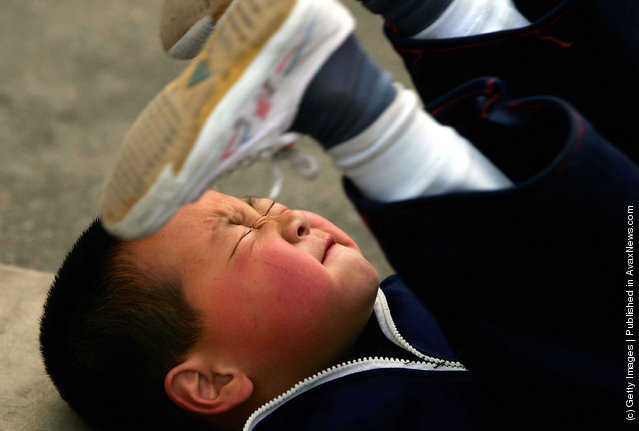
Wang Zeyu, 4, a fee-paying enthusiast of kung fu, practises during a training class at a kung fu school near the Shaolin Temple April 10, 2005 in Dengfeng, Henan Province, China. Zeyu's father sent him to the school from his home in Jiangsu Province, thousands kilometres away from Dengfeng, when he was just 3 years old. And his father must pay 9,800 yuan (US$1195) for one year's tuition at the school, a huge amount for most Chinese. There are more than 80 kung fu schools that line the road from the city of Dengfeng to the Shaolin Temple with hundreds and thousands of young kung-fu lovers from all over the country and beyond studying here. All the schools use the Shaolin name to attract students as the Shaolin Temple is the birthplace of Chinese Kung Fu. (Photo by Cancan Chu/Getty Images)
Details
06 Jul 2011 11:21:00