Loading...
Done
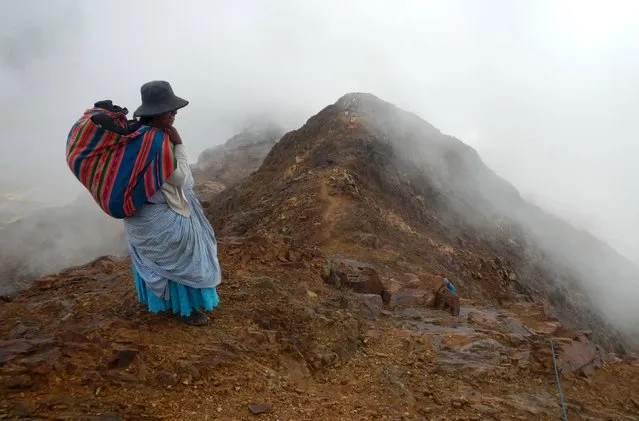
A porter stands at the bottom of the Illimani mountain, on the outskirts of La Paz, Bolivia, April 16, 2016. (Photo by David Mercado/Reuters)

A porter stands at the bottom of the Illimani mountain, on the outskirts of La Paz, Bolivia, April 16, 2016. For years, Lydia Huayllas, 48, has worked as a cook at base camps and mountain-climbing refuges on the steep, glacial slopes of Huayna Potosi, a 19,974-foot (6,088-meter) Andean peak outside of La Paz, Bolivia. But two years ago, she and 10 other Aymara indigenous women, ages 42 to 50, who also worked as porters and cooks for mountaineers, put on crampons – spikes fixed to a boot for climbing – under their wide traditional skirts and started to do their own climbing. (Photo by David Mercado/Reuters)
Details
22 Apr 2016 12:33:00
This green-skinned trio were happy to pose for the camera – with one little frog smiling happily for its close up. The three Reinwardt's Flying Frog, commonly known as the black webbed tree frog or the green flying frog, were spotted playing in a tree by photographer Hendy Mp. (Photo by Hendy Mp/SOLENT News)

This green-skinned trio were happy to pose for the camera – with one little frog smiling happily for its close up. The three Reinwardt's Flying Frog, commonly known as the black webbed tree frog or the green flying frog, were spotted playing in a tree by photographer Hendy Mp. The 25-year-old who saw the frogs near his home in Sambas, Kalimantan Barat, in Indonesia, said they reminded him of three brothers playing together. (Photo by Hendy Mp/SOLENT News)
Details
03 Feb 2015 13:27:00
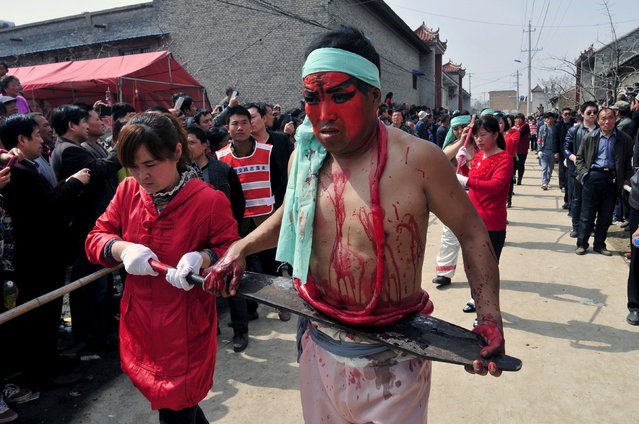
A folk performer (front R) with make-up and props takes part in a “Blood Shehuo” parade, during a performance in Linyi county, Shanxi province March 21, 2015. “Shehuo” is the common name of Chinese traditional activities consisting of folk performances in northern China. The "Blood Shehuo" performers use make-up and props to re-enact scenes of horror in classic Chinese novels like Water Margin. (Photo by Reuters/Stringer)

A folk performer (front R) with make-up and props takes part in a “Blood Shehuo” parade, during a performance in Linyi county, Shanxi province March 21, 2015. “Shehuo” is the common name of Chinese traditional activities consisting of folk performances in northern China. The “Blood Shehuo” performers use make-up and props to re-enact scenes of horror in classic Chinese novels like Water Margin. (Photo by Reuters/Stringer)
Details
23 Mar 2015 10:33:00
Fighters Holly “The Lotus” Mei (L) and Teri “Feisty Fists” London train for the upcoming 'Lingerie Fighting Championships 22: Costume Brawl I' at DXG Self Defense on October 25, 2016 in Las Vegas, Nevada. The event is scheduled to feature eight bouts at 4 Bears Casino & Lodge on October 29, 2016 in New Town, North Dakota. (Photo by Ethan Miller/Getty Images)

Fighters Holly “The Lotus” Mei (L) and Teri “Feisty Fists” London train for the upcoming 'Lingerie Fighting Championships 22: Costume Brawl I' at DXG Self Defense on October 25, 2016 in Las Vegas, Nevada. The event is scheduled to feature eight bouts at 4 Bears Casino & Lodge on October 29, 2016 in New Town, North Dakota. (Photo by Ethan Miller/Getty Images)
Details
27 Oct 2016 12:15:00
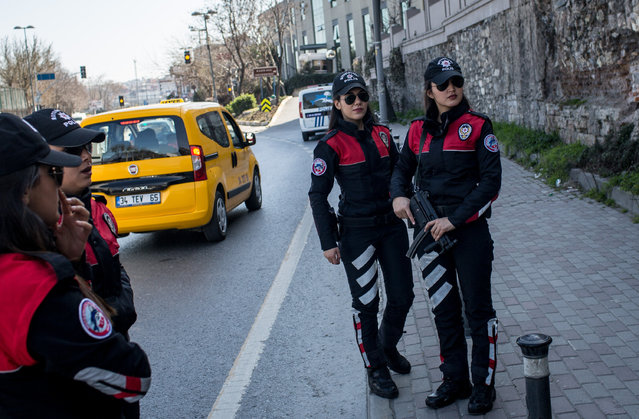
Female police officers from Istanbul's Motorcycled Police Unit wait to search vehicles during a roadside checkpoint operation on March 7, 2017 in Istanbul, Turkey. The rapid response unit nicknamed Dolphins is used primarily in crime prevention operations and has 25 female officers. 6% of Turkey's 250,000 strong police force are women, March 8 marks International Women's Day. (Photo by Chris McGrath/Getty Images)

Female police officers from Istanbul's Motorcycled Police Unit wait to search vehicles during a roadside checkpoint operation on March 7, 2017 in Istanbul, Turkey. The rapid response unit nicknamed Dolphins is used primarily in crime prevention operations and has 25 female officers. 6% of Turkey's 250,000 strong police force are women, March 8 marks International Women's Day. (Photo by Chris McGrath/Getty Images)
Details
09 Mar 2017 11:58:00
A man walks into a room in the Ice hotel in Jukkasjarvi, Sweden, December 16, 2015. (Photo by Ints Kalnins/Reuters)

In Jukkasjärvi, a village a few miles east of Kiruna, the proprietors of one hotel begin planning for a winter ice festival in March. That’s when they begin collecting some 5,000 tons of ice from the River Torne in order to prepare the Icehotel, the world’s coolest place to stay. Options for overnight stay include snow rooms, ice rooms, art suites, and the Northern Lights room, all of which range from about $300 to $900 per night. But the deluxe suite’s the only way to go. These rooms come with a critical amenity: heated ensuite bathrooms and saunas. Here: A man walks into a room in the Ice hotel in Jukkasjarvi, Sweden, December 16, 2015. (Photo by Ints Kalnins/Reuters)
Details
18 Dec 2015 08:02:00
A model waits backstage to present creations from the Fall-Winter 2021/2022 collection of the Georgiela Studio fashion brand during a young talents “EGO” fashion show on the last day of the 73rd Mercedes-Benz Fashion Week Madrid, in Madrid, Spain, 11 April 2021. The fashion event runs from 08 to 11 April. (Photo by Mariscal/EPA/EFE)

A model waits backstage to present creations from the Fall-Winter 2021/2022 collection of the Georgiela Studio fashion brand during a young talents “EGO” fashion show on the last day of the 73rd Mercedes-Benz Fashion Week Madrid, in Madrid, Spain, 11 April 2021. The fashion event runs from 08 to 11 April. (Photo by Mariscal/EPA/EFE)
Details
13 Apr 2021 07:43:00
Kawakanih Yawalapiti, 9, Upper Xingu region of Mato Grosso, Brazil, 2018: Kawakanih lives with her tribe, the Yawalapiti, in Xingu national park, a preserve in the Amazon basin of Brazil. The Yawalapiti collect seeds to preserve species unique to their ecosystem, which lies between the rain forest and savannah. Kawakanih’s diet is simple, consisting mainly of fish, cassava, porridge, fruit and nuts. “It takes five minutes to catch dinner”, says Kawakanih. “When you’re hungry, you just go to the river with your net”. (Photo by Gregg Segal/The Guardian)

Photographer Gregg Segal travelled the world to document children and the food they eat in a week. Partly inspired by the increasing problems of childhood obesity, he tracked traditional regional diets as yet unaffected by globalisation, and ironically, found that the healthiest diets were often eaten by the least well off. (Photo by Gregg Segal/The Guardian)
Details
03 Jul 2019 00:03:00