Loading...
Done
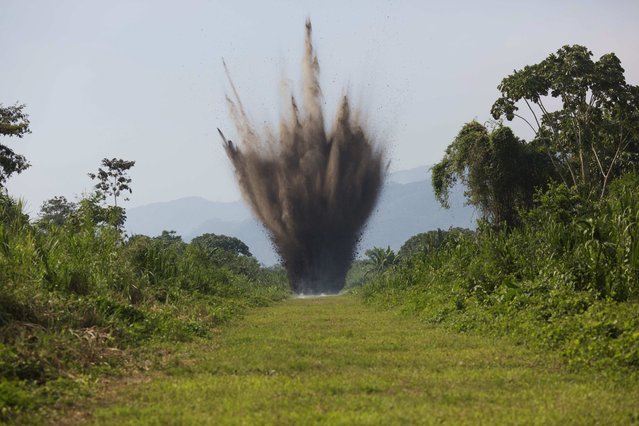
In this September 19, 2014 photo, explosives are detonate by Peruvian counternarcotics forces on a part of a clandestine grassy airstrip in the Apurimac, Ene and Mantaro River Valleys, or VRAEM, the world's No. 1 coca-growing region, in Ayacucho, Peru. The dynamiting of craters by Peruvian security forces into clandestine airstrips cuts into profits but hardly discourages cocaine traffickers who net tens of thousands of dollars with each flight flown from these airstrips. (Photo by Rodrigo Abd/AP Photo)

In this September 19, 2014 photo, explosives are detonate by Peruvian counternarcotics forces on a part of a clandestine grassy airstrip in the Apurimac, Ene and Mantaro River Valleys, or VRAEM, the world's No. 1 coca-growing region, in Ayacucho, Peru. The dynamiting of craters by Peruvian security forces into clandestine airstrips cuts into profits but hardly discourages cocaine traffickers who net tens of thousands of dollars with each flight flown from these airstrips. (Photo by Rodrigo Abd/AP Photo)
Details
23 Sep 2014 12:56:00
A woman buys bread at a bakery in Cairo, January 8, 2015. The successful roll-out so far of a new “smart card” system to distribute subsidised bread has been a major achievement for Egypt's government, saving money while earning praise from families who no longer have to wake early to fight for loaves. (Photo by Mohamed Abd El Ghany/Reuters)

A woman buys bread at a bakery in Cairo, January 8, 2015. The successful roll-out so far of a new “smart card” system to distribute subsidised bread has been a major achievement for Egypt's government, saving money while earning praise from families who no longer have to wake early to fight for loaves. (Photo by Mohamed Abd El Ghany/Reuters)
Details
13 Jan 2015 14:35:00
This November 11, 2014 aerial photo, shows a deforested area dotted with blue tarps, marking the area where miners reside, and craters filled with water, caused by illegal gold mining activities, in La Pampa, in Peru's Madre de Dios region. (Photo by Rodrigo Abd/AP Photo)

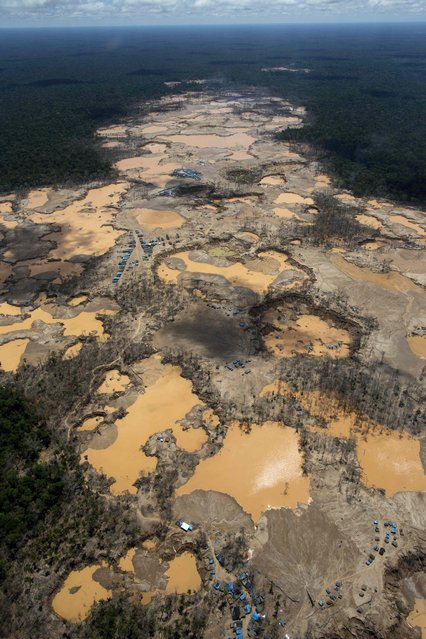
This November 11, 2014 aerial photo, shows a deforested area dotted with blue tarps, marking the area where miners reside, and craters filled with water, caused by illegal gold mining activities, in La Pampa, in Peru's Madre de Dios region. Less than a month before Peru plays host to global climate talks, the government sent a battalion of police into southeastern jungles to dismantle illegal gold-mining mining camps. Peru's anti-illegal mining czar, retired army Gen. Augusto Soto, marched the men to the wasteland known as La Pampa, where 50,000 hectares of rainforest have been obliterated in the past six years. (Photo by Rodrigo Abd/AP Photo)
Details
21 Nov 2014 12:35:00
Marie Joseph bathes her friend Jean Robert outside a shelter for the internally displaced where they live due to police violence in Port-au-Prince, Haiti, Thursday, September 16, 2021. Most of the population of Port-au-Prince has no access to basic public services, no drinking water, electricity or garbage collection. (Photo by Rodrigo Abd/AP Photo)

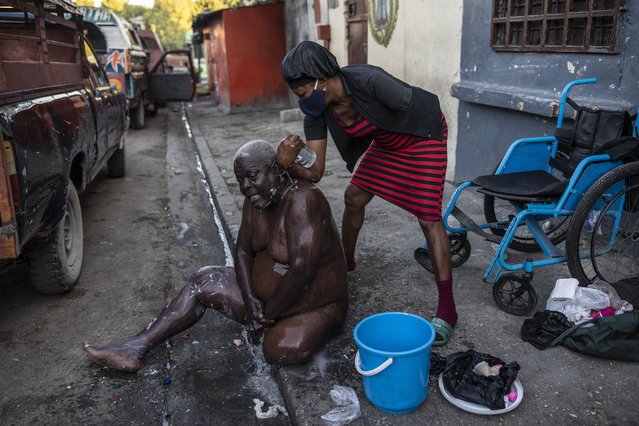
Marie Joseph bathes her friend Jean Robert outside a shelter for the internally displaced where they live due to police violence in Port-au-Prince, Haiti, Thursday, September 16, 2021. Most of the population of Port-au-Prince has no access to basic public services, no drinking water, electricity or garbage collection. (Photo by Rodrigo Abd/AP Photo)
Details
26 Oct 2021 08:34:00
Fisherman Jose Miguel Perez, whose nickname is “Taliban”, navigates the oil infested waters of Lake Maracaibo, near Cabimas, Venezuela, May 21, 2019. Nobody lives as closely with the environmental fallout of Venezuela's collapsing oil industry as the fishermen who scratch out an existence on the blackened, sticky shores of Lake Maracaibo. (Photo by Rodrigo Abd/AP Photo)

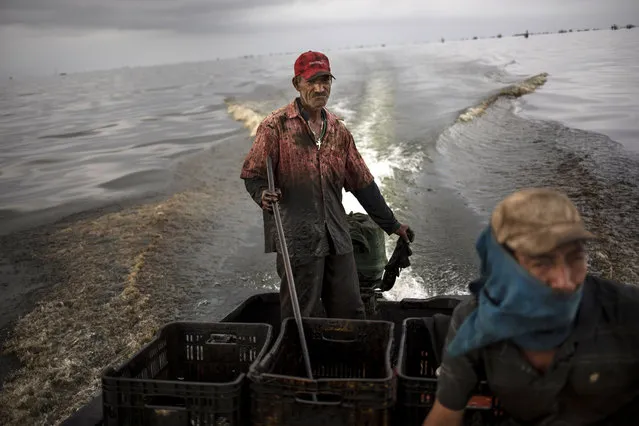
Fisherman Jose Miguel Perez, whose nickname is “Taliban”, navigates the oil infested waters of Lake Maracaibo, near Cabimas, Venezuela, May 21, 2019. Nobody lives as closely with the environmental fallout of Venezuela's collapsing oil industry as the fishermen who scratch out an existence on the blackened, sticky shores of Lake Maracaibo. (Photo by Rodrigo Abd/AP Photo)
Details
26 Nov 2019 00:03:00
In this June 20, 2015 photo, Niberta Galvez uses the bottom half of his shirt to collect coca leaves in Samugari, Peru. Coca farmers were among the locals who, in 1984, formed citizen militias to help the military beat back Shining Path rebels, reducing them to a small group of fewer than 500 who now are deeply involved in drug trafficking. (Photo by Rodrigo Abd/AP Photo)

In this June 20, 2015 photo, Niberta Galvez uses the bottom half of his shirt to collect coca leaves in Samugari, Peru. Coca farmers were among the locals who, in 1984, formed citizen militias to help the military beat back Shining Path rebels, reducing them to a small group of fewer than 500 who now are deeply involved in drug trafficking. (Photo by Rodrigo Abd/AP Photo)
Details
01 Jul 2015 13:11:00
In this June 23, 2015 photo, Ashaninka Indian beauty contestants pose for a photo with members of a visiting music group, hired to perform during the annual founding anniversary festivities, in Otari Nativo, Pichari, Peru. The contestants wear the simple brown dresses of the Ashaninka woman, their faces dotted in a traditional design with a red dye extracted from a spice called achiote. (Photo by Rodrigo Abd/AP Photo)

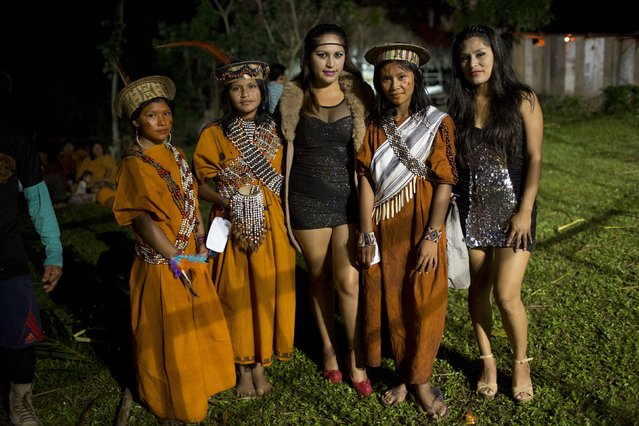
In this June 23, 2015 photo, Ashaninka Indian beauty contestants pose for a photo with members of a visiting music group, hired to perform during the annual founding anniversary festivities, in Otari Nativo, Pichari, Peru. The contestants wear the simple brown dresses of the Ashaninka woman, their faces dotted in a traditional design with a red dye extracted from a spice called achiote. (Photo by Rodrigo Abd/AP Photo)
Details
16 Jul 2015 11:12:00
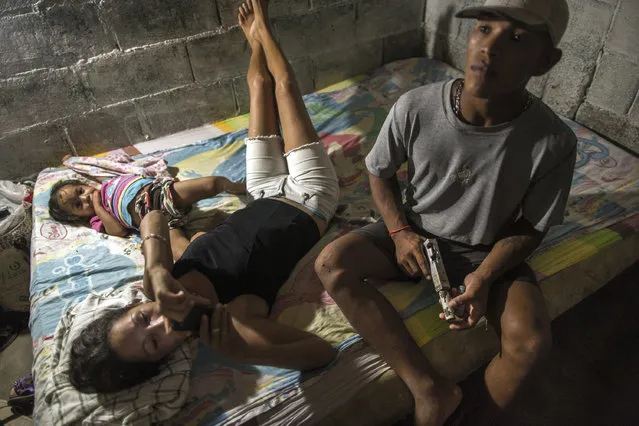
In this November 7, 2016 photo, “El Menor”, a member of “Los Cainos” self-defense group formed by the Marval fishing family, holds a homemade gun before starting a night patrol to help protect fishermen from pirate attacks in Punta de Araya, Sucre state, Venezuela. Pirates are terrorizing the coastal state of Sucre, once home to the world's fourth-largest tuna fleet and a thriving fishing industry. (Photo by Rodrigo Abd/AP Photo)

In this November 7, 2016 photo, “El Menor”, a member of “Los Cainos” self-defense group formed by the Marval fishing family, holds a homemade gun before starting a night patrol to help protect fishermen from pirate attacks in Punta de Araya, Sucre state, Venezuela. Pirates are terrorizing the coastal state of Sucre, once home to the world's fourth-largest tuna fleet and a thriving fishing industry. (Photo by Rodrigo Abd/AP Photo)
Details
09 Dec 2016 11:46:00