Loading...
Done
The new Citroen Concept Car Divine DS is presented at the 2014 Paris Auto Show on October 2, 2014 in Paris on the first of the two press days. (Photo by Miguel Medina/AFP Photo)

The new Citroen Concept Car Divine DS is presented at the 2014 Paris Auto Show on October 2, 2014 in Paris on the first of the two press days. European carmakers are hoping to impress with new models at this week's Paris Motor Show and prove they have come out stronger from years of economic trouble and cost-cutting. (Photo by Miguel Medina/AFP Photo)
Details
05 Oct 2014 11:58:00
Deadly Insects Hornet

Hornets are insects that are the largest eusocial wasps. Some species can reach up to 5.5 cm (2.2 in) in length. The true hornets make up the genus Vespa and are distinguished from other vespines by the width of the vertex (part of the head behind the eyes), which is proportionally larger in Vespa and by the anteriorly rounded gasters (the section of the abdomen behind the wasp waist). The best known species is the European hornet (Vespa crabro), about 2–3.5 cm in length, widely distributed throughout Europe, Russia, North America and Northeast Asia.
Details
13 Oct 2014 10:17:00
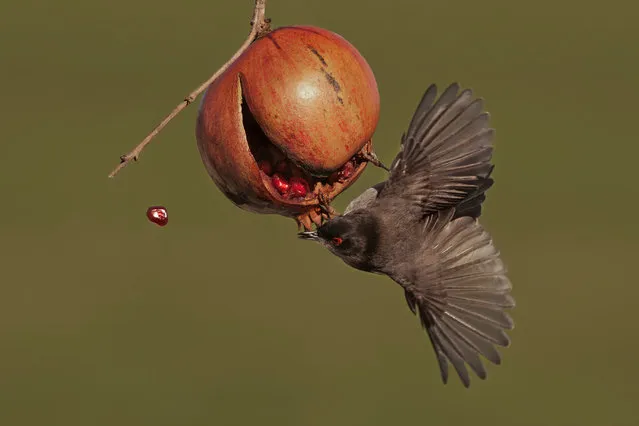
Nature on My Doorstep, finalist. I Want That Pomerade Grain by Biagio Alberto Scalia, taken in national park of Circeo, Latina, Italy. (Photo by Biagio Alberto Scalia/REDISCOVER Nature/EEA)

A praying mantis, a huddle of butterflies, Galician horses and an alpine sunset are the winners of this year’s European Environment Agency’s “Rediscover Nature” photo competition. Here: Nature on My Doorstep, finalist. I Want That Pomerade Grain by Biagio Alberto Scalia, taken in national park of Circeo, Latina, Italy. (Photo by Biagio Alberto Scalia/REDISCOVER Nature/EEA)
Details
20 Nov 2020 00:03:00
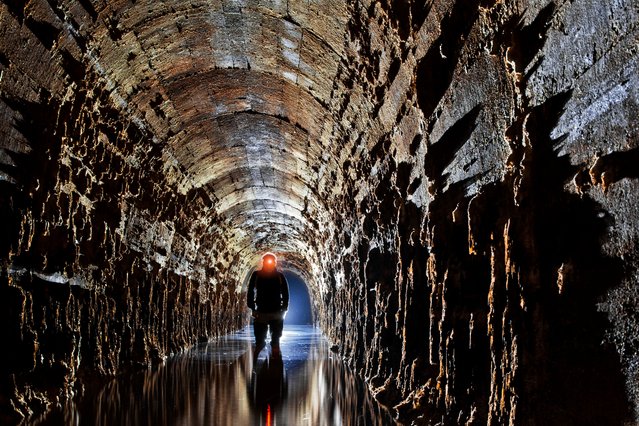
Regenwurmlager, Poland. The Regenwurmlager is an extensive underground fortification area constructed by Germany in 1920s-1940s, now in western Poland, near the city of Międzyrzecz. (Photo by Anna Arinova/Caters News)

Stunning silhouettes under European cities reveal the size and splendor of the continent’s urban foundations. Photographer and content-manager Anna Arinova, 28, from Moscow, captured the awe-inspiring labyrinths in Russia and Germany. Here: Regenwurmlager, Poland. The Regenwurmlager is an extensive underground fortification area constructed by Germany in 1920s-1940s, now in western Poland, near the city of Międzyrzecz. (Photo by Anna Arinova/Caters News)
Details
29 Dec 2016 07:53:00
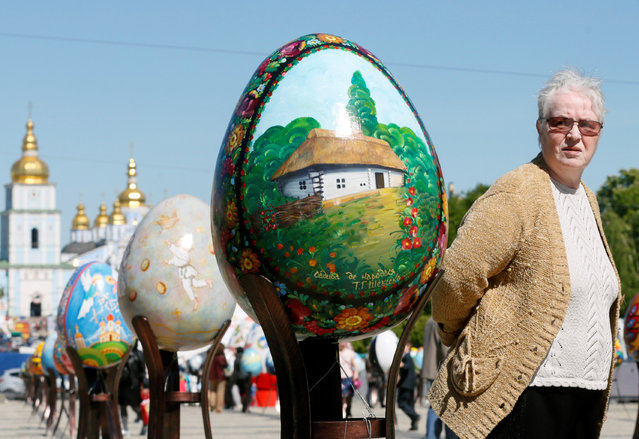
A woman looks at traditional Ukrainian Easter eggs “Pysanka”, installed as part of the upcoming celebrations of Easter, in central Kiev, Ukraine, April 29, 2016. A pysanka is a Ukrainian Easter egg, decorated with traditional Ukrainian folk designs using a wax-resist (batik) method. The word pysanka comes from the verb pysaty, “to write”, as the designs are not painted on, but written with beeswax. Many other eastern European ethnic groups decorate eggs using wax resist for Easter. These include the Belarusians, Bulgarians, Croats, Czechs, Hungarians, Lithuanians, Poles, Romanians, Serbs, Slovaks, Slovenes and Sorbs. (Photo by Valentyn Ogirenko/Reuters)

A woman looks at traditional Ukrainian Easter eggs “Pysanka”, installed as part of the upcoming celebrations of Easter, in central Kiev, Ukraine, April 29, 2016. A pysanka is a Ukrainian Easter egg, decorated with traditional Ukrainian folk designs using a wax-resist (batik) method. The word pysanka comes from the verb pysaty, “to write”, as the designs are not painted on, but written with beeswax. Many other eastern European ethnic groups decorate eggs using wax resist for Easter. These include the Belarusians, Bulgarians, Croats, Czechs, Hungarians, Lithuanians, Poles, Romanians, Serbs, Slovaks, Slovenes and Sorbs. (Photo by Valentyn Ogirenko/Reuters)
Details
30 Apr 2016 09:00:00
Emilia Pechinkova, a 24-years-old Bulgarian Pomak (Bulgarian speaking Muslims) bride poses for a photograph following the “gelina” or face painting ceremony carried out by female guests and relatives in preparation for her three-day wedding ceremony in the village of Draginovo, 100 kms southeast of Sofia on April 22, 2016. Bulgaria's Muslim population is one of the highest in the European Union. (Photo by Nikolay Doychinov/AFP Photo)

Emilia Pechinkova, a 24-years-old Bulgarian Pomak (Bulgarian speaking Muslims) bride poses for a photograph following the “gelina” or face painting ceremony carried out by female guests and relatives in preparation for her three-day wedding ceremony in the village of Draginovo, 100 kms southeast of Sofia on April 22, 2016. Bulgaria's Muslim population is one of the highest in the European Union. During the Communist regime religious rituals were not tolerated, and Muslims were forced to abandon wearing their traditional wedding outfits. Recently, more young Pomak women want to include traditional wedding customs that were forbidden during the regime, regardless of their secular lifestyles and the high cost of such a wedding. (Photo by Nikolay Doychinov/AFP Photo)
Details
25 Apr 2016 09:55:00


In this artist's impression supplied by the ESO (European Southern Observatory) on April 25, 2007, the planetary system around the red dwarf, Gliese 581, is pictured showing what astronomers believe is the most earth like planet found outside our solar system to date. Using the ESO 3.6-m telescope in Chile, astronomers have uncovered the planet which could have water running on its surface. The planet orbits the faint star Gliese 581, which is 20.5 light-years away in the constellation Libra. (Photo by ESO via Getty Images)
Details
12 Apr 2011 11:00:00
UEFA,Euro 2012,Gdansk

Gdańsk is a Polish city on the Baltic coast. The city's professional football club is Lechia Gdansk. Founded in 1945, they play in the Ekstraklasa, Poland's top division. The European Football Championship will take place in Gdansk 2012.

Photo by: Sludgegulper ; Source: Flickr
Details
07 Aug 2011 21:53:00