Loading...
Done
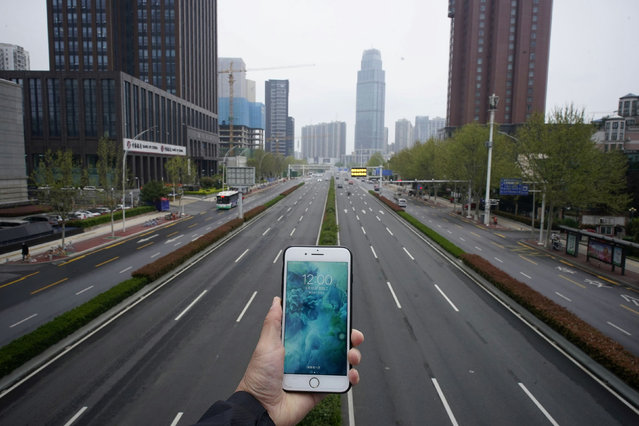
A mobile phone showing the time at noon, is displayed for a photo in front of an almost empty road with low traffic, during the coronavirus disease (COVID-19) outbreak, in Wuhan, Hubei province, China, March 31, 2020. (Photo by Aly Song/Reuters)

A mobile phone showing the time at noon, is displayed for a photo in front of an almost empty road with low traffic, during the coronavirus disease (COVID-19) outbreak, in Wuhan, Hubei province, China, March 31, 2020. (Photo by Aly Song/Reuters)
Details
07 Apr 2020 00:01:00
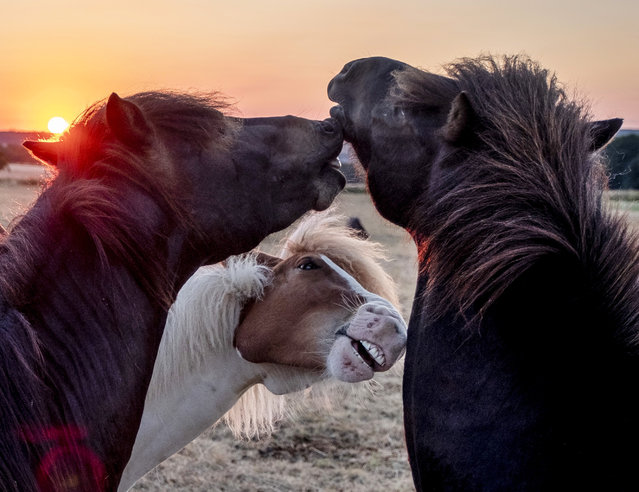
Iceland horses play on a meadow of a stud farm in Obernhain near Frankfurt, Germany, as the sun rises Thursday, July 23, 2020. (Photo by Michael Probst/AP Photo)

Iceland horses play on a meadow of a stud farm in Obernhain near Frankfurt, Germany, as the sun rises Thursday, July 23, 2020. (Photo by Michael Probst/AP Photo)
Details
18 Aug 2020 00:03:00
A reveller takes part in an annual block party known as “Ceu na Terra” (Heaven on Earth), one of the many carnival parties to take place in the neighbourhoods of Rio de Janeiro, January 30, 2016. (Photo by Pilar Olivares/Reuters)

A reveller takes part in an annual block party known as “Ceu na Terra” (Heaven on Earth), one of the many carnival parties to take place in the neighbourhoods of Rio de Janeiro, January 30, 2016. (Photo by Pilar Olivares/Reuters)
Details
31 Jan 2016 09:09:00


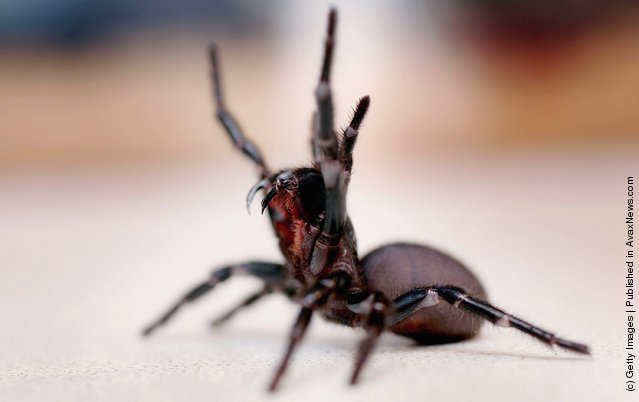
A Funnel Web spider is pictured at the Australian Reptile Park January 23, 2006 in Sydney, Australia. The Funnel Web is one of Australia's deadliest animals, with a venom that is packed with at least 40 different toxic proteins. A bite from a Funnel Web causes massive electrical over-load in the body's nervous system. Finally, fatalities occur from either heart attack or a pulmonary oedema, where the capillaries around the lungs begin to leak fluid and the patient effectively drowns. Death can come as quickly as two hours after a bite if no medical treatment is sought. Due to advances in anti-venom, there has been no death from a Funnel Web bite in Australia since 1980. Australia is home to some of the most deadly and poisonous animals on earth. (Photo by Ian Waldie/Getty Images)
Details
25 Apr 2011 07:49:00
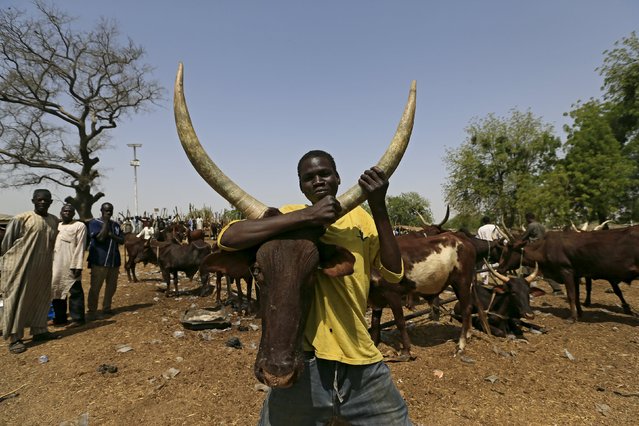
A man holds a cow at the cattle market in Maiduguri, Nigeria, March 9, 2016. (Photo by Afolabi Sotunde/Reuters)

A man holds a cow at the cattle market in Maiduguri, Nigeria, March 9, 2016. A Nigerian government push to strangle the Boko Haram insurgency has shut down the cattle trade that sustained the city of Maiduguri, leaving many residents with no livelihood, including many of the two million people displaced by the war. In recent months the army has taken back much of the territory lost to the jihadists during the five-year insurgency. (Photo by Afolabi Sotunde/Reuters)
Details
16 Mar 2016 14:06:00
Chernobyl Disaster – Disaster Fighters

“The Chernobyl disaster was a catastrophic nuclear accident that occurred on 26 April 1986 at the Chernobyl Nuclear Power Plant in Ukrainian SSR, which was under the direct jurisdiction of the central authorities in Moscow. An explosion and fire released large quantities of radioactive contamination into the atmosphere, which spread over much of Western USSR and Europe. It is widely considered to have been the worst nuclear power plant accident in history, and is one of only two classified as a level 7 event on the International Nuclear Event Scale (the other being the Fukushima Daiichi nuclear disaster)”. – Wikipedia (Photos by Alexandr Strannik, August 1986; Source: LiveJournal)
Details
26 Apr 2012 13:20:00
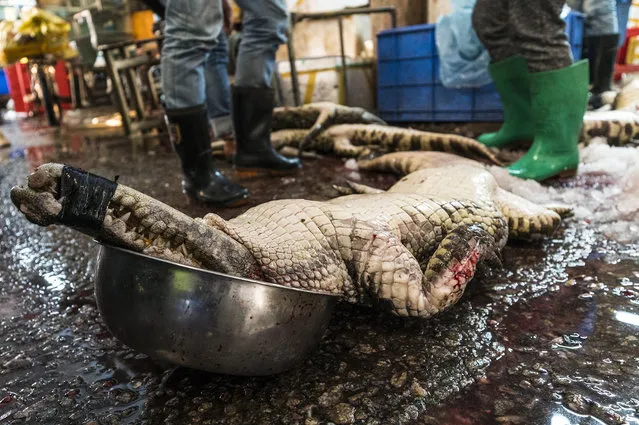
A dead crocodile is seen on Huangsha Seafood Market in Guangzhou, Guandong Province, China, 22 January 2018. Tsukiji Market of China or Huangsha Seafood Market is biggest one in Southern China and one of the biggest in China, as there are literally hundreds of different varieties of fish and seafood scattered throughout the market. Since the proximity of the fish market is so close to the Zhujiang River, it's quite easy for the large fishing vessels and fishermen to unload their fresh catch right at the market, which ensures that the fish and seafood remain fresh. Fish and other seafood are coming there from all around the globe. Seafood Market is full of different kinds of live fish, live shellfish, and live seafood on display in crystal clear tanks and it's common to see 5-star chefs, retailers and expats to source for fresh and high-quality seafood supplies for reasonable prices. While it is a wholesale fish market, since many Guangzhou restaurants and businesses come to purchase their seafood here, the public is welcome to come and even purchase. Many local Chinese have the vendors slice up fresh salmon fillets to take home or carry seafood into one of the nearby specialty restaurants, where they will cook if for them and serve it with vegetables and other side dishes of their choice. One of the biggest attractions for both, tourists and buyers, on market are crocodiles, which are brought there alive in wooden cases with taped jaws so they can?t accidentally bite. They are from crocodile farms from Guangdong, China and from Vietnam. Crocodile meat is popular in most Asian countries and it is consider as delicate one. Crocodiles weight from 10 to 25 kg and bigger ones are about 2 years old. They cost about 70 RMB (8.90 EURO) when bout as whole, or if you buy as parts most expensive and appreciated parts are paws 120 RMB (15.26 EURO) per kg, and tail 100 RMB (12.72 EURO) per kg. (Photo by Aleksandar Plavevski/EPA/EFE)

A dead crocodile is seen on Huangsha Seafood Market in Guangzhou, Guandong Province, China, 22 January 2018. Tsukiji Market of China or Huangsha Seafood Market is biggest one in Southern China and one of the biggest in China, as there are literally hundreds of different varieties of fish and seafood scattered throughout the market. (Photo by Aleksandar Plavevski/EPA/EFE)
Details
17 Apr 2020 00:05:00
Medical staff celebrate after all patients were discharged at a temporary hospital set up to treat people with the COVID-19 coronavirus in Wuhan in China's central Hubei province on March 9, 2020. China closed most of its makeshift hospitals for coronavirus patients, some schools reopened and Disney resort staff went back to work on March 9 as normality slowly returns to the country after weeks battling the epidemic. (Photo by AFP Photo/China Stringer Network)

Medical staff celebrate after all patients were discharged at a temporary hospital set up to treat people with the COVID-19 coronavirus in Wuhan in China's central Hubei province on March 9, 2020. China closed most of its makeshift hospitals for coronavirus patients, some schools reopened and Disney resort staff went back to work on March 9 as normality slowly returns to the country after weeks battling the epidemic. (Photo by AFP Photo/China Stringer Network)
Details
12 Mar 2020 00:05:00