Loading...
Done
Women's Sabre Gold medalist Olga Kharlan (L) and bronze medalist in the Men's Greco-Roman Wrestling Zhan Beleniuk (R) react as they arrive at the railway station in Kyiv, Ukraine, 13 August 2024. Ukrainians meet and greet the members of National Olympic team as they return from Olympic Games 2024 in Paris amid the ongoing Russian invasion. (Photo by Sergey Dolzhenko/EPA/EFE)

Women's Sabre Gold medalist Olga Kharlan (L) and bronze medalist in the Men's Greco-Roman Wrestling Zhan Beleniuk (R) react as they arrive at the railway station in Kyiv, Ukraine, 13 August 2024. Ukrainians meet and greet the members of National Olympic team as they return from Olympic Games 2024 in Paris amid the ongoing Russian invasion. (Photo by Sergey Dolzhenko/EPA/EFE)
Details
20 Aug 2024 03:37:00
Belarusian ornithologist Vladimir Ivanovski, 72, stands on a tree as he builds an artificial nest for birds of prey from tree branches, in a marsh near the village of Kazyany, Belarus on October 20, 2019. (Photo by Vasily Fedosenko/Reuters)

Belarusian ornithologist Vladimir Ivanovski, 72, stands on a tree as he builds an artificial nest for birds of prey from tree branches, in a marsh near the village of Kazyany, Belarus on October 20, 2019. (Photo by Vasily Fedosenko/Reuters)
Details
10 Dec 2019 00:03:00
This photo taken on April 4, 2021 shows migratory birds flying over a wetland near the Yalu River in Dandong, in China's northeastern Liaoning province. (Photo by AFP Photo/China Stringer Network)

This photo taken on April 4, 2021 shows migratory birds flying over a wetland near the Yalu River in Dandong, in China's northeastern Liaoning province. (Photo by AFP Photo/China Stringer Network)
Details
27 May 2021 08:50:00
Black Winged Stilt is seen on Kavak Delta, a natural and ecologically important wetland for many migratory birds, in Canakkale, Turkiye on May 13, 2025. (Photo by Alper Tuydes/Anadolu via Getty Images)

Black Winged Stilt is seen on Kavak Delta, a natural and ecologically important wetland for many migratory birds, in Canakkale, Turkiye on May 13, 2025. (Photo by Alper Tuydes/Anadolu via Getty Images)
Details
25 May 2025 03:33:00
A man dressed as a  “Trapajon”, representing entities of nature, poses for a picture after taking part in the Vijanera Festival in Silio, northern Spain, Sunday, Jan. 6, 2013. The Vijanera masquerade, of pre-Roman origin, is the first carnival of the year in Europe symbolizing the triumph of good over evil and involving the participation of crowds of residents wearing different masks, animal skins and brightly colored clothing with its own complex function and symbolism and becoming the living example of the survival of archaic cults to nature. (Photo by Daniel Ochoa de Olza/AP Photo)

A man dressed as a “Trapajon”, representing entities of nature, poses for a picture after taking part in the Vijanera Festival in Silio, northern Spain, Sunday, Jan. 6, 2013. The Vijanera masquerade, of pre-Roman origin, is the first carnival of the year in Europe symbolizing the triumph of good over evil and involving the participation of crowds of residents wearing different masks, animal skins and brightly colored clothing with its own complex function and symbolism and becoming the living example of the survival of archaic cults to nature. (Photo by Daniel Ochoa de Olza/AP Photo)
Details
19 Jan 2013 13:01:00
A volunteer photographs a woman as she kisses a volunteer wearing a condom costume during marking the International Condom Day in Kiev, Ukraine, 13 February 2015. The event was organized to promote and create awareness towards “Safe s*x” and the use of condoms to control and prevent Human Immunodeficiency Virus (HIV) and other sexually transmitted diseases on the occasion of the International Condom day. (Photo by Roman Pilipey/EPA)

A volunteer photographs a woman as she kisses a volunteer wearing a condom costume during marking the International Condom Day in Kiev, Ukraine, 13 February 2015. The event was organized to promote and create awareness towards “Safe s*x” and the use of condoms to control and prevent Human Immunodeficiency Virus (HIV) and other sexually transmitted diseases on the occasion of the International Condom day. (Photo by Roman Pilipey/EPA)
Details
14 Feb 2015 12:20:00
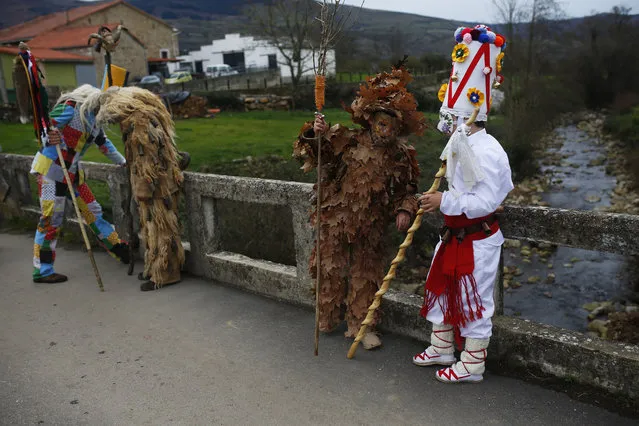
Joaldunaks return in a trailer to their town at the end of Carnival between of the Pyrenees villages of Ituren and Zubieta, northern Spain, Monday, February 1, 2016. In one of the most ancient carnivals in Europe, dating from before the Roman empire, companies of Joaldunak (cowbells) made up of residents of two towns, Ituren and Zubieta, parade the streets costumed in sandals, lace petticoats, sheepskins around the waist and shoulders, coloured neckerchiefs, conical caps with ribbons and a hyssop of horsehair in their right hands and cowbells hung across their lower back. (Photo by Alvaro Barrientos/AP Photo)

Joaldunaks return in a trailer to their town at the end of Carnival between of the Pyrenees villages of Ituren and Zubieta, northern Spain, Monday, February 1, 2016. In one of the most ancient carnivals in Europe, dating from before the Roman empire, companies of Joaldunak (cowbells) made up of residents of two towns, Ituren and Zubieta, parade the streets costumed in sandals, lace petticoats, sheepskins around the waist and shoulders, coloured neckerchiefs, conical caps with ribbons and a hyssop of horsehair in their right hands and cowbells hung across their lower back. (Photo by Alvaro Barrientos/AP Photo)
Details
02 Feb 2016 13:07:00
Remarkable discoveries were made, like the decapitated head of a bronze statue of Roman emperor Augustus, sacked from a raid on Roman garrisons further north in Egypt. Here: A group visiting the excavations at Meroë, including (from left) Midwinter Bey, director of Sudan Railways; Lord Kitchener; General Sir Francis Reginald Wingate, Sirdar of the Egyptian Army; Professor Archibald Sayce; John Garstang; and Lady Catherine Wingate, 1911. (Photo by Garstang Museum of Archaeology)

The city of Meroë laid undiscovered for two millennia before British archaeologist John Garstang excavated it in the early 20th century. Garstang took the radical decision to document his discoveries with photography – and immortalised an ancient world. “Meroë: Africa’s Forgotten Empire” is being shown until 14 September at Garstang Museum of Archaeology, Liverpool. Here: A group visiting the excavations at Meroë, including (from left) Midwinter Bey, director of Sudan Railways; Lord Kitchener; General Sir Francis Reginald Wingate, Sirdar of the Egyptian Army; Professor Archibald Sayce; John Garstang; and Lady Catherine Wingate, 1911. (Photo by Garstang Museum of Archaeology)
Details
15 Jun 2016 14:49:00