Loading...
Done


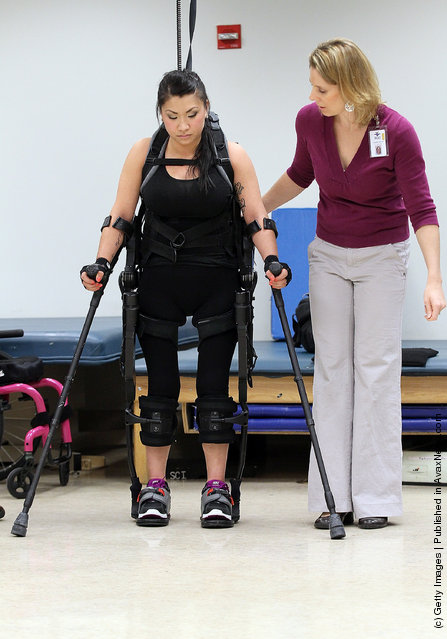
“eLEGS is a wearable, artificially intelligent, bionic device that enables people with paralysis to stand up and walk again. The exoskeleton is battery-powered and rechargeable, fitting comfortably and securely over clothing. Initially, eLEGS will be used under medical supervision for rehabilitation and training”. – BerkeleyBionics.com

Photo: Paralysis victim Stephanie Sablan (L) is helped by physical therapist Shonna Moran as she walks using eLEGS robotic legs at Santa Clara Valley Medical Center on May 25, 2011 in San Jose, California. Sablan, 24, was paralyzed from the waist down earlier this year when she was in a car accident and has begun using the newly developed eLEGS made by Berkeley Bionics. The robot-like battery powered eLEGS fit over clothing and enables people with paralysis to stand up and walk again. (Photo by Justin Sullivan/Getty Images)
Details
26 May 2011 09:56:00
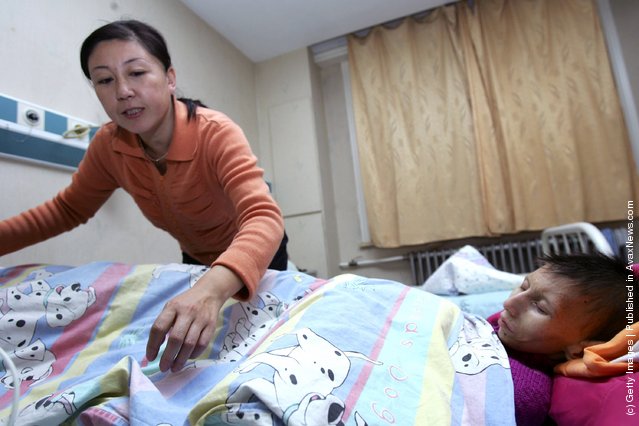
12-year-old Chinese girl Sun Yangyang suffering from Cockayne syndrome

“Cockayne syndrome (also called Weber-Cockayne syndrome, or Neill-Dingwall Syndrome) is a rare autosomal recessive congenital disorder characterized by growth failure, impaired development of the nervous system, abnormal sensitivity to sunlight (photosensitivity), and premature aging. Hearing loss and eye abnormalities (pigmentary retinopathy) are other common features, but problems with any or all of the internal organs are possible. It is associated with a group of disorders called leukodystrophies. The underlying disorder is a defect in a DNA repair mechanism. It is named after English physician Edward Alfred Cockayne (1880–1956)”. – Wikipedia

Photo: Mother of 12-year-old Chinese girl Sun Yangyang suffering from Cockayne syndrome, tends her at the First Affiliated Hospital of Jilin University on November 11, 2006 in Changchun of Jilin Province, China. The disease results in the senile appearance of Yangyang and also causes eyesight, hearing weakness and other problems. Doctors failed to cure the girl... (Photo by China Photos/Getty Images)
Details
08 Aug 2011 11:17:00
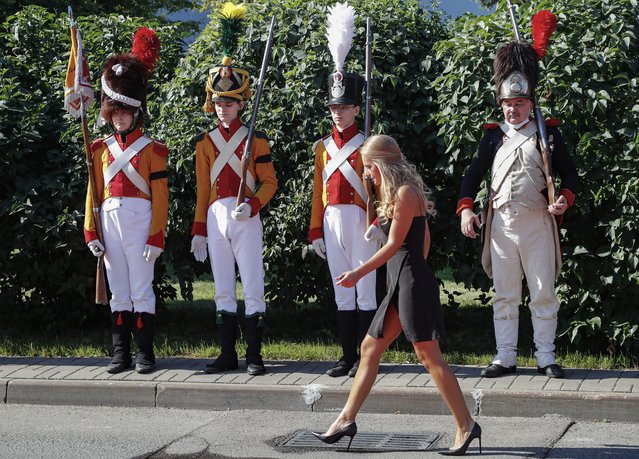
A woman passes Members of historical clubs dressed in the uniform of French soldiers during ceremony of repatriation of the remains of French General Charles-Etienne Gudin de la Sablonniere, participant in the French Revolutionary wars and Napoleonic wars, to France in Moscow airport Vnukovo-3, Russia, 13 July 2021. One of Napoleon Bonaparte's favourite military commanders died in the Battle of Smolensk during the Russian campaign of 1812. The search for his remains was one of the main goals of the joint archaeological expedition, which the historians of the two countries, led by Pierre Malinowski, President of the Foundation for the Development of Russian- French Historical Initiatives, began in the summer of 2019. A significant find was made during excavations at the Royal Bastion in the Lopatinsky Garden of Smolensk. (Photo by Sergei Ilnitsky/EPA/EFE)

A woman passes Members of historical clubs dressed in the uniform of French soldiers during ceremony of repatriation of the remains of French General Charles-Etienne Gudin de la Sablonniere, participant in the French Revolutionary wars and Napoleonic wars, to France in Moscow airport Vnukovo-3, Russia, 13 July 2021. (Photo by Sergei Ilnitsky/EPA/EFE)
Details
23 Jul 2021 09:07:00
Lisandra Perez, 7, practices in his house before his flute lesson at the Integral System of Artistic Education for Social Inclusion (SIFAIS) center in the poor neighborhood of La Carpio, Costa Rica October 8, 2015. (Photo by Juan Carlos Ulate/Reuters)

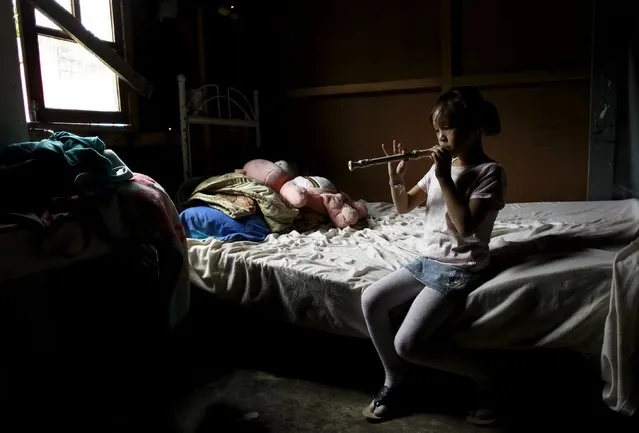
Lisandra Perez, 7, practices in his house before his flute lesson at the Integral System of Artistic Education for Social Inclusion (SIFAIS) center in the poor neighborhood of La Carpio, Costa Rica October 8, 2015. SIFAIS center is developing a social program with the help of 156 volunteers who teach art, music, sports and education, for children and youth living in La Carpio, known for being the home to gangs, violence, drugs and social vulnerability, according to the centre. (Photo by Juan Carlos Ulate/Reuters)
Details
15 Oct 2015 08:02:00
A Uyghur boy sits atop a horse as he has his picture taken outside the Id Kah Mosque before the Eid holiday  on July 28, 2014 in old Kashgar, Xinjiang Province, China. (Photo by Kevin Frayer/Getty Images)

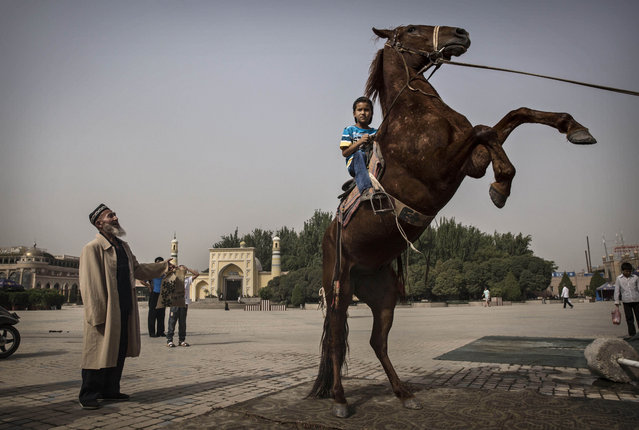
A Uyghur boy sits atop a horse as he has his picture taken outside the Id Kah Mosque before the Eid holiday on July 28, 2014 in old Kashgar, Xinjiang Province, China. Nearly 100 people have been killed in unrest in the restive Xinjiang Province in the last week in what authorities say is terrorism but advocacy groups claim is a result of a government crackdown to silence opposition to its policies. China's Muslim Uyghur ethnic group faces cultural and religious restrictions by the Chinese government. Beijing says it is investing heavily in the Xinjiang region but Uyghurs are increasingly dissatisfied with the influx of Han Chinese and uneven economic development. (Photo by Kevin Frayer/Getty Images)
Details
10 Aug 2014 10:53:00
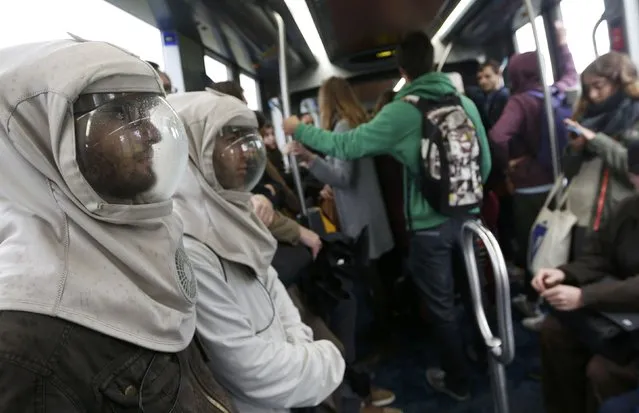
French twins Thomas and Vincent (L) Seris take the tram in Bordeaux, November 12, 2014. Born with Xeroderma Pigmentosum (XP), the twins cannot be exposed to the sun and its ultraviolet (UV) light, which could provoke precocious cancers due to an autosomal recessive genetic disorder of DNA repair. (Photo by Regis Duvignau/Reuters)

French twins Thomas and Vincent (L) Seris take the tram in Bordeaux, November 12, 2014. Born with Xeroderma Pigmentosum (XP), the twins cannot be exposed to the sun and its ultraviolet (UV) light, which could provoke precocious cancers due to an autosomal recessive genetic disorder of DNA repair. Colloquially referred to as Children of the Night (Les Enfants de la Lune) the Seris twins are among 70 to 80 people in France who suffer from the genetic defect. The French association “Les Enfants de la Lune” reports that there are between five and ten thousand such cases in the world. Thomas and Vincent have been testing a new protective mask for the last year which is transparent and ventilated and developed by several hospitals in France. (Photo by Regis Duvignau/Reuters)
Details
01 Feb 2015 10:27:00
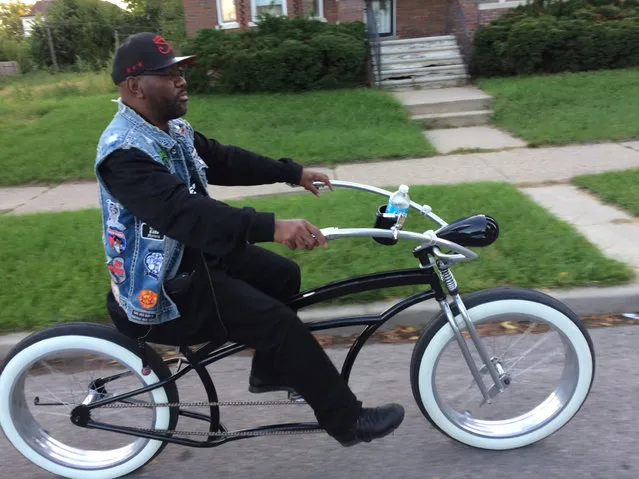
Bo (pictured) is president and co-founder of Grown Men On Bikes (GMOB), one of the oldest groups at Slow Roll. Bo spent $1,300 getting a one-off low-rider custom bike build – but that’s just the start. “Once I go back in it’s going to get big”, he says. “I’m going to get a custom seat, wheels, paint” … The finished bike could cost around $3,000 – but would still be far cheaper than pimping a car. “This is much better. It’s a community. We party”. (Photo by Nick Van Mead)

“We take rusty old junk and we put love into it”. The old Motor City has a unique style in bicycles these days: from fat wheels and fake fuel tanks to stretched cycles with powerful sound systems – and even a family-sized BBQ. “Detroit’s custom bike scene developed alongside Slow Roll, a weekly cycle ride started in 2010 by Jason Hall and Mike MacKool. Now upwards of 2,000 people turn up each Monday to cruise a different part of the city. The week I go the crowd seems evenly split between black and white, male and female, city and suburbs. It’s the most inclusive cycle event I’ve ever witnessed”. (Photo by Jason Walker/Slow Roll Monday Nights)
Details
03 Nov 2016 12:33:00
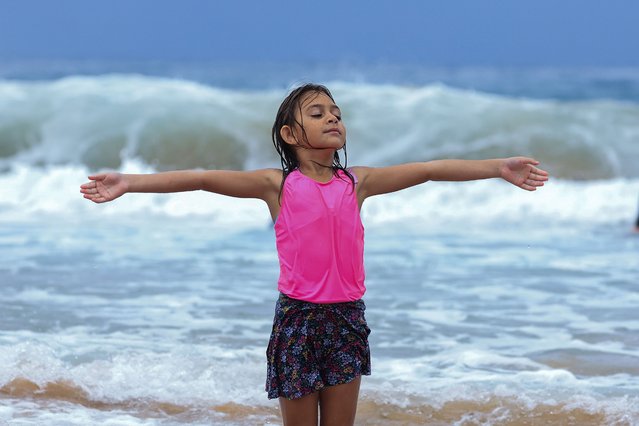
A girl stands with arms outstretched at North Narrabeen on January 27, 2024 in Sydney, Australia. Around 30 indigenous children from Brewarrina, Weilmoringle, and Goodooga in the far North West NSW travelled to Sydney to participate in the program. The initiative is part of the Bush to Beach programme, which now in its 19th year, gives indigenous children a unique opportunity to learn and explore Sydney's beach culture. The efforts are made possible entirely by volunteers, donations and sponsorship. Bush to Beach is a charity dedicated to inspiring hope, confidence, and self-esteem and promoting education for Aussie bush kids, a release by the charity said. This trip is a reward for school attendance and an opportunity for the kids to see that there is another world outside their community and help develop confidence and self-esteem, according to Bush to Beach co-founder Jack Cannons. (Photo by Jenny Evans/Getty Images)

A girl stands with arms outstretched at North Narrabeen on January 27, 2024 in Sydney, Australia. Around 30 indigenous children from Brewarrina, Weilmoringle, and Goodooga in the far North West NSW travelled to Sydney to participate in the program. The initiative is part of the Bush to Beach programme, which now in its 19th year, gives indigenous children a unique opportunity to learn and explore Sydney's beach culture. (Photo by Jenny Evans/Getty Images)
Details
10 Feb 2024 09:26:00