Loading...
Done


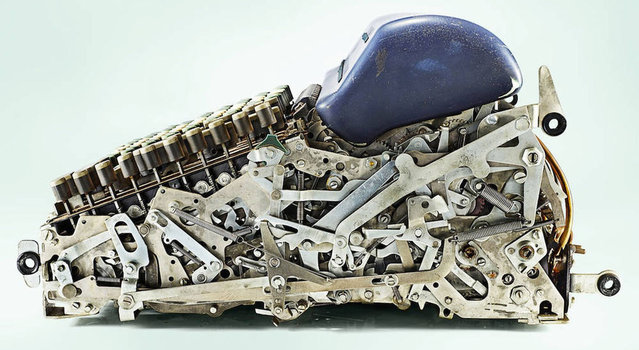
In his newest series of photos called Low Tech, Kevin Twomey artfully captures the complexity of old-style typewriters and similar machines. Despite being completely outdated, you cannot help being amazed at how complicated those “simple” devises really are. Hundreds of little parts were meticulously put together to form a machine that would perform such “basic” functions by today’s standards. Similarly, very few modern people actually think about how complicated the current technology really is. We take for granted streaming videos, GPS, and countless devises that we use every day, while in reality, these things would seem like magic to even the most prominent scientists from only half a century ago. (Photo by Kevin Twomey)
Details
21 Nov 2014 12:42:00
Two visitors look at an artwork “Home Sweet Home: Pandemic Love 1” created by Hong Kong artist Mak Ying Tung at Art Basel in Hong Kong Wednesday, May 19, 2021. (Photo by Vincent Yu/AP Photo)

Two visitors look at an artwork “Home Sweet Home: Pandemic Love 1” created by Hong Kong artist Mak Ying Tung at Art Basel in Hong Kong Wednesday, May 19, 2021. Art Basel, one of the world's most prestigious modern and contemporary art exhibitions, is returning to Hong Kong in its ninth edition. The prestige art fair is hosting 104 galleries from 23 countries and territories. (Photo by Vincent Yu/AP Photo)
Details
22 May 2021 08:48:00
Russian soldiers are pictured next to the Reichstag building in this undated photo taken May 1945 in Berlin. Some 70 years on from the Battle for Berlin, instrumental in the end of World War II, Reuters photographer Fabrizio Bensch unearthed pictures by Red Army photographer Georgiy Samsonov, showing his portrayal of a city laid siege. (Photo by Georgiy Samsonov/Reuters/MHM)

Russian soldiers are pictured next to the Reichstag building in this undated photo taken May 1945 in Berlin. Some 70 years on from the Battle for Berlin, instrumental in the end of World War II, Reuters photographer Fabrizio Bensch unearthed pictures by Red Army photographer Georgiy Samsonov, showing his portrayal of a city laid siege. Bensch bought an exactly equivalent FED camera, a Soviet copy of the German-made Leica II, choosing to use black and white film to capture images of the self-same locations he detected his way to in modern-day Berlin. (Photo by Georgiy Samsonov/Reuters/MHM)
Details
07 May 2015 12:01:00
Dive The Deadly Jacob’s Well In Texas

Jacob's Well is a perennial karstic spring in the Texas Hill Country flowing from the bed of Cypress Creek, located northwest of Wimberley, Texas. The twelve foot (four meter) diameter mouth of the spring serves as a popular swimming spot for the local land owners whose properties adjoin Cypress Creek. From the opening in the creek bed, Jacob's Well cave descends vertically for about thirty feet (ten meters), then continues downward at an angle through a series of silted chambers separated by narrow restrictions, finally reaching a depth of one hundred and twenty feet (forty meters). Until the modern era, the Trinity Aquifer-fed natural artesian spring gushed water from the mouth of the cave, with a measured flow in 1924 of one hundred and seventy gallons per second (six hundred and forty liters per second) discharging six feet (two meters) into the air. The spring is the greatest source of water recharging the Edwards Aquifer.
Details
03 Jan 2014 08:20:00
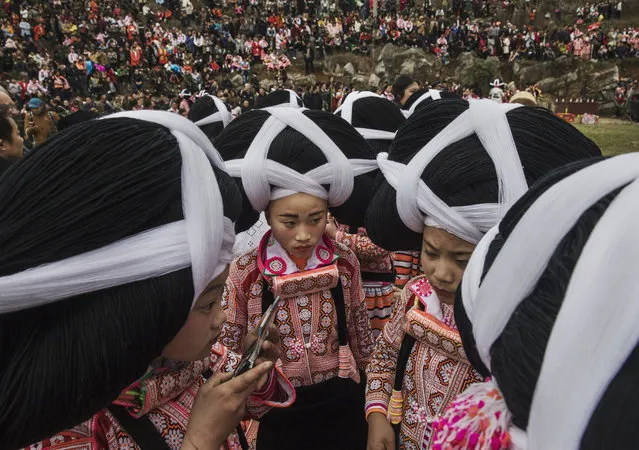
Girls of the Long Horn Miao ethnic minority group wear headdresses as they prepare gather for Tiaohua or Flower Festival as part of the Lunar New Year on February 6, 2017 in Longga village, Guizhou province, southern China. The Long Horn Miao are recognized for their declining practice of wrapping a blend of linen, wool, and the hair of their ancestors around animal horns or a wooden clip to make headdresses. Many young women say they now wear the headdresses only for special occasions and festivals, as the ornaments, which are attached by the horns to their real hair, have proved impractical for modern daily life in a fast changing world. China officially recognizes 56 different ethnic minorities, and statistics show over 7 million Chinese identifying themselves as Miao. But the small Long Horn Miao community counts only around 5000 people living in 12 villages, whose age-old traditions, language, and culture are fading. It is increasingly difficult in a modernizing China, as young people are drawn from remote rural villages to opportunities in bigger cities amongst wide-scale urbanization. Farming and labour remain the mainstays of life for the Long Horn Miao, leaving the area relatively poor in comparison with many parts of China. The government has invested significant amounts into local infrastructure and the tourism industry to try to bolster the local economy. (Photo by Kevin Frayer/Getty Images)

Girls of the Long Horn Miao ethnic minority group wear headdresses as they prepare gather for Tiaohua or Flower Festival as part of the Lunar New Year on February 6, 2017 in Longga village, Guizhou province, southern China. (Photo by Kevin Frayer/Getty Images)
Details
13 Feb 2017 00:01:00
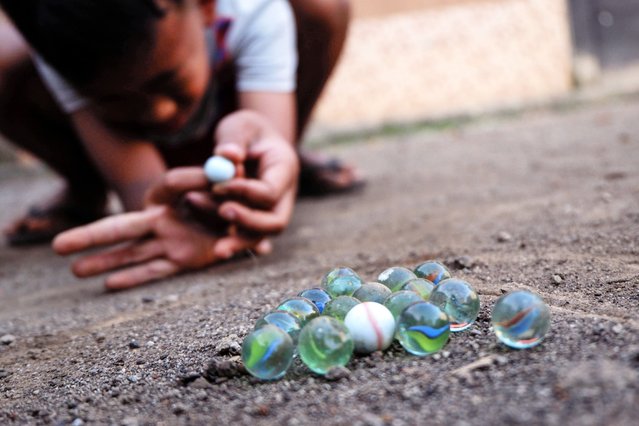
Children play marbles on the dirt in Garut, West Java, Indonesia on October 17, 2025. This traditional game, which was popular in the 1980s, is now rarely played by children due to the increasing popularity of modern games with advanced technology. According to a survey by the Indonesian Child Protection Commission (KPAI), more than 71.3% of school-age children own gadgets and play them for a considerable amount of time each day, and as many as 79% of child respondents are allowed to play gadgets for purposes other than learning. (Photo by Algi Febri Sugita/ZUMA Press Wire/Rex Features/Shutterstock)

Children play marbles on the dirt in Garut, West Java, Indonesia on October 17, 2025. This traditional game, which was popular in the 1980s, is now rarely played by children due to the increasing popularity of modern games with advanced technology. According to a survey by the Indonesian Child Protection Commission (KPAI), more than 71.3% of school-age children own gadgets and play them for a considerable amount of time each day, and as many as 79% of child respondents are allowed to play gadgets for purposes other than learning. (Photo by Algi Febri Sugita/ZUMA Press Wire/Rex Features/Shutterstock)
Details
26 Nov 2025 03:06:00
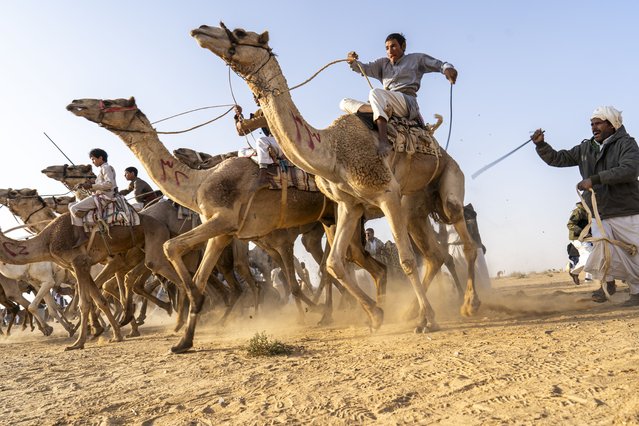
The start of the Al-Sirr camel race on November 19, 2025 in El Hassana, Egypt. The Al-Sirr camel race is one of the most culturally significant and widely celebrated sporting events among the Bedouin communities of Sinai. Every year, Bedouin tribes gather here to hold this traditional race, an event that preserves its authentic heritage. Unlike modern camel races elsewhere, the Bedouin here do not use robotic jockeys or advanced racing technologies. Instead, the camels are ridden by young boys aged approximately 5 to 16, maintaining a long-standing cultural practice. (Photo by Ali Moustafa/Getty Images)

The start of the Al-Sirr camel race on November 19, 2025 in El Hassana, Egypt. The Al-Sirr camel race is one of the most culturally significant and widely celebrated sporting events among the Bedouin communities of Sinai. Every year, Bedouin tribes gather here to hold this traditional race, an event that preserves its authentic heritage. Unlike modern camel races elsewhere, the Bedouin here do not use robotic jockeys or advanced racing technologies. Instead, the camels are ridden by young boys aged approximately 5 to 16, maintaining a long-standing cultural practice. (Photo by Ali Moustafa/Getty Images)
Details
03 Jan 2026 12:49:00
In this Friday, January 9, 2015 photo, bathhouse worker Omid Riahi, 39, scrubs a man to remove dead skin, at the Ghebleh public bathhouse, in Tehran, Iran. The steamy air and curved tiled walls of Iran's famed public bathhouses, some rinsing and massaging patrons for hundreds of years, slowly may wash away as interest in them wanes. (Photo by Ebrahim Noroozi/AP Photo)

In this Friday, January 9, 2015 photo, bathhouse worker Omid Riahi, 39, scrubs a man to remove dead skin, at the Ghebleh public bathhouse, in Tehran, Iran. The steamy air and curved tiled walls of Iran's famed public bathhouses, some rinsing and massaging patrons for hundreds of years, slowly may wash away as interest in them wanes. The bathhouses, known as “hammams” in Persian, find themselves in rough financial times as modern conveniences now allow showers and baths in most homes across the Islamic Republic. (Photo by Ebrahim Noroozi/AP Photo)
Details
03 Apr 2015 12:40:00