A performer dances during Salgueiro performance at the Rio de Janeiro Carnival at Sambodromo on February 26, 2017 in Rio de Janeiro, Brazil. (Photo by Raphael Dias/Getty Images)
Mexican fashion model Daniela de Jesus Cosio attends the screening of “Nostalgia” during the 75th annual Cannes film festival at Palais des Festivals on May 24, 2022 in Cannes, France. (Photo by Sarah Meyssonnier/Reuters)
Dressed up participants run at the “Course de la Marmite” during the 46th Escalade Race (Course de l'Escalade) in Geneva, Switzerland, 07 December 2024. (Photo by Martial Trezzini/EPA/EFE)
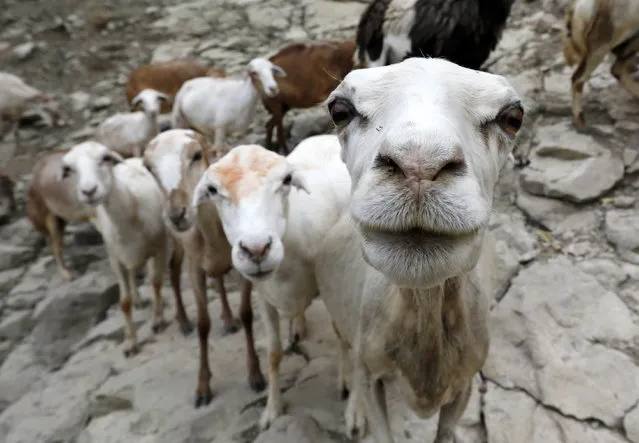
A flock of sheep and goats is led by shepherds to pastures at a mountain village on the outskirts of Sana'a, Yemen, 27 July 2023. At least eight million sheep and goats from about 470,000 pastoralist and agro pastoralist households across Yemen will be treated and vaccinated over the two years 2023 and 2024, in an effort to reduce livestock losses, improve production efficiency, and household income generation amid an acute food insecurity, the UN Food and Agriculture Organization (FAO) has reported. (Photo by Yahya Arhab/EPA)
Pavel Sidorenko is an award winning Estonian designer who was born in 1980 in Tallinn and studied product design at Estonian Academy of Arts and Graduated in 2006. Not only does he incorporate pragmatic necessity, but also transmits an emotional qualities within the everyday environment. His fantastic collection of Re Vinyl designs are a result of upcycling a product fashioned from old vinyl records. Beautifully crafted and working with a range of themes from scenography to animal creatures, there is sure to be something for everyone with these stylish selection of recycled vinyl clocks!
“One Third” – a project on food waste by an Austrian photography Klaus Pichler. According to a UN study one third of the world's food goes to waste – the largest part thereof in the industrialized nations of the global north. Equally, 925 million people around the world are threatened by starvation. The series “One Third” describes the connection between individual wastage of food and globalized food production.
Photo: Pineapple. Place of production: Guayaquil, Ecuador. Cultivation method: Outdoor plantation • Time of harvest: All- season. Transporting distance: 10.666 km (linear distance) • Means of transportation: Aircraft, truck. Carbon footprint (total) per kg: 11,94 kg • Water requirement (total) per kg: 360 l. Price: 2,10 € / kg. (Photo by Klaus Picher)
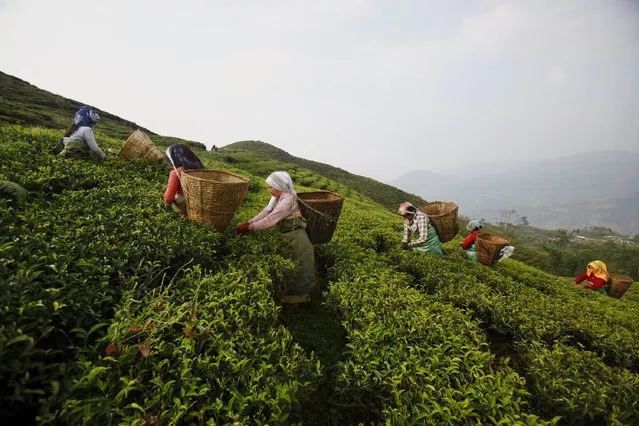
In this Sunday, November 16, 2014 photo, Nepalese women pick tea at a tea garden of Kanyam in Illam district, around 500 kilometers (310 miles) from Katmandu, Nepal. Illam is a hilly district of tea gardens and estates in eastern Nepal's Himalayan region with one of its largest and most productive tea estate being Kanyam estates. The district produces orthodox tea, hand-processed or machine rolled, which is generally exported to international markets, specially Europe and the United States. Most of the tea pickers here are paid 186 Nepalese Rupees (US $ 2) for 8 hours of work everyday. (Photo by Niranjan Shrestha/AP Photo)
A life-size robot named “Mark 1”, built by product and graphic designer Ricky Ma, 42, is seen in Hong Kong, China March 31, 2016. Ma, a robot enthusiast, spent a year-and-a half and more than HK$400,000 ($51,000) to create the humanoid robot, which is modelled after a Hollywood star, to fulfil his childhood dream. The eyes of the robot include face and color tracking functions. (Photo by Bobby Yip/Reuters)