Loading...
Done


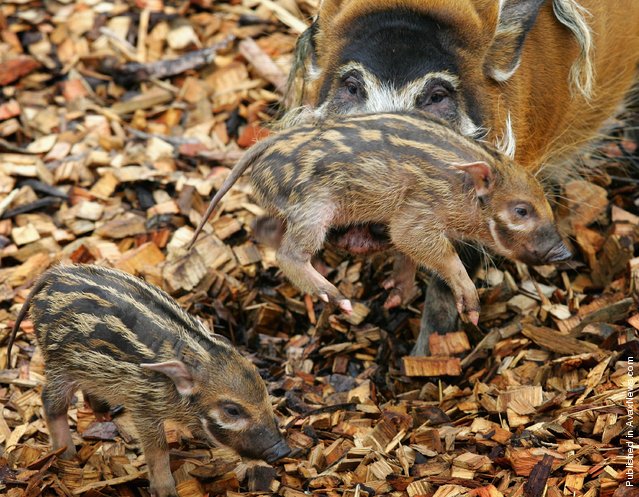
“The Red River Hog (Potamochoerus porcus), also known as the Bush Pig (but not to be confused with P. larvatus, common name “Bushpig”), is a wild member of the pig family living in Africa, with most of its distribution in the Guinean and Congolian forests. It is rarely seen away from rainforests, and generally prefers areas near rivers or swamps.

Red River Hogs eat grass, berries, roots, insects, molluscs, small vertebrates and carrion. They are capable of causing damage to plantations. Red River Hogs typically live in herds of 6-20 members led by a dominant boar. Sows rear 3-6 piglets at a time.”

Photo: Two 17 day old red river hoglet twins forage for food next to their mother Bahiti at London Zoo on August 23, 2007 in London, England. Red River hoglets inhabit the forests and swamps of West and Central Africa. The recent additions to the London Zoo pig pen have been eagerly awaited by zoo keepers. (Photo by Chris Jackson/Getty Images)
Details
18 Mar 2011 15:15:00
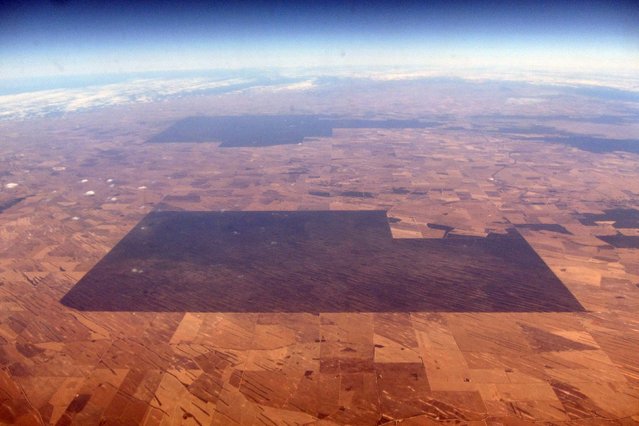
An area of vegetation can be seen amongst drought effected farmland in South Australia, November 12, 2015. (Photo by David Gray/Reuters)

An area of vegetation can be seen amongst drought effected farmland in South Australia, November 12, 2015. A pioneering Australian scheme to improve the management of water in the world's driest inhabited continent is facing its first real test as an intensifying El Nino threatens crops and builds tensions between farmers and environmentalists. An El Nino, a warming of sea-surface temperatures in the Pacific, is already causing drought and other extreme weather, affecting millions of people across parts of the world, and experts warn that the intensifying weather pattern could emerge as one of the strongest on record. (Photo by David Gray/Reuters)
Details
15 Nov 2015 08:01:00
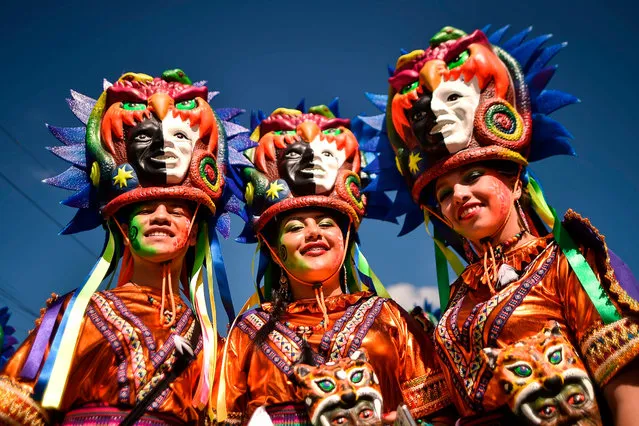
Revellers take part in the “Canto a la Tierra” parade on January 3, 2018, during the Carnival of Blacks and Whites in Pasto, Colombia, the largest festivity in the south- western region of the country. (Photo by Luis Robayo/AFP Photo)

Revellers take part in the “Canto a la Tierra” parade on January 3, 2018, during the Carnival of Blacks and Whites in Pasto, Colombia, the largest festivity in the south- western region of the country. More than 10,000 people among artists, craftsmen and revellers take part in the Blacks and Whites Carnival, which has its origins in the mix of the multiple Andean, Amazonian and Pacific cultural expressions. It is celebrated every year from January 2 to 6 in the city of Pasto and is part of UNESCO's Intangible Cultural Heritage of Humanity since 2009. (Photo by Luis Robayo/AFP Photo)
Details
10 Jan 2018 06:51:00
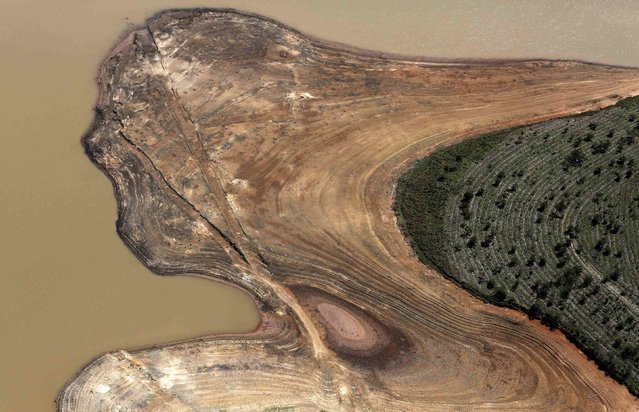
An aerial view of the Atibainha dam, part of the Cantareira reservoir, during a drought in Nazare Paulista, Sao Paulo state November 18, 2014. (Photo by Nacho Doce/Reuters)

An aerial view of the Atibainha dam, part of the Cantareira reservoir, during a drought in Nazare Paulista, Sao Paulo state November 18, 2014. Brazil's worst drought in 80 years has left the Cantareira system, that provides greater Sao Paulo with most of its water, with the lowest water level on record, with daily rationing becoming common in the region's smaller cities, according to the state authorities and the two main reservoirs serving metropolitan Sao Paulo, South America's largest city, could dry out by February if relief does not arrive in the upcoming rainy season. (Photo by Nacho Doce/Reuters)
Details
20 Nov 2014 12:19:00
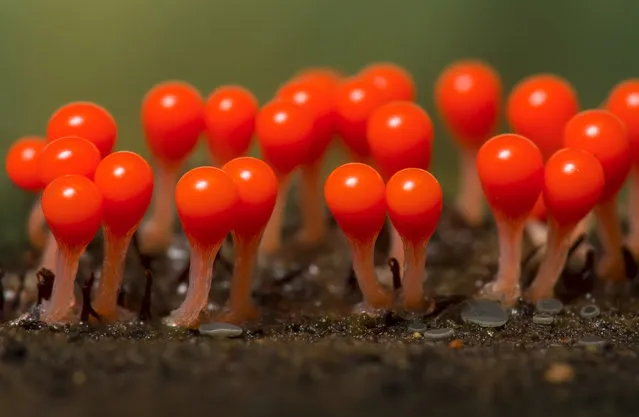
These may look like alien creatures from another planet, but the odd organisms are, in fact, colorful, microscopic life forms found in our forests. The bizarre slime molds, known as mycetozoa or fungus animals, were captured by geologist Valeriya Zvereva. (Photo by Valeriya Zvereva/Caters News)

These may look like alien creatures from another planet, but the odd organisms are, in fact, colorful, microscopic life forms found in our forests. The bizarre slime molds, known as mycetozoa or fungus animals, were captured by geologist Valeriya Zvereva. She spent months documenting the common life forms that are found beneath our feet – but are rarely seen. Incredibly, the organisms can move and hunt for other microscopic life forms on which to feed. Zvereva, who is from Moscow, used a special macro lens to capture the vibrant and up-close shots, which show off the organisms’ unlikely beauty. (Photo by Valeriya Zvereva/Caters News)
Details
20 Apr 2015 13:27:00
British Prime Minister Rishi Sunak is greeted by Italian Prime Minister Giorgia Meloni during a welcome ceremony on day one of the 50th G7 summit at Borgo Egnazia on June 13, 2024 in Fasano, Italy. The G7 summit in Puglia, hosted by Italian Prime Minister Giorgia Meloni, the seventh held in Italy, gathers leaders from the seven member states, the EU Council, and the EU Commission. Discussions will focus on topics including Africa, climate change, development, the Middle East, Ukraine, migration, Indo-Pacific economic security, and artificial intelligence. (Photo by Christopher Furlong/Getty Images)

British Prime Minister Rishi Sunak is greeted by Italian Prime Minister Giorgia Meloni during a welcome ceremony on day one of the 50th G7 summit at Borgo Egnazia on June 13, 2024 in Fasano, Italy. The G7 summit in Puglia, hosted by Italian Prime Minister Giorgia Meloni, the seventh held in Italy, gathers leaders from the seven member states, the EU Council, and the EU Commission. (Photo by Christopher Furlong/Getty Images)
Details
16 Jun 2024 06:00:00
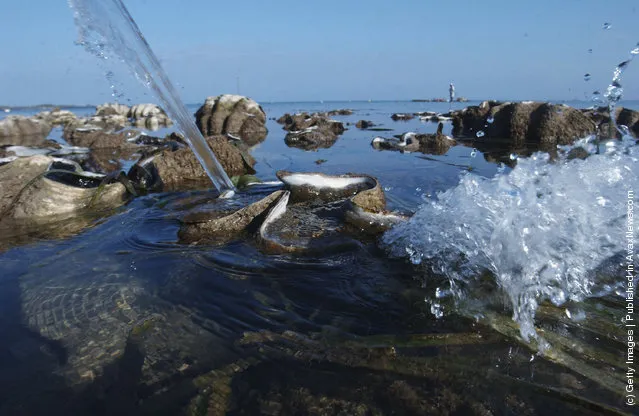
Tridacna Gigas, or Giant Clams

“The giant clam, Tridacna gigas (known as pā’ua in Cook Islands Māori), is the largest living bivalve mollusc. T. gigas is one of the most endangered clam species. It was mentioned as early as 1825 in scientific reports. One of a number of large clam species native to the shallow coral reefs of the South Pacific and Indian oceans, they can weigh more than 200 kilograms (440 lb) measure as much as 120 cm (47 in) across, and have an average lifespan in the wild of 100 years or more”. – Wikipedia

Photo: Tridacna Gigas, or Giant Clams spew water as a traditional fisherman passes by a small sanctuary on January 23, 2004 near Bolinao in the Northern Philippines. The clams, prime builders for coral reefs and providing shelter for spawning fish and other marine life, are exposed by low tides in the sanctuary. Overfishing and pollution throughout the country are not only threatening food security, but are also starting to choke one of the few working clam sanctuaries in the world. (Photo by David Greedy/Getty Images)
Details
01 Oct 2011 13:10:00
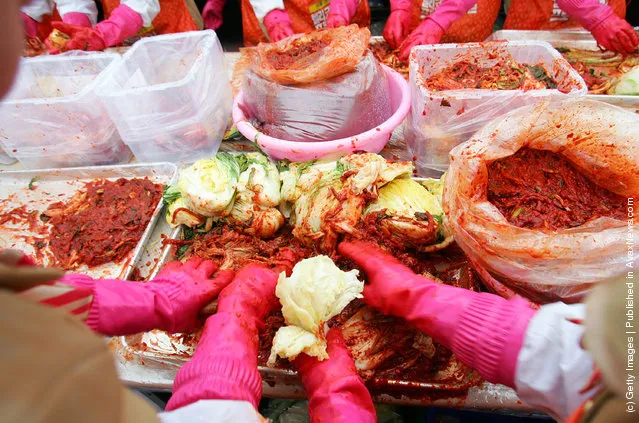
Kimchi

“Kimchi, also spelled gimchi, kimchee, or kim chee, is a traditional fermented Korean dish made of vegetables with varied seasonings. There are hundreds of varieties of kimchi made with a main vegetable ingredient such as napa cabbage, radish, green onions or cucumber. It is the most common banchan, or side dish, in Korean cuisine. Kimchi is also a main ingredient for many popular Korean dishes such as kimchi stew (kimchi jjigae), kimchi soup (kimchiguk), and kimchi fried rice (kimchi bokkeumbap)”. – Wikipedia

Photo: South Korean housewives, among more than two thousand who gathered for an event sponsored by state officials to help the needy, make kimchi, the traditional pungent vegetable dish on the grounds in front of Seoul City Hall on November 20 in Seoul, South Korea. (Photo by Chung Sung-Jun/Getty Images)
Details
21 Dec 2011 13:24:00