Loading...
Done
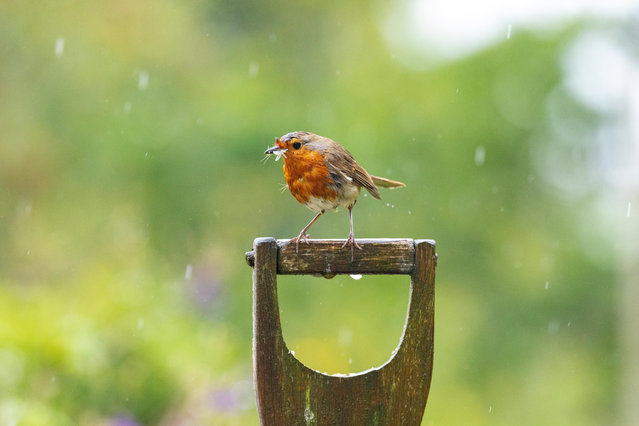
A robin perches on a spade handle in a garden on a rainy day in Lixwm, north Wales. Researchers said this week that when European robins are subjected to human-produced noise, their behaviour changes. (Photo by DGDImages/Alamy Live News)

A robin perches on a spade handle in a garden on a rainy day in Lixwm, north Wales. Researchers said this week that when European robins are subjected to human-produced noise, their behaviour changes. (Photo by DGDImages/Alamy Live News)
Details
28 Jul 2019 00:03:00
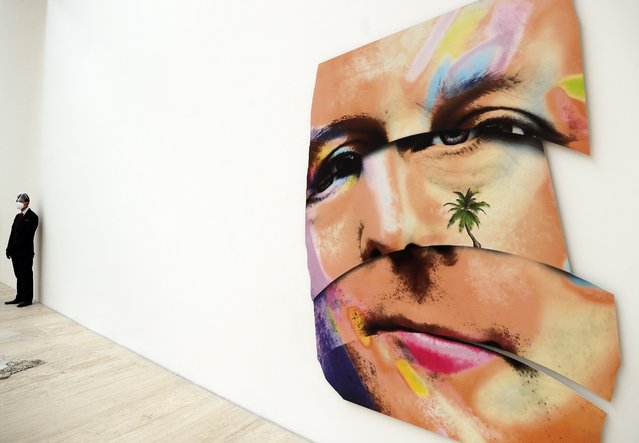
View of the work “Divided” (2016), within the visual artist's exhibition “Urs Fischer: Lovers”, exhibited at the Museo Jumex in Mexico City, Mexico 31 March 2022. The sensations and emotions of love and life, as well as the energy and forces that create and wear it down, inhabit “Urs Fischer: Lovers”, the first solo exhibition in Mexico by Swiss plastics artist Urs Fischer. (Photo by Alex Cruz/EPA/EFE)

View of the work “Divided” (2016), within the visual artist's exhibition “Urs Fischer: Lovers”, exhibited at the Museo Jumex in Mexico City, Mexico 31 March 2022. The sensations and emotions of love and life, as well as the energy and forces that create and wear it down, inhabit “Urs Fischer: Lovers”, the first solo exhibition in Mexico by Swiss plastics artist Urs Fischer. (Photo by Alex Cruz/EPA/EFE)
Details
26 May 2022 04:25:00
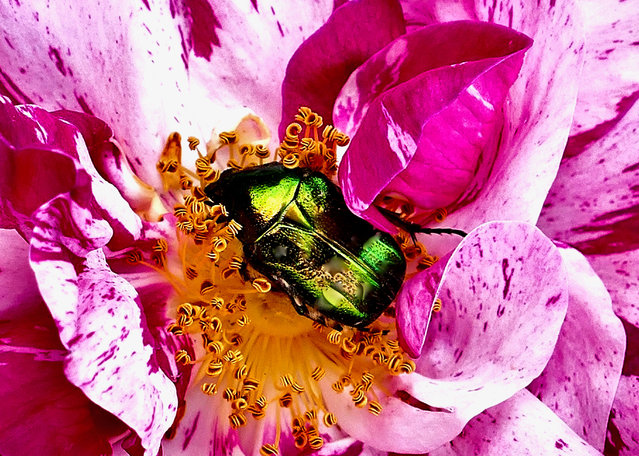
A rose chafer in Oxfordshire, UK on July 8, 2024. The beetles are often seen on flowers in the garden and are sometimes maligned for munching their way through these plants. However, they are an important detritivore as they feed on dead and decaying matter and recycle its nutrients, which makes a helpful addition to any compost. (Photo by Geoffrey Swaine/Rex Features/Shutterstock)

A rose chafer in Oxfordshire, UK on July 8, 2024. The beetles are often seen on flowers in the garden and are sometimes maligned for munching their way through these plants. However, they are an important detritivore as they feed on dead and decaying matter and recycle its nutrients, which makes a helpful addition to any compost. (Photo by Geoffrey Swaine/Rex Features/Shutterstock)
Details
21 Jul 2024 05:04:00
15-year old Terminally Ill American girl Donica Streling meets with members of SHINee (샤이니) at SM Entertainment head office on June 20, 2012 in Seoul, South Korea

15-year old American girl Donica Streling meets with members of SHINee (샤이니) at SM Entertainment head office on June 20, 2012 in Seoul, South Korea. Donica, diagnosed with Charcot-Marie-Tooth disease, visited Seoul, South Korea to meet her favorite K-pop groups SHINee and Super Junior after finding hope in listening to Korean pop. (Photo by Chung Sung-Jun)
Details
20 Jun 2012 11:32:00
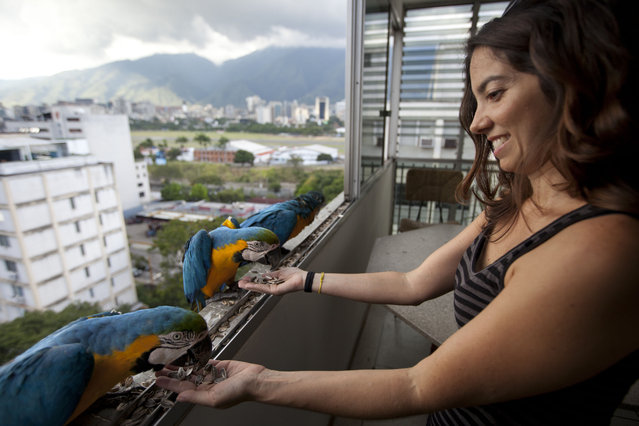
Vanessa Silva, 38, feeds macaws that fly to her apartment window every day looking for food, in Caracas, Venezuela. A group of gold-and-royal blue birds poked their heads through Silva’s window, as if saying “I’m here, is anyone home?” “I’d seen them flying when I was down on the street, and I thought ‘Oh how pretty,’” the 38-year-old said, a macaw eating out of her hand. (Photo by Ariana Cubillos/AP Photo)

Vanessa Silva, 38, feeds macaws that fly to her apartment window every day looking for food, in Caracas, Venezuela, on November 24, 2014. A group of gold-and-royal blue birds poked their heads through Silva’s window, as if saying “I’m here, is anyone home?” “I’d seen them flying when I was down on the street, and I thought ‘Oh how pretty,’” the 38-year-old said, a macaw eating out of her hand. (Photo by Ariana Cubillos/AP Photo)
Details
27 Nov 2014 15:27:00
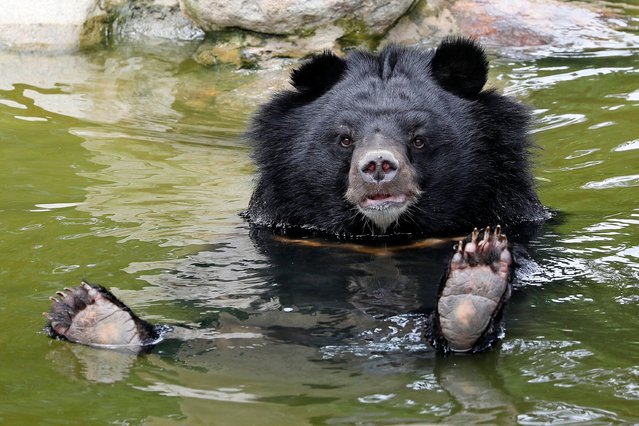
A moon bear rests in a pool inside an enclosure at the Vietnam bear rescue centre, in Tam Dao national park, Vinh Phuc, Vietnam, 09 July 2019. The center is operated by international organization Animals Asia. There are currently 184 bears living at the the Vietnam Bear Rescue Centre. It is estimated that there are less than a few hundred bears left in the wild in Vietnam. According to the latest data from the Ministry of Agriculture and Rural development, around 600 bears are still being kept on farms. In Vietnam, Animals Asia has rescued a total of 209 sun bears and moon bears. (Photo by Minh Hoang/EPA/EFE/Rex Features/Shutterstock)

A moon bear rests in a pool inside an enclosure at the Vietnam bear rescue centre, in Tam Dao national park, Vinh Phuc, Vietnam, 09 July 2019. The center is operated by international organization Animals Asia. There are currently 184 bears living at the the Vietnam Bear Rescue Centre. It is estimated that there are less than a few hundred bears left in the wild in Vietnam. According to the latest data from the Ministry of Agriculture and Rural development, around 600 bears are still being kept on farms. In Vietnam, Animals Asia has rescued a total of 209 sun bears and moon bears. (Photo by Minh Hoang/EPA/EFE/Rex Features/Shutterstock)
Details
14 Jul 2019 00:05:00
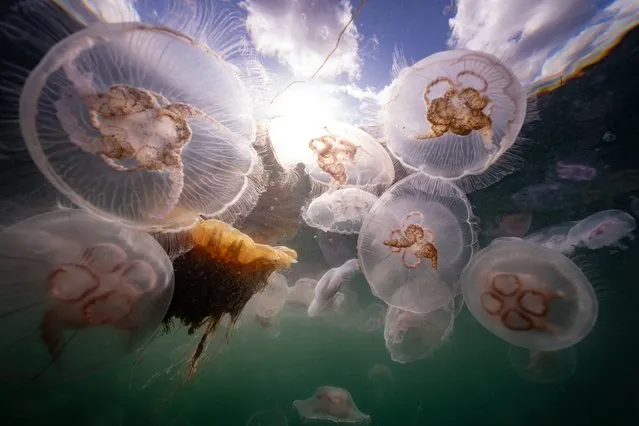
This picture taken on September 11, 2023 shows Moon Jellyfish (with rings) and Sting Jellyfish (yellow-orange inside) among a smack of a several thousand swimming off Seglvik, in northern Norway. (Photo by Olivier Morin/AFP Photo)

This picture taken on September 11, 2023 shows Moon Jellyfish (with rings) and Sting Jellyfish (yellow-orange inside) among a smack of a several thousand swimming off Seglvik, in northern Norway. (Photo by Olivier Morin/AFP Photo)
Details
07 Mar 2024 06:09:00


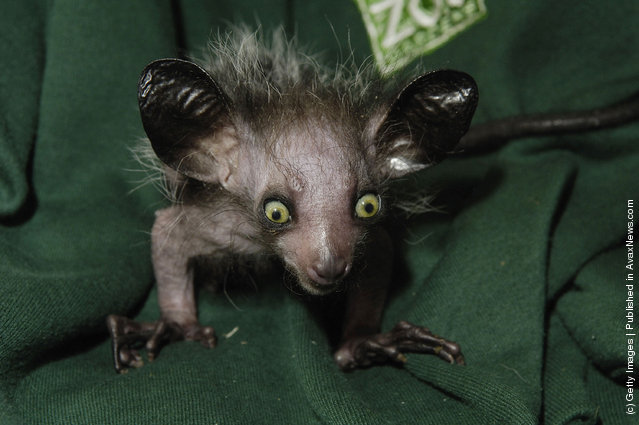
“The aye-aye (Daubentonia madagascariensis) is a lemur, a strepsirrhine primate native to Madagascar that combines rodent-like teeth and a special thin middle finger to fill the same ecological niche as a woodpecker. It is the world's largest nocturnal primate, and is characterized by its unusual method of finding food; it taps on trees to find grubs, then gnaws holes in the wood and inserts its narrow middle finger to pull the grubs out. The only other animal species known to find food in this way is the striped possum. From an ecological point of view the aye-aye fills the niche of a woodpecker as it is capable of penetrating wood to extract the invertebrates within”. – Wikipedia

Photo: In this handout image from Bristol Zoo is seen the first captive bred aye-aye in the UK named “Kintana” (meaning star in Malagasy) April 15, 2005 at Bristol Zoo Gardens, England. The zoo announced today only the second baby aye-aye to be hand-reared in the world (the first was in Jersey Zoo) and has now made his first public appearance since his birth on 11 February 2005. (Photo by Rob Cousins/Bristol Zoo via Getty Images)
Details
13 Apr 2011 13:33:00