Loading...
Done
Scientists say that a “Martian flower”, seen here in an image from the Curiosity rover's Mars Hand Lens Imager, is a 2-millimeter-wide grain or pebble that's embedded in the surrounding rock. Another, darker-colored mineral grain can be seen above and to the left. (Photo by NASA)

“The scientists behind NASA's $2.5 billion Curiosity rover mission on Mars on Tuesday explained the nature of a tiny, gleaming "flower" embedded in Red Planet rock, and revealed where they'll be using the SUV-sized robot's drill for the first time”. – Alan Boyle via NBCNews.com

Photo: Scientists say that a “Martian flower”, seen here in an image from the Curiosity rover's Mars Hand Lens Imager, is a 2-millimeter-wide grain or pebble that's embedded in the surrounding rock. Another, darker-colored mineral grain can be seen above and to the left. (Photo by NASA)
Details
16 Jan 2013 11:12:00
The spinning vortex of Saturn's north polar storm resembles a deep red rose of giant proportions surrounded by green foliage in this false-color image from NASA's Cassini spacecraft. (Photo by NASA/JPL-Caltech/SSI)

NASA's Cassini spacecraft has provided scientists the first close-up, visible-light views of a behemoth hurricane swirling around Saturn's north pole. In high-resolution pictures and video, scientists see the hurricane's eye is about 1,250 miles (2,000 kilometers) wide, 20 times larger than the average hurricane eye on Earth. Thin, bright clouds at the outer edge of the hurricane are traveling 330 mph(150 meters per second). The hurricane swirls inside a large, mysterious, six-sided weather pattern known as the hexagon. Photo: The spinning vortex of Saturn's north polar storm resembles a deep red rose of giant proportions surrounded by green foliage in this false-color image from NASA's Cassini spacecraft. (Photo by NASA/JPL-Caltech/SSI)
Details
31 May 2015 09:11:00
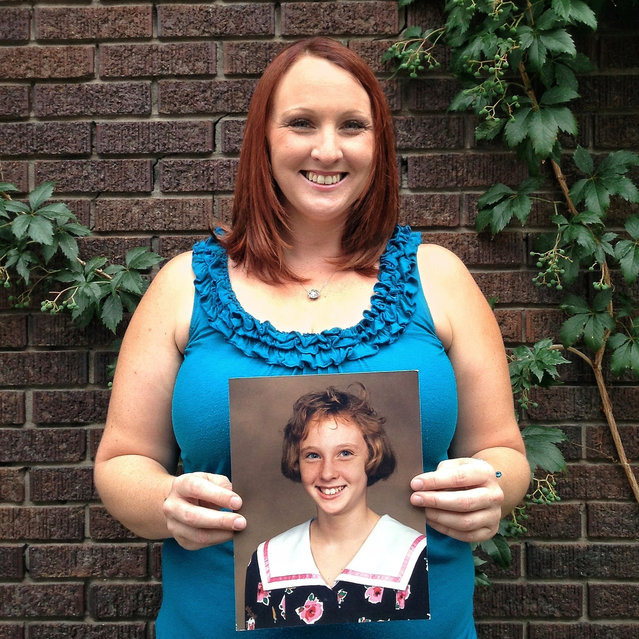
Lindsey. Then: 11 years old, 6th Grade, in Maumelle, Arkansas.
Now: 32 years old, Nanny/personal assistant residing in Holladay, Utah. (Photo by Awkward Years Project)

“The Awkward Years Project highlights the time in our lives when we felt the most awkward. Some of us had crazy hair, glasses, and/or braces. Some fell victim to the fashion trends of the decade. And some of us struggled even deeper than others realize. This project is a before-and-after transition showing how far the subjects have come and who they turned out to be”. – Awkward Years Project. Photo: Lindsey. Then: 11 years old, 6th Grade, in Maumelle, Arkansas.
Now: 32 years old, Nanny/personal assistant residing in Holladay, Utah. (Photo by Awkward Years Project)
Details
31 Jul 2013 06:41:00
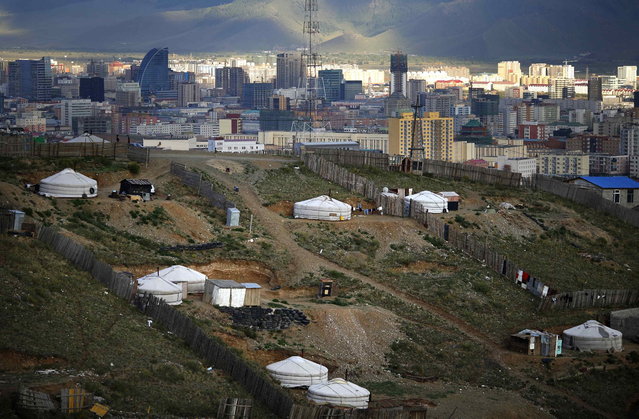
Gers, traditional Mongolian tents, are seen on a hill in an area known as a ger district in Ulan Bator June 26, 2013. (Photo by Carlos Barria/Reuters)

Gers, traditional Mongolian tents, are seen on a hill in an area known as a ger district in Ulan Bator June 26, 2013. Approximately 60 percent of the population of Ulan Bator live in settlements known as ger districts and in many cases residents have limited access to basic services such as water and sanitation. According to a 2010 National Population Center census, every year between thirty and forty thousand people migrate from the countryside to the capital Ulan Bator. Ger districts in the city have been expanding rapidly in recent years. Mongolia is the world's least densely populated country, with 2.8 million people spread across an area around three times the size of France. (Photo by Carlos Barria/Reuters)
Details
11 Aug 2013 11:45:00
Passengers hold 500 (bottom) rupee banknotes to buy train tickets at a railway booking counter in Allahabad, India, November 9, 2016. (Photo by Jitendra Prakash/Reuters)

Passengers hold 500 (bottom) rupee banknotes to buy train tickets at a railway booking counter in Allahabad, India, November 9, 2016. People are queuing up outside banks across India to exchange 500 and 1,000 rupee notes after they were withdrawn as part of anti-corruption measures. Indians will be able to exchange their old notes, which stopped being legal tender at midnight on Tuesday, for new ones at banks until 30 December. The surprise move is part of a government crackdown on corruption and illegal cash holdings. Banks were shut on Wednesday to allow them enough time to stock new notes. There are also limits on cash withdrawals from ATMs. The BBC's Yogita Limaye in Mumbai says there have been chaotic scenes outside many banks. (Photo by Danish Siddiqui/Reuters)
Details
10 Nov 2016 12:10:00
Hong Kong Shop Cats #17. Marcel Heijnen returned to Hong Kong in 2015 and found himself living without a cat for the first time in decades. Soon, though, he was indulging in what he calls “re-tail therapy” and found himself on a first-name basis with a number of cats in his neighbourhood, Sai Ying Pun. (Photo by Marcel Heijnen/Blue Lotus)

When Dutch photographer Marcel Heijnen moved to Hong Kong, the territory’s shop cats instantly caught his eye. While the “feline emperors” are the stars, his shots also offer insights into Hong Kong’s wares, from dried fish to paper. Here: Hong Kong Shop Cats #17. (Photo by Marcel Heijnen/Blue Lotus)
Details
03 Jan 2017 11:04:00
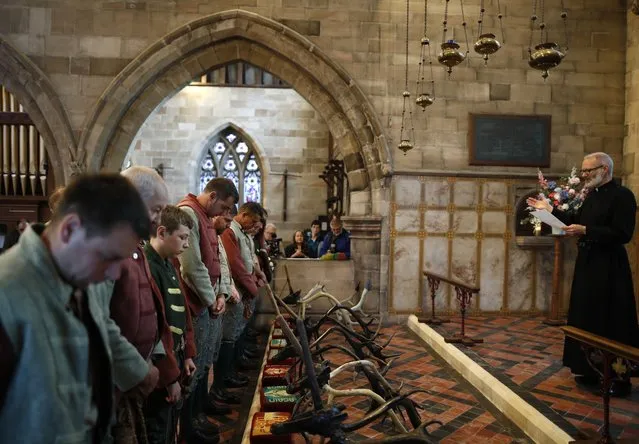
Reverend Simon Davis prays with the dancers before the Abbots Bromley Horn Dance in Abbots Bromley, Britain, September 12, 2016. The Abbots Bromley Horn Dance is an English folk dance dating back to the Middle Ages. The dance takes place each year in Abbots Bromley, a village in Staffordshire, England. The modern version of the dance involves reindeer antlers, a hobby horse, Maid Marian, and a Fool. According to some, the use of antlers suggests an Anglo-Saxon origin along with other native Anglo-Saxon traditions that have survived into modern times in various forms. (Photo by Darren Staples/Reuters)

Reverend Simon Davis prays with the dancers before the Abbots Bromley Horn Dance in Abbots Bromley, Britain, September 12, 2016. The Abbots Bromley Horn Dance is an English folk dance dating back to the Middle Ages. (Photo by Darren Staples/Reuters)
Details
13 Sep 2016 09:36:00
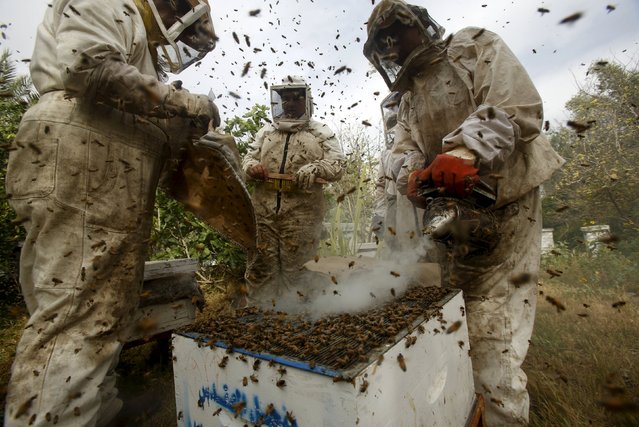
A Palestinian beekeeper uses smoke to calm bees in the process of collecting honey at a farm in Rafah, in the southern Gaza Strip April 11, 2016. (Photo by Suhaib Salem/Reuters)

A Palestinian beekeeper uses smoke to calm bees in the process of collecting honey at a farm in Rafah, in the southern Gaza Strip April 11, 2016. Rateb Samour sees 250 patients a day, whose complaints range from hair loss to cerebral palsy and cancer. He is not a doctor and has never worked in a hospital. Samour inherited the skill of bee-sting therapy from his father. From 2003 the agricultural engineer dedicated all his time to study and develop the alternative-medicine treatment of apitherapy, which uses bee-related products from honey, propolis – or bee glue used to build hives – to venom. (Photo by Suhaib Salem/Reuters)
Details
13 Apr 2016 09:14:00