Loading...
Done
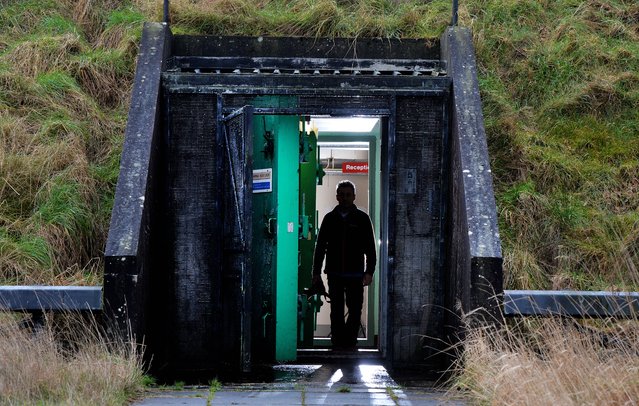
The main entrance and blast door at the nuclear bunker site on the Woodside Road industrial estate on February 4, 2016 in Ballymena, Northern Ireland. The underground shelter has been put up for sale by the offices of the Northern Ireland First and Deputy First Minister. The bunker which was completed in 1990 was built to hold up to 235 people in the event of a nuclear bomb and is complete with kitchen facilities, dormitories and decontamination chambers. (Photo by Charles McQuillan/Getty Images)

The main entrance and blast door at the nuclear bunker site on the Woodside Road industrial estate on February 4, 2016 in Ballymena, Northern Ireland. The underground shelter has been put up for sale by the offices of the Northern Ireland First and Deputy First Minister. The bunker which was completed in 1990 was built to hold up to 235 people in the event of a nuclear bomb and is complete with kitchen facilities, dormitories and decontamination chambers. The site, one of approximately 1,600 nuclear monitoring posts built in the UK since 1955, is on the housing market with an asking price of £575,000. (Photo by Charles McQuillan/Getty Images)
Details
05 Feb 2016 10:55:00
Alexandra Mazo, 12, with her cellphone on her way down the mountain after finishing school. The remote mountain village of Pueblo Nuevo has been highly affected by the armed conflict and direct combat between the national army and Farc guerrillas due to its strategic location and the intensive production on coca crops on the surrounding hillsides. (Photo by Mads Nissen/Politiken/The Guardian/Panos Pictures/The Nobel Peace Center)

Alexandra Mazo, 12, with her cellphone on her way down the mountain after finishing school. The remote mountain village of Pueblo Nuevo has been highly affected by the armed conflict and direct combat between the national army and Farc guerrillas due to its strategic location and the intensive production on coca crops on the surrounding hillsides. (Photo by Mads Nissen/Politiken/The Guardian/Panos Pictures/The Nobel Peace Center)
Details
18 Jun 2018 00:05:00
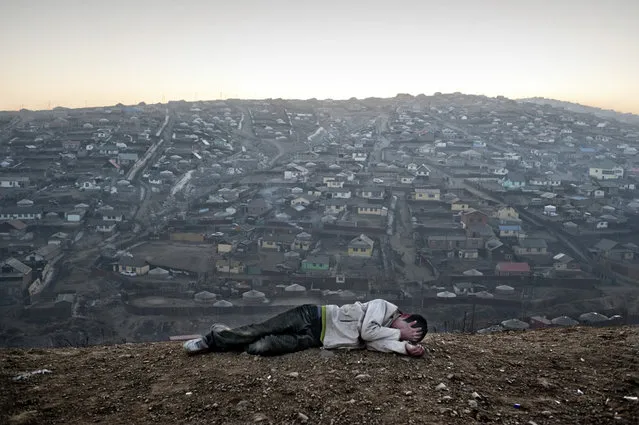
Asia, Mongolia, March 27, 2011. A view of Ulaan Baator over the shoulder of a slumbering drunk. Alcoholism is a huge problem in the city, home to almost half of Mongolia's people. The capital's population has doubled in the past two years, expanding outward in a haphazard sprawl, and many inhabitants live in slums known as the “Gher District”. (Photo by Alessandro Grassani)

“Environmental Migrants: The Last Illusion” by photographer Alessandro Grassani, documents the life of people in Kenya, Mongolia and Bangladesh who migrate to escape environmental stresses to the city of their own countries in hopes for a better life. Here: Asia, Mongolia, March 27, 2011. A view of Ulaan Baator over the shoulder of a slumbering drunk. Alcoholism is a huge problem in the city, home to almost half of Mongolia's people. The capital's population has doubled in the past two years. High levels of unemployment and poverty await herders who abandon rural areas and arrive in the city, illiterate and untrained in any skills necessary for urban jobs. (Photo by Alessandro Grassani)
Details
21 Jul 2015 10:10:00
A general view of Uluru is seen as it rains on November 28, 2013 in Uluru-Kata Tjuta National Park, Australia. Uluru/ Ayers Rock is a large sandstone formation situated in central Australia approximately 335km from Alice Springs. The site and its surrounding area is scared to the Anangu people, the Indigenous people of this area and is visited by over 250,000 people each year.  (Photo by Mark Kolbe/Getty Images)

A general view of Uluru is seen as it rains on November 28, 2013 in Uluru-Kata Tjuta National Park, Australia. Uluru/ Ayers Rock is a large sandstone formation situated in central Australia approximately 335km from Alice Springs. The site and its surrounding area is scared to the Anangu people, the Indigenous people of this area and is visited by over 250,000 people each year. (Photo by Mark Kolbe/Getty Images)
Details
30 Jan 2014 13:27:00
An Iraqi man comforts his 4-year-old son at a regroupment center for POWs of the 101st Airborne Division near An Najaf, Iraq

An Iraqi man comforts his 4-year-old son at a regroupment center for POWs of the 101st Airborne Division near An Najaf, Iraq, March 31, 2003. The man was seized in An Najaf with his son and the U.S. military did not want to separate them. (Photo by Jean-Marc Bouju/Associated Press)
Details
18 Jul 2012 06:22:00
Mongolia's Olympic wrestler Battsetseg Soronzonbold (front) fights with her training partner during a daily training session at the Mongolia Women’s National Wrestling Team training centre in Bayanzurkh district of Ulaanbaatar, Mongolia, July 1, 2016. Battsetseg Soronzonbold became a national hero in her native Mongolia after winning wrestling bronze at the London Olympics and is determined to turn the medal into gold in Rio next month. (Photo by Jason Lee/Reuters)

Mongolia's Olympic wrestler Battsetseg Soronzonbold (front) fights with her training partner during a daily training session at the Mongolia Women’s National Wrestling Team training centre in Bayanzurkh district of Ulaanbaatar, Mongolia, July 1, 2016. Battsetseg Soronzonbold became a national hero in her native Mongolia after winning wrestling bronze at the London Olympics and is determined to turn the medal into gold in Rio next month. (Photo by Jason Lee/Reuters)
Details
07 Jul 2016 11:54:00
Two rescued pangolins sit in a basket during a news conference in Bangkok on June 7, 2012

Two rescued pangolins sit in a basket during a news conference in Bangkok on June 7, 2012. Thai customs rescued 110 pangolins worth about $35,500 that they say were to be sold outside the country as exotic food. The animals, hidden in a pickup truck, were seized at a customs checkpoint in Prachuap Khiri Khan province, south of Bangkok. (Photo by Sakchai Lalit/Associated Press)
Details
09 Jun 2012 12:20:00
Aerial view of the “Viracocha III”, a boat made only from the totora reed, as it is being prepared to cross the Pacific from Chile to Australia on an expected six-month journey, La Paz, Bolivia, October 19, 2016. An expedition in a boat made only of reeds crafted by indigenous Bolivians is getting ready to cross the Pacific from South America to Australia, in a fresh attempt to prove that ancient mariners were capable of making the journey. Phil Buck, a 51-year-old explorer from the United States, already has led two similar expeditions and will captain the “Viracocha III” set to depart from northern Chile in February on an expected six-month journey. (Photo by David Mercado/Reuters)

Aerial view of the “Viracocha III”, a boat made only from the totora reed, as it is being prepared to cross the Pacific from Chile to Australia on an expected six-month journey, La Paz, Bolivia, October 19, 2016. An expedition in a boat made only of reeds crafted by indigenous Bolivians is getting ready to cross the Pacific from South America to Australia, in a fresh attempt to prove that ancient mariners were capable of making the journey. (Photo by David Mercado/Reuters)
Details
20 Oct 2016 10:53:00