Loading...
Done
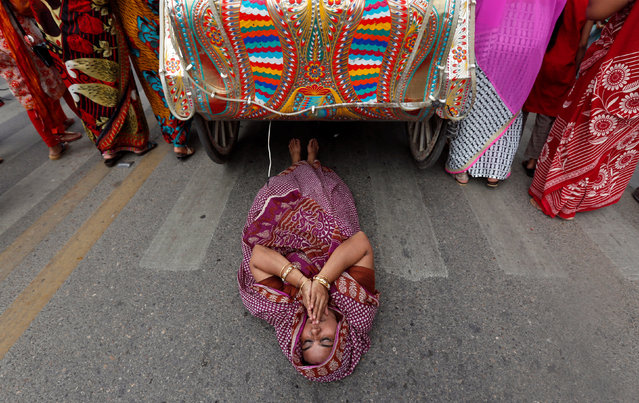
A Hindu devotee lies on a road as the holy “Rath”, or the chariot of lord Jagannath, passed over her during the Rath Yatra, or chariot procession in Karachi, Pakistan, July 17, 2016. Ratha-jatra is derived from two Odia words ratha/rotho meaning “chariot” and jatra meaning “journey”. The festival involves an annual procession (journey) of a deity's idols. Other names for the festival include ratha jatra or chariot festival. (Photo by Akhtar Soomro/Reuters)

A Hindu devotee lies on a road as the holy “Rath”, or the chariot of lord Jagannath, passed over her during the Rath Yatra, or chariot procession in Karachi, Pakistan, July 17, 2016. Ratha-jatra is derived from two Odia words ratha/rotho meaning “chariot” and jatra meaning “journey”. The festival involves an annual procession (journey) of a deity's idols. Other names for the festival include ratha jatra or chariot festival. (Photo by Akhtar Soomro/Reuters)
Details
18 Jul 2016 12:42:00
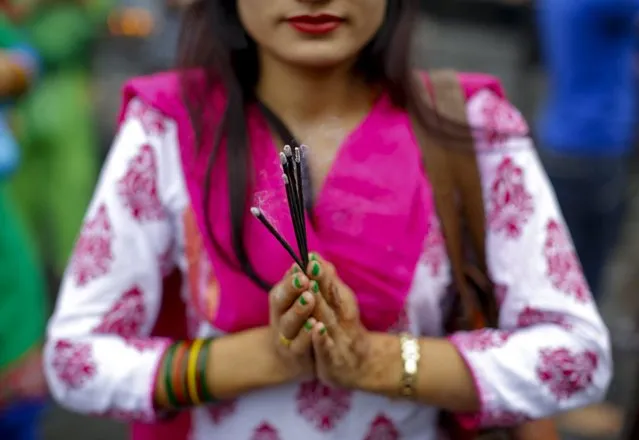
Nepalese Hindu women pray to worship Lord Shiva during the first day of the Sarwan Brata festival, the month of fasting, at the premises of Pashupati Temple in Kathmandu, Nepal, 18 July 2016. Thousands of married and single Nepalese Hindu women will gather in temples for each Monday of the Sawan month (spanning from 16 July to 16 August) to pray for a long and prosperous life of their husbands or for a chance to find a good one. (Photo by Narendra Shrestha/EPA)

Nepalese Hindu women pray to worship Lord Shiva during the first day of the Sarwan Brata festival, the month of fasting, at the premises of Pashupati Temple in Kathmandu, Nepal, 18 July 2016. Thousands of married and single Nepalese Hindu women will gather in temples for each Monday of the Sawan month (spanning from 16 July to 16 August) to pray for a long and prosperous life of their husbands or for a chance to find a good one. (Photo by Narendra Shrestha/EPA)
Details
19 Jul 2016 12:59:00
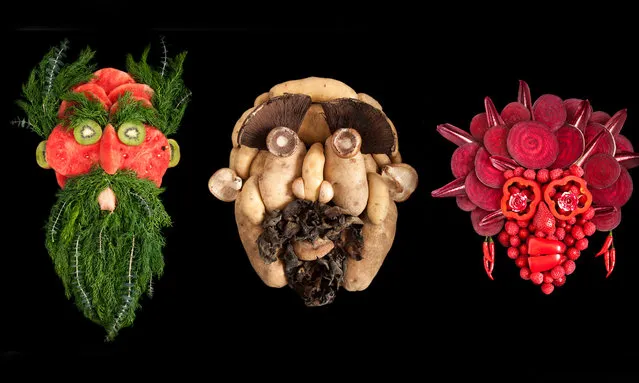
Photographer Emily Dryden and sculptor/actor Zahydé Pietri combine theatricality and organic produce to compose the photographs for their series Fresh Faces. The portraits are made from a wide range of fruit and vegetables and aim to highlight humanity’s diversity – Pietri is from Puerto Rico and Dryden is from New York. Each face has its own name and identity: “We have stories for them, which you can see in the expressions”, says Dryden, “but we decided to keep them to ourselves. We didn’t want to spoil that”. (Photo by Emily Dryden and Zahydé Pietri/The Guardian)

Photographer Emily Dryden and sculptor/actor Zahydé Pietri combine theatricality and organic produce to compose the photographs for their series Fresh Faces. The portraits are made from a wide range of fruit and vegetables and aim to highlight humanity’s diversity – Pietri is from Puerto Rico and Dryden is from New York. Each face has its own name and identity: “We have stories for them, which you can see in the expressions”, says Dryden, “but we decided to keep them to ourselves. We didn’t want to spoil that”. (Photo by Emily Dryden and Zahydé Pietri/The Guardian)
Details
25 Jul 2016 11:08:00
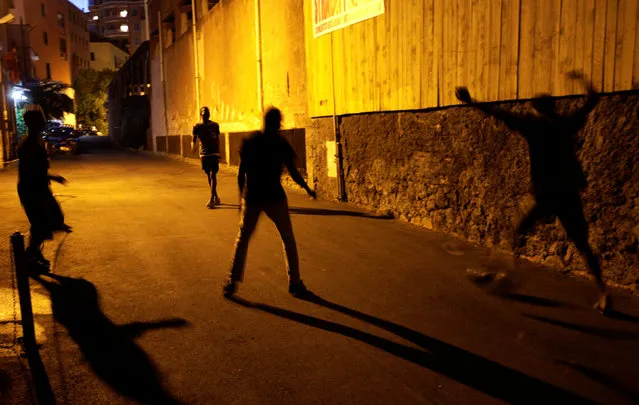
Migrants play soccer at makeshift camp in Via Cupa (Gloomy Street) in downtown Rome, Italy, August 2, 2016. Italy is taking in thousands of boat migrants every week for a third year in a row, and friction is common between them and those who live along the path many take on their journey towards northern Europe. Set up by volunteers, the Baobab centre, by Rome's Tiburtina train station, was shut down by police in December in the wake of the Paris attacks and because the European Union wants Italy to stop migrants from moving on, not help them to do so. B(Photo by Max Rossi/Reuters)

Migrants play soccer at makeshift camp in Via Cupa (Gloomy Street) in downtown Rome, Italy, August 2, 2016. Italy is taking in thousands of boat migrants every week for a third year in a row, and friction is common between them and those who live along the path many take on their journey towards northern Europe. (Photo by Max Rossi/Reuters)
Details
11 Aug 2016 14:31:00
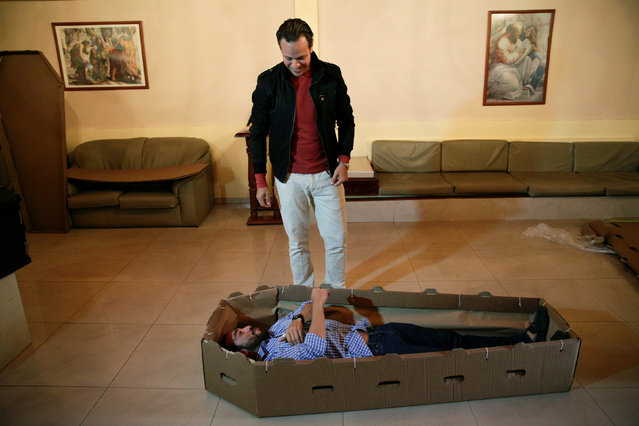
Elio Angulo (bottom C) lies inside a cardboard coffin next to Alejandro Blanchard as they introduce their product to potential customers at a mortuary in Valencia, in the state of Carabobo, Venezuela August 25, 2016. (Photo by Marco Bello/Reuters)

Elio Angulo (bottom C) lies inside a cardboard coffin next to Alejandro Blanchard as they introduce their product to potential customers at a mortuary in Valencia, in the state of Carabobo, Venezuela August 25, 2016. When Venezuelan entrepreneurs Alejandro Blanchard and Elio Angulo decided to create cardboard coffins, they were looking for an ecological selling point to compete against classic wood and brass caskets. Three years on, with the oil-rich country mired in deep economic crisis, their “bio-coffins” are becoming a viable option because of high prices for wooden coffins and shortages of brass ones. (Photo by Marco Bello/Reuters)
Details
27 Aug 2016 11:18:00
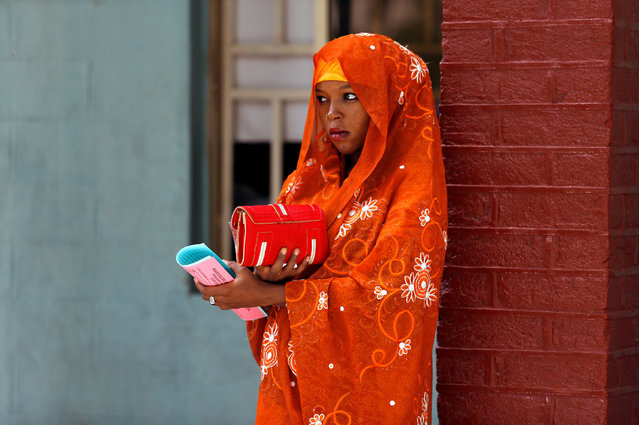
A woman waits at a polio immunisation health centre, in Maiduguri, Borno State, Nigeria, August 29, 2016. Nigeria's military has liberated large swathes of land from Boko Haram but a ride with an army convoy, all guns firing for fear of ambush, shows how far the northeast is from normality after a brutal Islamist insurgency that has displaced millions. The moment military convoys leave the relative safety of Bama, Borno state's second town, soldiers in the lead vehicle open fire with a heavy cannon into the scrub along the road to pre-empt attacks by remaining fighters from the Islamist group. (Photo by Afolabi Sotunde/Reuters)

A woman waits at a polio immunisation health centre, in Maiduguri, Borno State, Nigeria, August 29, 2016. Nigeria's military has liberated large swathes of land from Boko Haram but a ride with an army convoy, all guns firing for fear of ambush, shows how far the northeast is from normality after a brutal Islamist insurgency that has displaced millions. (Photo by Afolabi Sotunde/Reuters)
Details
08 Sep 2016 09:45:00
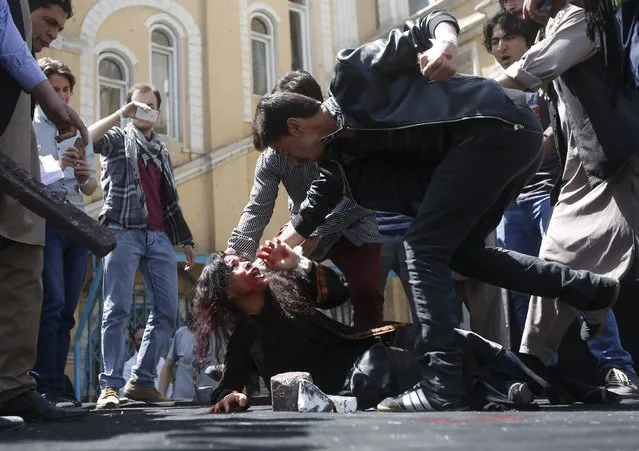
Afghan artists perform a re-enactment of the lynching of Farkhunda, a 27-year old woman, to protest against her killing in Kabul, April 27, 2015. (Photo by Omar Sobhani/Reuters)

Afghan artists perform a re-enactment of the lynching of Farkhunda, a 27-year old woman, to protest against her killing in Kabul, April 27, 2015. Farkhunda, who was killed by an angry mob in front of police in the Afghan capital in March for allegedly burning a copy of Islam's holy book was wrongly accused, Afghanistan's top criminal investigator said on March 22. The killing has fuelled anger about the weak rule of law and corruption that is crippling the country's instutitions. (Photo by Omar Sobhani/Reuters)
Details
28 Apr 2015 13:39:00
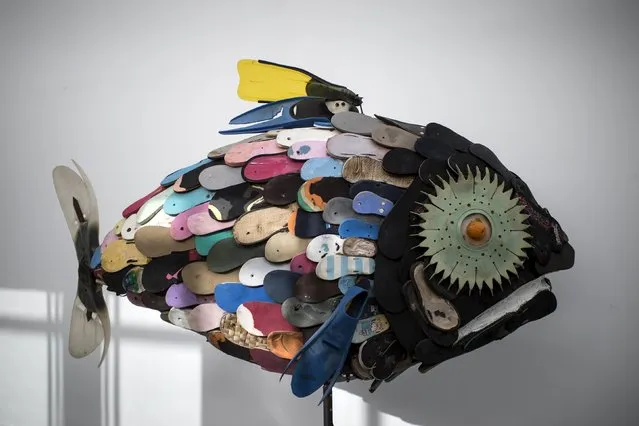
A sculpture of a fish made from waste products collected from the sea is displayed during the exhibition Keep The Oceans Clean by art collective Skeleton Sea, at the Torre Madariaga Biodiversity Centre in Busturia, Spain, May 17, 2015. (Photo by Vincent West/Reuters)

A sculpture of a fish made from waste products collected from the sea is displayed during the exhibition Keep The Oceans Clean by art collective Skeleton Sea, at the Torre Madariaga Biodiversity Centre in Busturia, Spain, May 17, 2015. Skeleton Sea, a group of surfers and artists, recycle waste collected from the world's oceans to create artworks and draw attention to the dangers faced from overfishing, pollution and oil spills. (Photo by Vincent West/Reuters)
Details
19 May 2015 11:16:00