Loading...
Done
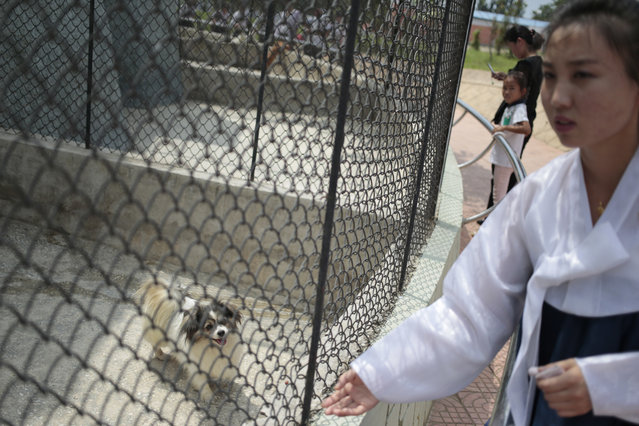
A dog is kept at a pen at the newly opened Central Zoo in Pyongyang, North Korea, Tuesday, August 23, 2016. One of the most popular attractions at the zoo might come as a surprise to foreign visitors. Just across the way from the hippopotamus pen and the reptile house, dozens of varieties of dogs, including schnauzers, German shepherds, Shih Tzus and Saint Bernards – are on display in the “dog pavilion”. (Photo by Dita Alangkara/AP Photo)

A dog is kept at a pen at the newly opened Central Zoo in Pyongyang, North Korea, Tuesday, August 23, 2016. One of the most popular attractions at the zoo might come as a surprise to foreign visitors. Just across the way from the hippopotamus pen and the reptile house, dozens of varieties of dogs, including schnauzers, German shepherds, Shih Tzus and Saint Bernards – are on display in the “dog pavilion”. (Photo by Dita Alangkara/AP Photo)
Details
24 Aug 2016 11:48:00
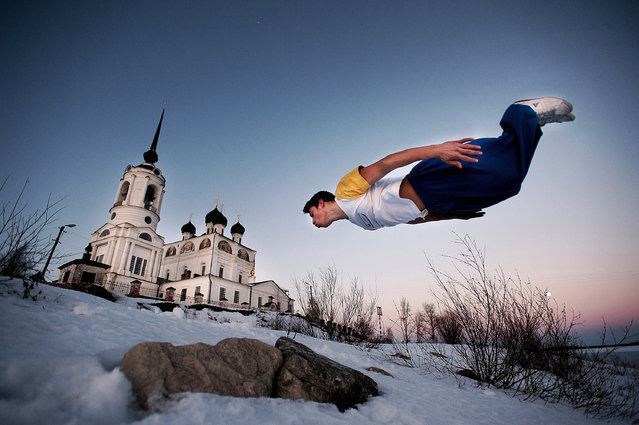
Anton Unitsyn, Russia. Shortlist, Professional , Daily Life. Parkour jumpers on their daily training. On the background – one of the main Solvychegodsk sights – Blagoveshchensky Cathedral. This church is among 3 churches, that survived soviet times. At the begining of 20th century there were 13 churches in Solvichegodsk. After breakdown of the communism, Solvichegodsk as many small towns in russia is stuck in it's past. Despite everything, people in Solvichegodsk still belive in their positive future, and wait for wind of change. (Photo by Anton Unitsyn/Sony World Photography Awards)

Anton Unitsyn, Russia. Shortlist, Professional , Daily Life. Parkour jumpers on their daily training. On the background – one of the main Solvychegodsk sights – Blagoveshchensky Cathedral. This church is among 3 churches, that survived soviet times. At the begining of 20th century there were 13 churches in Solvichegodsk. After breakdown of the communism, Solvichegodsk as many small towns in russia is stuck in it's past. Despite everything, people in Solvichegodsk still belive in their positive future, and wait for wind of change. (Photo by Anton Unitsyn/Sony World Photography Awards)
Details
25 Feb 2016 12:16:00
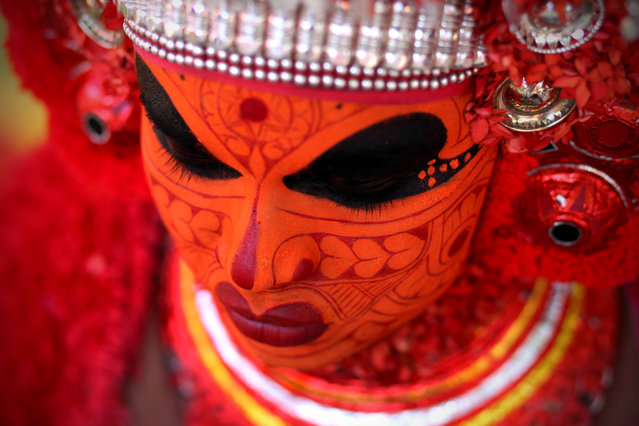
“Theyyam”. Preparation for the Theyyam performance in the surroundings of Kasaragod city. Theyyam is a popular ritual dance form of North Kerala, particularly in Kannur and Kasargod districts. The Theyyam represents a mythological, divine or heroic character. Make up of Theyyams is done by specialist. There are different types of face painting for which primarily and secondary colours are used. Photo location:  Kasaragod, India. (Photo and caption by Rafal Ziejewski/National Geographic Photo Contest)

“Theyyam”. Preparation for the Theyyam performance in the surroundings of Kasaragod city. Theyyam is a popular ritual dance form of North Kerala, particularly in Kannur and Kasargod districts. The Theyyam represents a mythological, divine or heroic character. Make up of Theyyams is done by specialist. There are different types of face painting for which primarily and secondary colours are used. Therefore it is essential that the makeup man should have perfect knowledge of primary and secondary colour combinations. Sometimes, it takes several hours to paint each face. Photo location: Kasaragod, India. (Photo and caption by Rafal Ziejewski/National Geographic Photo Contest)
Details
02 Jul 2014 10:42:00
In this handout photo provided by Warner Brothers Pictures and Village Roadshow Pictures, Tom Cruise plays Lieutenant Colonel Bill Cage, a soldier who replays his last day while trying to fight aliens, in director Doug Liman's “All You Need Is Kill”. The film is set to premiere on March 14, 2014. (Photo by David James/Warner Brothers Pictures)

In this handout photo provided by Warner Brothers Pictures and Village Roadshow Pictures, Tom Cruise plays Lieutenant Colonel Bill Cage, a soldier who replays his last day while trying to fight aliens, in director Doug Liman's “All You Need Is Kill”. The film is set to premiere on March 14, 2014. (Photo by David James/Warner Brothers Pictures)
Details
26 Nov 2012 13:14:00
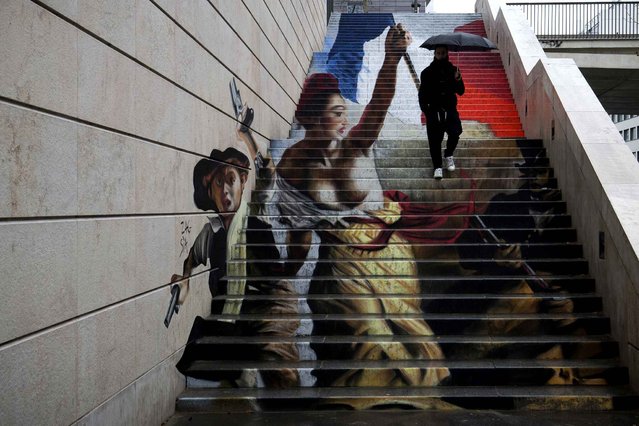
A man passes by an unfinished street art graffiti made in a stairway by French street artists Zag and Sia in Paris on March 1, 2016. The two artists drew inspiration from famous “Liberty Leading the People” (La Liberte guidant le peuple) painting by French Eugene Delacroix commemorating the July Revolution of 1830 and viewed as a symbol of the French Republic. (Photo by Joel Saget/AFP Photo)

A man passes by an unfinished street art graffiti made in a stairway by French street artists Zag and Sia in Paris on March 1, 2016. The two artists drew inspiration from famous “Liberty Leading the People” (La Liberte guidant le peuple) painting by French Eugene Delacroix commemorating the July Revolution of 1830 and viewed as a symbol of the French Republic. (Photo by Joel Saget/AFP Photo)
Details
04 Mar 2016 12:31:00
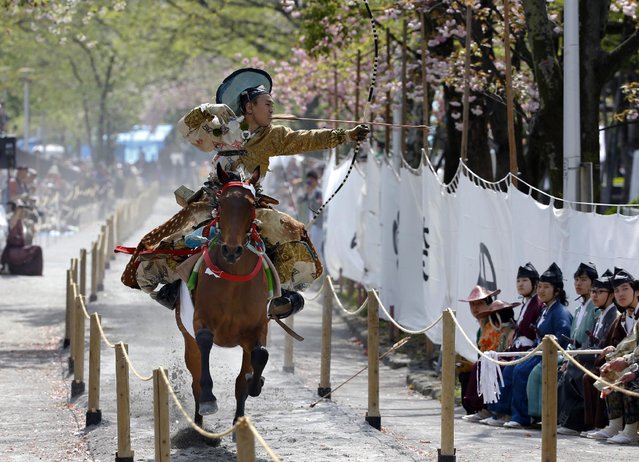
An archer in a samurai warrior costume aims at a target in the Asakusa Yabusame horseback archery event at Sumida Park in Tokyo, Saturday, April 18, 2015. (Photo by Shizuo Kambayashi/AP Photo)

An archer in a samurai warrior costume aims at a target in the Asakusa Yabusame horseback archery event at Sumida Park in Tokyo, Saturday, April 18, 2015. (Photo by Shizuo Kambayashi/AP Photo)
Details
25 Apr 2015 10:17:00
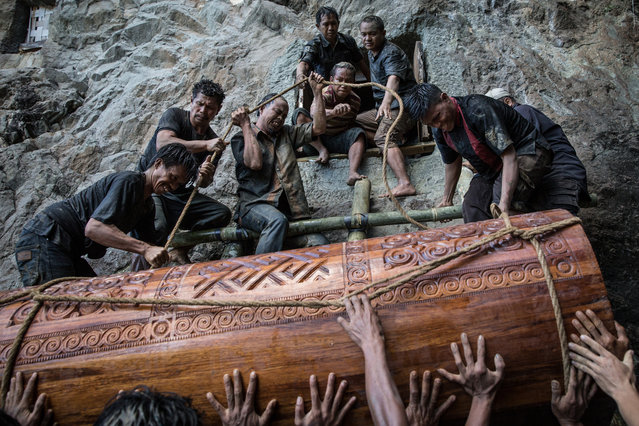
It is said that Torajans are people who “live to die”. For this Indonesian ethnic group, funerals are such extravagant events that they sometimes attract tourists. Families can postpone burials years (and the deceased are considered sick and hosted at home until the funeral) until the family can raise enough money and gather as many relatives as possible. And then it’s a jubilant multiday social event with a parade, dances and animal sacrifices. Agung Parameswara photographed these funerary practices when he traveled to South Sulawesi province, where the Torajans live. But often, their funeral isn’t the last time the dead are seen. In August, crypts are opened, coffins are slid back out and bodies delicately unsheathed. This tender ritual is known as Ma’Nene, which is customarily performed every few years. (Photo by Agung Parameswara/The Washington Post)

It is said that Torajans are people who “live to die”. For this Indonesian ethnic group, funerals are such extravagant events that they sometimes attract tourists. Families can postpone burials years (and the deceased are considered sick and hosted at home until the funeral) until the family can raise enough money and gather as many relatives as possible. And then it’s a jubilant multiday social event with a parade, dances and animal sacrifices. Agung Parameswara photographed these funerary practices when he traveled to South Sulawesi province, where the Torajans live. (Photo by Agung Parameswara/The Washington Post)
Details
06 Oct 2016 09:15:00
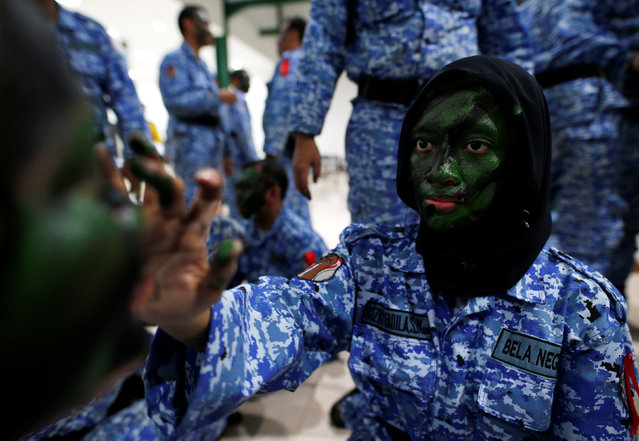
A female participant of the Bela Negara – “defend the nation” – programme applies camouflage face paint on another participant's face at a training centre in Rumpin, Bogor, West Java, Indonesia June 2, 2016. (Photo by Darren Whiteside/Reuters)

A female participant of the Bela Negara – “defend the nation” – programme applies camouflage face paint on another participant's face at a training centre in Rumpin, Bogor, West Java, Indonesia June 2, 2016. (Photo by Darren Whiteside/Reuters)
Details
08 Jun 2016 10:26:00