Loading...
Done
Thor Heyerdahl with a model of the balsa raft Kon Tiki

“Thor Heyerdahl (October 6, 1914, Larvik, Norway – April 18, 2002, Colla Micheri, Italy) was a Norwegian ethnographer and adventurer with a background in zoology and geography. He became notable for his Kon-Tiki expedition, in which he sailed 8,000 km (4,300 miles) by raft from South America to the Tuamotu Islands. All his expeditions are shown in the Kon-Tiki Museum, Oslo”. – Wikipedia

Photo: Norwegian anthropologist Thor Heyerdahl with a model of the balsa raft “Kon-Tiki” on which he drifted 4,300 miles from Peru to the Tuamotu Islands, proving his theory that Polynesia could originally have been populated by South Americans. (Photo by Express/Express/Getty Images). 1950
Details
09 Aug 2011 11:05:00


“The Red River Hog (Potamochoerus porcus), also known as the Bush Pig (but not to be confused with P. larvatus, common name “Bushpig”), is a wild member of the pig family living in Africa, with most of its distribution in the Guinean and Congolian forests. It is rarely seen away from rainforests, and generally prefers areas near rivers or swamps.

Red River Hogs eat grass, berries, roots, insects, molluscs, small vertebrates and carrion. They are capable of causing damage to plantations. Red River Hogs typically live in herds of 6-20 members led by a dominant boar. Sows rear 3-6 piglets at a time.”

Photo: Two 17 day old red river hoglet twins forage for food next to their mother Bahiti at London Zoo on August 23, 2007 in London, England. Red River hoglets inhabit the forests and swamps of West and Central Africa. The recent additions to the London Zoo pig pen have been eagerly awaited by zoo keepers. (Photo by Chris Jackson/Getty Images)
Details
18 Mar 2011 15:15:00


“The Ainu (アイヌ?), also called Aynu, Aino (アイノ), and in historical texts Ezo (蝦夷), are indigenous people or groups in Japan and Russia. Historically they spoke the Ainu language and related varieties and lived in Hokkaidō, the Kuril Islands, and much of Sakhalin. Most of those who identify themselves as Ainu still live in this same region, though the exact number of living Ainu is unknown. This is due to ethnic issues in Japan resulting in those with Ainu backgrounds hiding their identities and confusion over mixed heritages. In Japan, because of intermarriage over many years with Japanese, the concept of a 'pure Ainu' ethnic group is no longer feasible. Official estimates of the population are of around 25,000, while the unofficial number is upwards of 200,000 people”. – Wkipedia

Photo: A captive bear drinking from a large bottle held by an Ainu tribeswoman. (Photo by Evans/Three Lions/Getty Images). Circa 1955
Details
24 Mar 2011 14:01:00


“The red panda (Ailurus fulgens, or shining-cat), is a small arboreal mammal native to the eastern Himalayas and southwestern China. It is the only species of the genus Ailurus. Slightly larger than a domestic cat, it has reddish-brown fur, a long, shaggy tail, and a waddling gait due to its shorter front legs. It feeds mainly on bamboo, but is omnivorous and may also eat eggs, birds, insects, and small mammals. It is a solitary animal, mainly active from dusk to dawn, and is largely sedentary during the day”. – Wikipedia

Photo: In this handout image provided by Taronga Zoo, Seba, a baby Red Panda, explores his new home at Taronga Zoo on April 7, 2011 in Sydney, Australia. The Red Panda cub was born at Christmas and is the 45th to be born at the zoo since 1977. (Photo by Peter Hardin/Taronga Zoo via Getty Images)
Details
07 Apr 2011 08:51:00
Residents, covered with mud and dried banana leaves, ask for money and candles from police before attending a mass celebrating the feast day of the Catholic patron Saint John the Baptist in the village of Bibiclat, Nueva Ecija, north of Manila, June 24, 2013. Hundreds of devotees took part in this annual religious tradition, which has been held in the village since 1945. (Photo by Cheryl Ravelo/Reuters)

Residents, covered with mud and dried banana leaves, ask for money and candles from police before attending a mass celebrating the feast day of the Catholic patron Saint John the Baptist in the village of Bibiclat, Nueva Ecija, north of Manila, June 24, 2013. Hundreds of devotees took part in this annual religious tradition, which has been held in the village since 1945. (Photo by Cheryl Ravelo/Reuters)
Details
26 Jun 2013 04:51:00
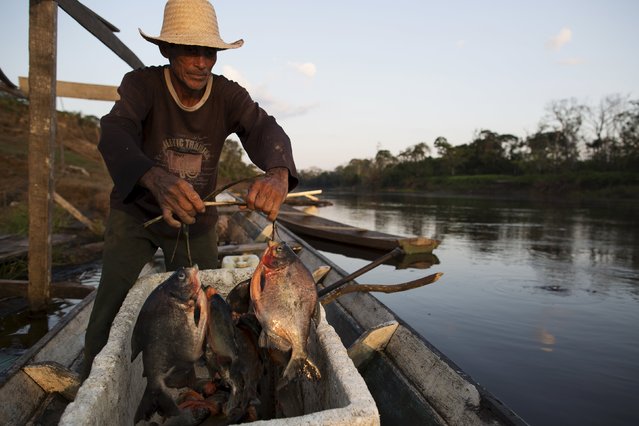
Villagers from the Medio Jurua nature reserve of Brazil's Amazon rainforest arrive with their catch of pirarucus, the largest freshwater fish in South America, after a night of fishing in Manaria Lake, Carauari municipality, September 3, 2012. Catching the pirarucu, a fish that is sought after for its meat and is considered by biologists to be a living fossil, is only allowed once a year by Brazil's environmental protection agency. (Photo by Bruno Kelly/Reuters)

Villagers from the Medio Jurua nature reserve of Brazil's Amazon rainforest arrive with their catch of pirarucus, the largest freshwater fish in South America, after a night of fishing in Manaria Lake, Carauari municipality, September 3, 2012. Catching the pirarucu, a fish that is sought after for its meat and is considered by biologists to be a living fossil, is only allowed once a year by Brazil's environmental protection agency. (Photo by Bruno Kelly/Reuters)
Details
19 Jul 2013 08:53:00
Pope Francis greets the crowd from his popemobile in downtown Rio de Janeiro. Pope Francis touched down in Rio de Janeiro on Monday, starting his first foreign trip as pontiff and a weeklong series of events expected to attract more than a million people to a gathering of young faithful in Brazil, home to the world's largest Roman Catholic population. (Photo by Ueslei Marcelino/Reuters)

Pope Francis greets the crowd from his popemobile in downtown Rio de Janeiro. Pope Francis touched down in Rio de Janeiro on Monday, starting his first foreign trip as pontiff and a weeklong series of events expected to attract more than a million people to a gathering of young faithful in Brazil, home to the world's largest Roman Catholic population. (Photo by Ueslei Marcelino/Reuters)
Details
28 Jul 2013 08:49:00
Tourists play at a beach covered by a thick layer of green algae in Qingdao, China, on July 3, 2013. A large quantity of non-poisonous green seaweed, enteromorpha prolifera, hit China's Qingdao coast last month. More than 20,000 tons of such seaweed has been removed from the city's beaches. This has now become an annual summer event. (Photo by Whitehotpix/ZumaPress.com)

Tourists play at a beach covered by a thick layer of green algae in Qingdao, China, on July 3, 2013. A large quantity of non-poisonous green seaweed, enteromorpha prolifera, hit China's Qingdao coast last month. More than 20,000 tons of such seaweed has been removed from the city's beaches. This has now become an annual summer event. (Photo by Whitehotpix/ZumaPress.com)
Details
04 Aug 2013 09:19:00