Cyclists compete during the UCI BMX World Championships Elite Women's Moto Race on May 29, 2016 in Medellin, Antioquia department, Colombia. (Photo by Raul Arboleda/AFP Photo)
A doll, placed by stranded Iranian migrant protesters, hangs from barbed wire in front of Madedonian police at the Greek-Macedonian border near to the Greek village of Idomeni November 29, 2015. The protesters were demonstrating against what they say is the closure of the border for Iranian migrants. According to the demonstrators, the hanging toys and dolls represent the outcome of being unable to return, if they are sent back to Iran. (Photo by Yannis Behrakis/Reuters)
French President Emmanuel Macron performs at the Shrine Africa in Lagos on July 3, 2018. French President Emmanuel Macron has arrived in Abuja for a meeting with his Nigerian counterpart Muhammadu Buhari, in his latest attempt to forge closer ties with English- speaking Africa. (Photo by Ludovic Marin/AFP Photo)
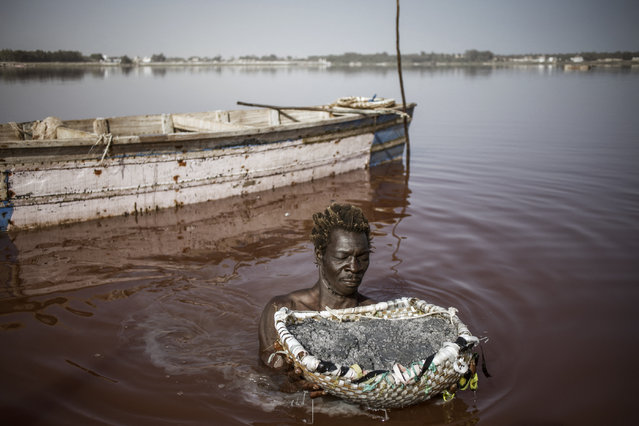
Toure, a Gambian salt harvester, holds a basket filled with the salt collected from the crust of the bottom of the Lake Retba (Pink Lake) in Senegal on March 16, 2021. Lake Retba, divided from the Atlantic Ocean by a narrow corridor of dunes, owes its name to the pink waters caused by the Dunaliella salina algae and is known for its high salt content, up to 40% in some areas. (Photo by Marco Longari/AFP Photo)
A motorcyclist carries three young woman as he performs a wheelie on his motorbike during an exhibition in the Chapellin neighborhood of Caracas, Venezuela, Sunday, June 12, 2022. (Photo by Matias Delacroix/AP Photo)
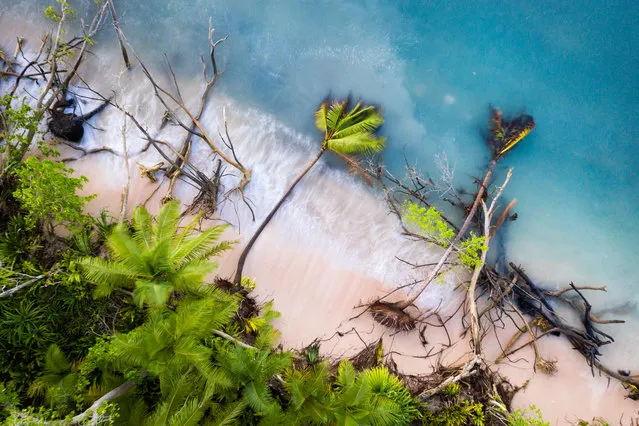
Tuvalu Beneath the Rising Tide by Sean Gallagher, Tuvalu. Changing environments prize: Fallen trees lie on a beach as the waves from the Funafuti lagoon in Tuvalu lap around them. Land erosion has always been a problem for the South Pacific country but problems are intensifying as sea levels rise. Rising seas are on the verge of completely submerging the tiny archipelago’s islands. (Photo by Sean Gallagher/CIWEM Environmental Photographer of the Year 2019)
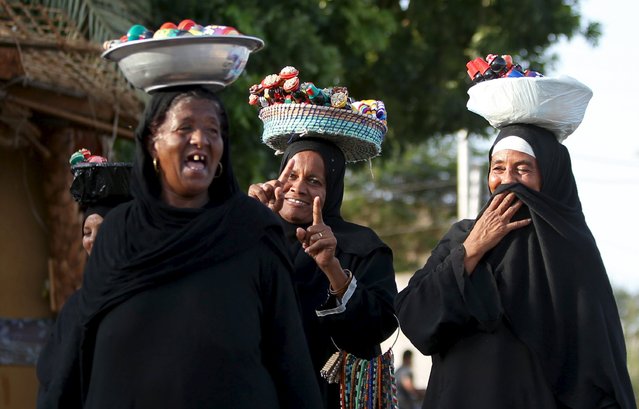
Nubian women sell traditional handicrafts at the Nubian Gharb Suheil village, near Aswan south of Egypt, October 1, 2015. For half a century, Egypt's Nubians have patiently lobbied the government in Cairo for a return to their homelands on the banks of the upper Nile, desperate to reclaim territory their ancestors first cultivated 3,000 years ago. (Photo by Mohamed Abd El Ghany/Reuters)