Loading...
Done
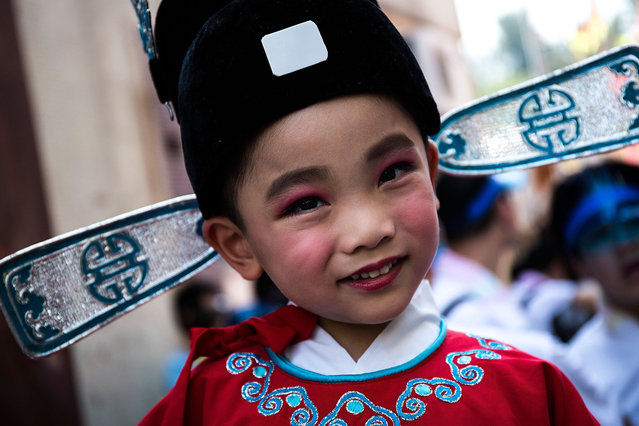
Behind The Scenes At The Chinese Opera In Thailand

Wanwisa, a Lao Yi Lai Heng Chinese opera performer waits backstage at the Plub Plachai temple on January 25, 2012 in Bangkok, Thailand. The traditional Chinese art form involving music, singing, martial arts and acting has a history of more than 500 years. There are about 30 members working with the group doing specials shows all week to celebrate the Chinese New year. The Chinese opera is popular in many parts of China, Malaysia, Singapore, Thailand and Macau. (Photo by Paula Bronstein/Getty Images)
Details
28 Jan 2012 12:14:00
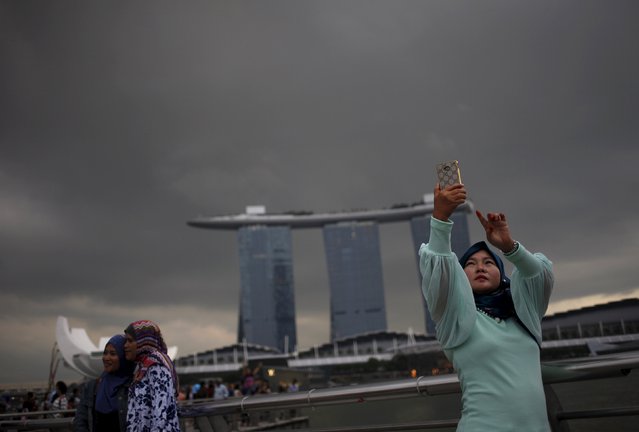
Indonesian tourists take photos at the Marina Bay in Singapore May 14, 2015. (Photo by Edgar Su/Reuters)

Indonesian tourists take photos at the Marina Bay in Singapore May 14, 2015. When Singapore celebrated its 50th birthday as an independent country in August,the city state bore little resemblance to the tiny island nation that was expelled from Malaysia in 1965. Its physical stature has swollen by 20 percent thanks to one of the world's most aggressive land reclamation drives. (Photo by Edgar Su/Reuters)
Details
21 Nov 2015 08:02:00
A devotee gest pierced at the Bang Neow shrine in Phuket. (Photo by Paula Bronstein/Getty Images)

“The Nine Emperor Gods Festival is a nine-day Taoist celebration beginning on the eve of 9th lunar month of the Chinese calendar, which is observed primarily in Southeast Asian countries like Myanmar, Singapore, Malaysia, Thailand and also the Riau Islands. In Thailand, this festival is called Tesagan Gin Je, the Vegetarian Festival. It is celebrated throughout the entire country, but the festivities are at their height in Phuket, where about 35% of the population is Chinese. It attracts crowds of spectators because of many of the unusual religious rituals that are performed”. – Wikipedia. Photo: A devotee gest pierced at the Bang Neow shrine in Phuket. (Photo by Paula Bronstein)
Details
11 Oct 2013 07:49:00
Cave Diver, Anhumas Abyss, Bonito, Brazil: The Anhumas Abyss is an underground cavern with a crystal-clear lake below, more than 260 feet (79 m) deep. A visitor must enter through a narrow opening at the top of the chamber and rappel into the cave. Snorkeling and scuba diving in the lake reveal amazing scenery. Distinctive, conical limestone stalagmites and stalactites occupy the lake and the surrounding area, some reaching 65 feet (20 m) high. “One must rappel about 235 feet (72 m) to get down into this deep lake. The photo was taken at a depth of 50 feet (15 m). It was a challenge to create the image because of the high contrast, plus the diver could not see into the darkness, making communication impossible”. (Photo by Marcio Cabral/Nature’s Best Photography Awards 2017)

Cave Diver, Anhumas Abyss, Bonito, Brazil: The Anhumas Abyss is an underground cavern with a crystal-clear lake below, more than 260 feet (79 m) deep. A visitor must enter through a narrow opening at the top of the chamber and rappel into the cave. Snorkeling and scuba diving in the lake reveal amazing scenery. Distinctive, conical limestone stalagmites and stalactites occupy the lake and the surrounding area, some reaching 65 feet (20 m) high. (Photo by Marcio Cabral/Nature’s Best Photography Awards 2017)
Details
26 Oct 2017 08:10:00
A Syrian rebel walks past Sham 2, a homemade armored vehicle, in Bishqatin, Syria, on December 8, 2012. From a distance it looks rather like a big rusty metal box but closer inspection reveals a homemade armored vehicle waiting to be deployed. Sham II, named after ancient Syria, is built from the chassis of a car and touted by rebels as “100 percent made in Syria”. (Photo by Herve Bar/AFP Photo)

A Syrian rebel walks past Sham 2, a homemade armored vehicle, in Bishqatin, Syria, on December 8, 2012. From a distance it looks rather like a big rusty metal box but closer inspection reveals a homemade armored vehicle waiting to be deployed. Sham II, named after ancient Syria, is built from the chassis of a car and touted by rebels as “100 percent made in Syria”. (Photo by Herve Bar/AFP Photo)
Details
03 Sep 2013 09:30:00
Master Sergey Suprun uses a portable radio set as he stands near a rotary dredge which works on the coal face of the Borodinsky opencast colliery, near the Siberian town of Borodino, east of Krasnoyarsk, Russia October 27, 2015. The Borodinsky colliery, 9 km (5.6 miles) long and more than 100 meters (328 feet) deep, annually produces more than 20 million tons of coal and is considered to be the biggest opencast coal mine in Russia, according to official representatives. (Photo by Ilya Naymushin/Reuters)

Master Sergey Suprun uses a portable radio set as he stands near a rotary dredge which works on the coal face of the Borodinsky opencast colliery, near the Siberian town of Borodino, east of Krasnoyarsk, Russia October 27, 2015. The Borodinsky colliery, 9 km (5.6 miles) long and more than 100 meters (328 feet) deep, annually produces more than 20 million tons of coal and is considered to be the biggest opencast coal mine in Russia, according to official representatives. (Photo by Ilya Naymushin/Reuters)
Details
31 Oct 2015 08:01:00
A bomb squad member wearing heavy equipment leaves the explosion site at the Yasukuni shrine precints in Tokyo, Japan, 23 November 2015. More than 100 police, firefighters and officials gathered at the site after an explosion was heard in the toilets of the Yasukuni Shrine, a controversial war shrine in the capital Tokyo. Local media reports said police found possible traces of an explosion, as well as batteries and wires at the shrine. There were no reports of injuries. (Photo by Franck Robichon/EPA)

A bomb squad member wearing heavy equipment leaves the explosion site at the Yasukuni shrine precints in Tokyo, Japan, 23 November 2015. More than 100 police, firefighters and officials gathered at the site after an explosion was heard in the toilets of the Yasukuni Shrine, a controversial war shrine in the capital Tokyo. Local media reports said police found possible traces of an explosion, as well as batteries and wires at the shrine. There were no reports of injuries. (Photo by Franck Robichon/EPA)
Details
25 Nov 2015 08:01:00
Two pins featuring former North Korean leader Kim Il Sung wearing different facial expressions are displayed in a glass case of Thomas Hui at his apartment in Hong Kong, China April 11, 2016. Collector Thomas Hui, 37, a former bank employee in Hong Kong, who is fascinated by North Korean pins and badges, has gathered over 100 featuring former leaders Kim Il Sung and Kim Jong Il, and has been buying and trading these Communist accessories since 2008. (Photo by Bobby Yip/Reuters)

Two pins featuring former North Korean leader Kim Il Sung wearing different facial expressions are displayed in a glass case of Thomas Hui at his apartment in Hong Kong, China April 11, 2016. Collector Thomas Hui, 37, a former bank employee in Hong Kong, who is fascinated by North Korean pins and badges, has gathered over 100 featuring former leaders Kim Il Sung and Kim Jong Il, and has been buying and trading these Communist accessories since 2008. (Photo by Bobby Yip/Reuters)
Details
13 Apr 2016 09:25:00