Loading...
Done
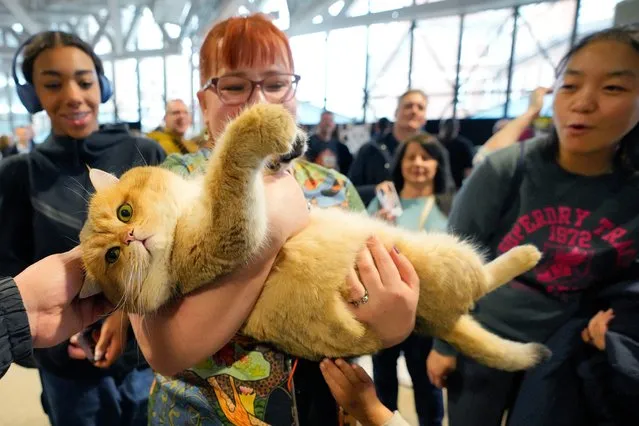
A black golden shaded British Shorthair cat is admired by visitors as he is carried at the Cat Extravaganza event at Olympia in London, Sunday, February 18, 2024. Loving Cats Worldwide brought its Cat Extravaganza and Rescue Awareness Event to London, where visitors could learn all about this intelligent species by observing the show's five judging rings. Plus, meet with local rescues and charities, as well as hear educational anecdotes about different cat breeds. (Photo by Kirsty Wigglesworth/AP Photo)

A black golden shaded British Shorthair cat is admired by visitors as he is carried at the Cat Extravaganza event at Olympia in London, Sunday, February 18, 2024. Loving Cats Worldwide brought its Cat Extravaganza and Rescue Awareness Event to London, where visitors could learn all about this intelligent species by observing the show's five judging rings. Plus, meet with local rescues and charities, as well as hear educational anecdotes about different cat breeds. (Photo by Kirsty Wigglesworth/AP Photo)
Details
25 Feb 2024 06:44:00
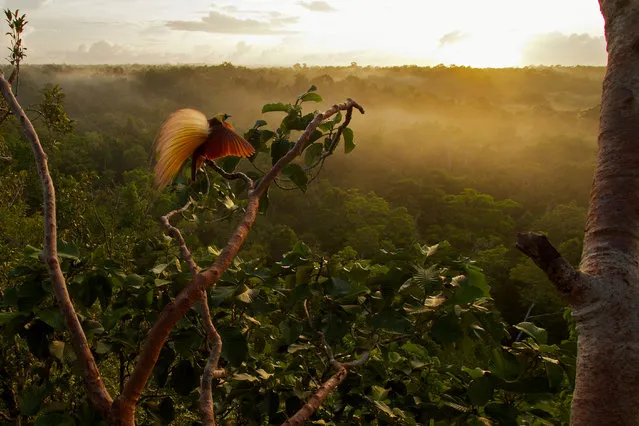
A greater bird of paradise (Paradisaea apoda) displaying in Badigaki Forest, Wokam Island (Aru Islands, Indonesia). Found here in Aru and on adjacent New Guinea, the greater bird of paradise represents about 40 different species of birds of paradise that depend on intact rainforest across the New Guinea region spanning eastern Indonesia and Papua New Guinea. With more than 80% of forest cover still intact, this region represents the largest remaining block of rainforest in the entire Asia-Pacific. (Photo by Tim Laman/naturepl.com/LDY Agency)

A greater bird of paradise (Paradisaea apoda) displaying in Badigaki Forest, Wokam Island (Aru Islands, Indonesia). Found here in Aru and on adjacent New Guinea, the greater bird of paradise represents about 40 different species of birds of paradise that depend on intact rainforest across the New Guinea region spanning eastern Indonesia and Papua New Guinea. With more than 80% of forest cover still intact, this region represents the largest remaining block of rainforest in the entire Asia-Pacific. (Photo by Tim Laman/naturepl.com/LDY Agency)
Details
14 Nov 2021 05:57:00
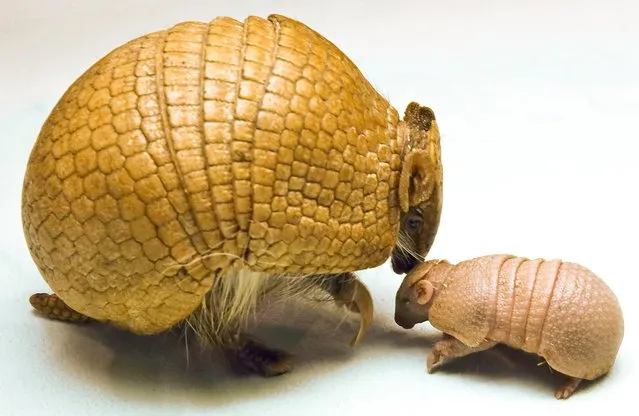
In this Sunday, April 27, 2014 handout photo provided by Busch Gardens Tampa, mother armadillo Zowie, left, welcomes her newborn Southern three-banded armadillo baby at the Animal Ambassador Team, in Tampa, Fla. The baby was able to walk and roll into a ball within moments of its birth. Southern three-banded armadillos are the only species of armadillo that can fully roll up into a ball. The baby armadillo currently weighs 118 grams, which is about the weight equivalent to an average cell phone. (Photo by AP Photo/Busch Gardens Tampa)

In this Sunday, April 27, 2014 handout photo provided by Busch Gardens Tampa, mother armadillo Zowie, left, welcomes her newborn Southern three-banded armadillo baby at the Animal Ambassador Team, in Tampa, Fla. The baby was able to walk and roll into a ball within moments of its birth. Southern three-banded armadillos are the only species of armadillo that can fully roll up into a ball. (Photo by AP Photo/Busch Gardens Tampa)
Details
03 May 2014 16:16:00
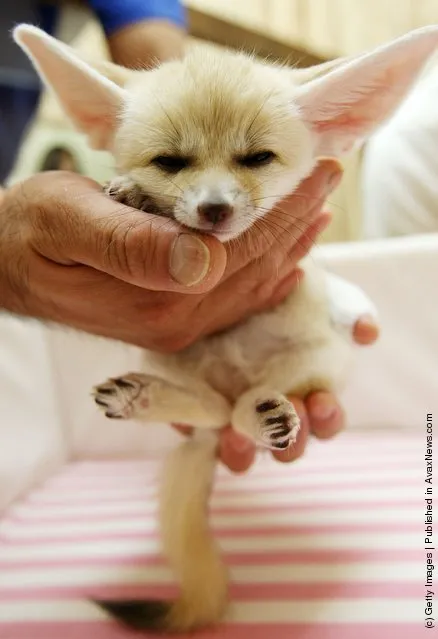
Baby Fennec Fox

“The fennec fox is a small nocturnal fox found in the Sahara of North Africa. Its most distinctive feature is unusually large ears. The name “fennec” comes from the Arabic word for fox, and the species name zerda has a Greek origin that refers to its habitat. The fennec is the smallest species of canid in the world; coat, ears and kidney functions have adapted to a high-temperature, low-water, desert environment. In addition, its hearing is sensitive enough to hear prey moving underground”. – Wikipedia

Photo: A Baby Fennec is seen at Sunshine International Aquarium on June 24, 2009 in Tokyo, Japan. The small nocturnal fox babies were born on May 17 2009. (Photo by Junko Kimura/Getty Images)
Details
16 Sep 2011 12:02:00
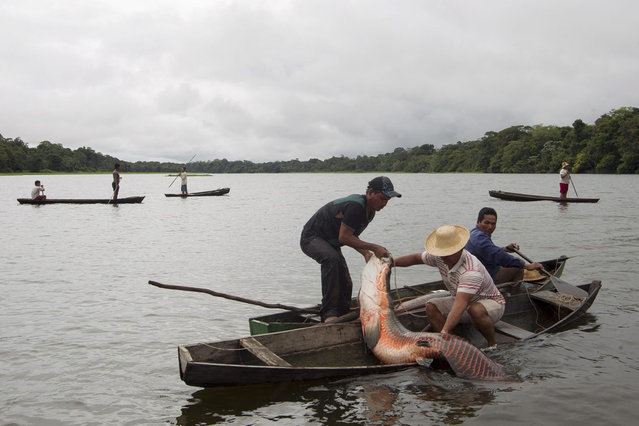
Villagers from the Porto Novo community load into their canoes arapaima or pirarucu, the largest freshwater fish species in South America and one of the largest in the world, while fishing in Poco Fundo lake along a branch of the Solimoes river, one of the main tributaries of the Amazon, in the Mamiraua nature reserve near Fonte Boa about 600 km (373 miles) west of Manaus, November 26, 2013. (Photo by Bruno Kelly/Reuters)

Villagers from the Porto Novo community load into their canoes arapaima or pirarucu, the largest freshwater fish species in South America and one of the largest in the world, while fishing in Poco Fundo lake along a branch of the Solimoes river, one of the main tributaries of the Amazon, in the Mamiraua nature reserve near Fonte Boa about 600 km (373 miles) west of Manaus, November 26, 2013. Catching the arapaima, a fish that is sought after for its meat and is considered by biologists to be a living fossil, is only allowed once a year by Brazil's environmental protection agency. The minimum size allowed for a fisherman to keep an arapaima is 1.5 meters (4.9 feet). (Photo by Bruno Kelly/Reuters)
Details
17 Dec 2013 08:03:00
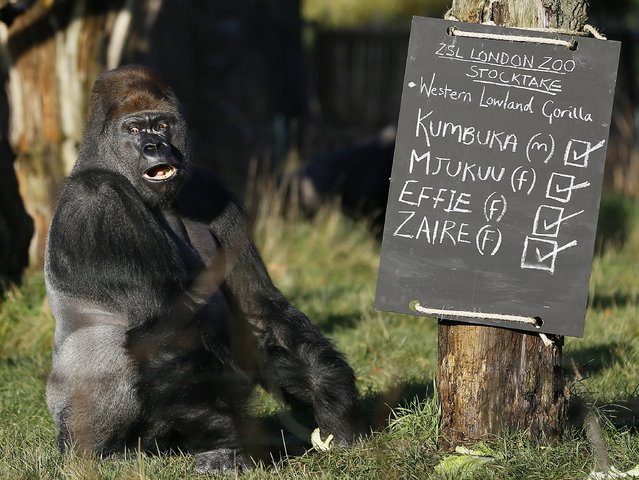
Kumbuka, a male silverback gorilla sits next to the keeper's chalk board in his enclosure at London Zoo, Thursday, January 2, 2014. Home to more than 850 different species, zoo keepers welcomed in the New Year armed with clipboards as they made a note of every single animal. The compulsory annual count is required as part of ZSL London Zoo's zoo license, and every creature, from the tiny leaf cutter ants to the huge silverback gorilla is duly noted and accounted for. (Photo by Kirsty Wigglesworth/AP Photo)

Kumbuka, a male silverback gorilla sits next to the keeper's chalk board in his enclosure at London Zoo, Thursday, January 2, 2014. Home to more than 850 different species, zoo keepers welcomed in the New Year armed with clipboards as they made a note of every single animal. The compulsory annual count is required as part of ZSL London Zoo's zoo license, and every creature, from the tiny leaf cutter ants to the huge silverback gorilla is duly noted and accounted for. (Photo by Kirsty Wigglesworth/AP Photo)
Details
03 Jan 2014 11:03:00
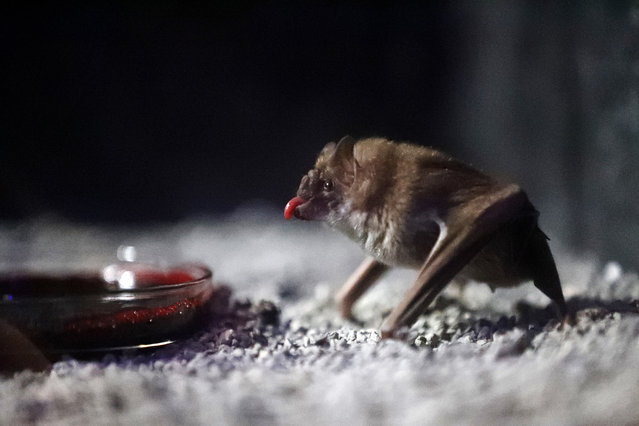
In this Tuesday, March 20, 2018 photo, a Vampire Bat drinks bovine blood in the Criaturas de la Noche (Creatures of the Night) Bat House, the Audubon Zoo's new night house in New Orleans. The various species are all from Central and South America, and the building's interior simulates an abandoned warehouse set up to protect Mayan artifacts during a dig. (Photo by Gerald Herbert/AP Photo)

In this Tuesday, March 20, 2018 photo, a Vampire Bat drinks bovine blood in the Criaturas de la Noche (Creatures of the Night) Bat House, the Audubon Zoo's new night house in New Orleans. The various species are all from Central and South America, and the building's interior simulates an abandoned warehouse set up to protect Mayan artifacts during a dig. (Photo by Gerald Herbert/AP Photo)
Details
25 Mar 2018 00:03:00
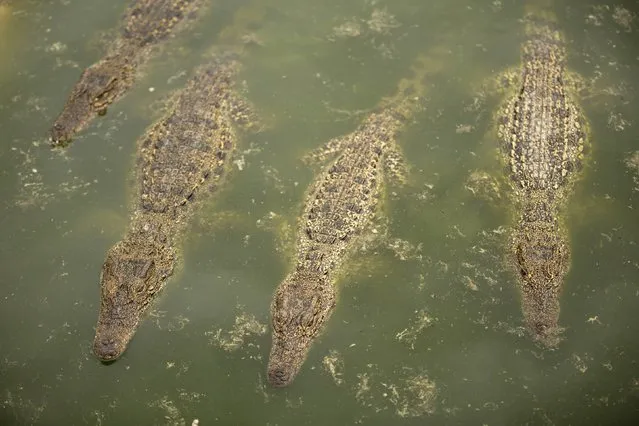
Cuban crocodiles (Crocodylus rhombifer), are seen in a hatchery at Zapata Swamp National Park, June 4, 2015. Ten baby crocodiles have been delivered to a Cuban hatchery in hopes of strengthening the species and extending the bloodlines of a pair of Cuban crocodiles that former President Fidel Castro had given to a Soviet cosmonaut as a gift in the 1970s. Picture taken June 4, 2015. REUTERS/Alexandre Meneghini

Cuban crocodiles (Crocodylus rhombifer), are seen in a hatchery at Zapata Swamp National Park, June 4, 2015. Ten baby crocodiles have been delivered to a Cuban hatchery in hopes of strengthening the species and extending the bloodlines of a pair of Cuban crocodiles that former President Fidel Castro had given to a Soviet cosmonaut as a gift in the 1970s. Picture taken June 4, 2015. REUTERS/Alexandre Meneghini
Details
15 Jun 2015 12:34:00