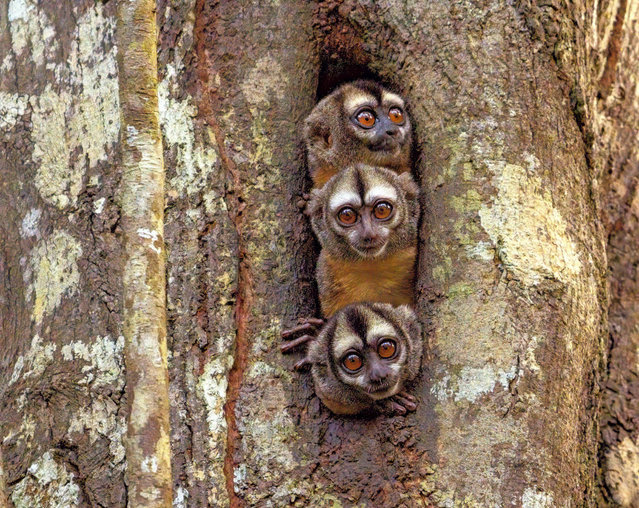
A curious trio of owl monkeys peep out of a tree hollow on the Marañón River near the city of Nauta, Peru in April 2024. (Photo by James Cai/Solent News)
A woman poses for a friend next to blossoming trees in the A.V. Fomin Botanical Garden, in Kyiv, Ukraine, Wednesday, April 10, 2024. (Photo by Vadim Ghirda/AP Photo)
A view of trees shrouded in fog on a late summer morning between Tureby and Slimminge on Zealand, Denmark, 10 September 2021. (Photo by Mads Claus Rasmussen/EPA/EFE)
Children play on an uprooted tree along a beach in Mele, Vanuatu that was once lined with vegetation, now largely lost to storms, erosion and other environmental pressures on Saturday, July 19, 2025. (Photo by Annika Hammerschlag/AP Photo)
Spectacular images offering insight into the lives of the Huaorani people in the Ecuadorian Amazon have been revealed showing how they use traditional methods to hunt monkeys for food. The stunning pictures were taken by conservation photographer Pete Oxford from Torquay, Devon in the Ecuadorian Amazon. Here: The tribe were seen celebrating after a hunter returned to camp with a wild pig. (Photo by Pete Oxford/Mediadrumworld.com)
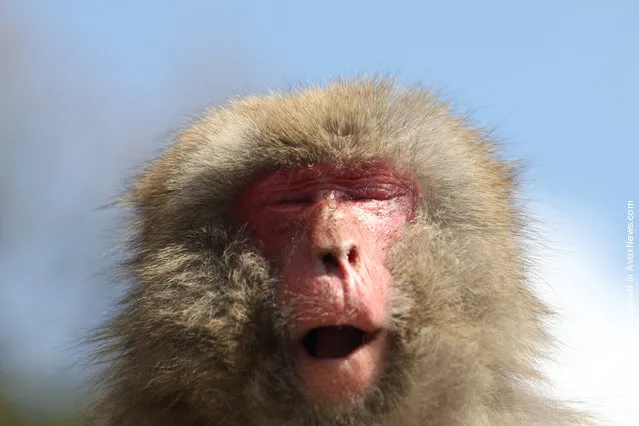
A 19-year-old Japanese macaque monkey named Monday sneezes while suffering an allergy to pollen from the cedar tree, at Awajishima Monkey Center on March 26, 2012 in Sumoto, Hyogo, Japan. Some twenty monkeys are suffering the effects of hay fever at this time of the year, with the typical symptoms being the same as with humans. (Photo by Buddhika Weerasinghe/Getty Images)
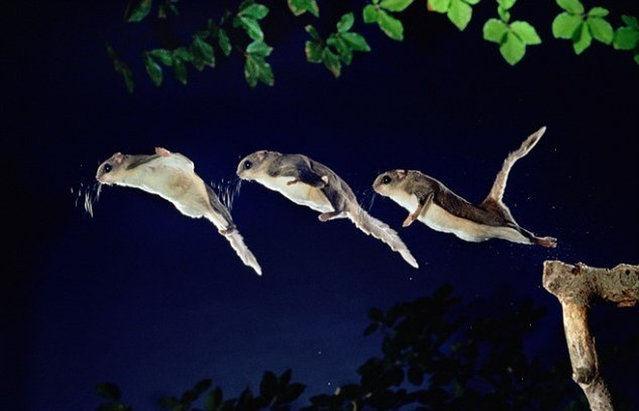
Flying squirrels are not capable of powered flight like birds or bats; instead, they glide between trees. They are capable of obtaining lift within the course of these flights, with flights recorded to 90 meters (295 ft). The direction and speed of the animal in midair is varied by changing the positions of its two arms and legs, largely controlled by small cartilaginous wrist bones. This changes the tautness of the patagium, a furry parachute-like membrane that stretches from wrist to ankle. It has a fluffy tail that stabilizes in flight. The tail acts as an adjunct airfoil, working as an air brake before landing on a tree trunk.
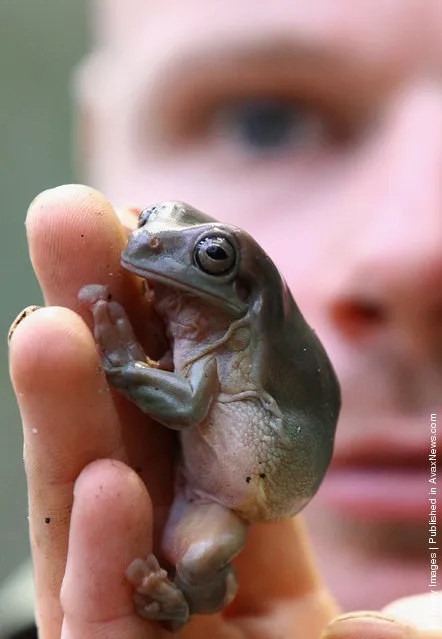
Zoo keeper Ross Poulter holds a White's Tree Frog in Edinburgh Zoo's new tropical forest zone on September 9, 2011 in Edinburgh, Scotland. The Brilliant Birds Exhibit which brings together beautiful and rare birds from all over the world is now more colourful and unusual, with the unveiling of the zoo's new tropical forest zone bringing together a collection of vertebrates, invertebrates and amphibians for the very first time. (Photo by Jeff J Mitchell/Getty Images)