Loading...
Done


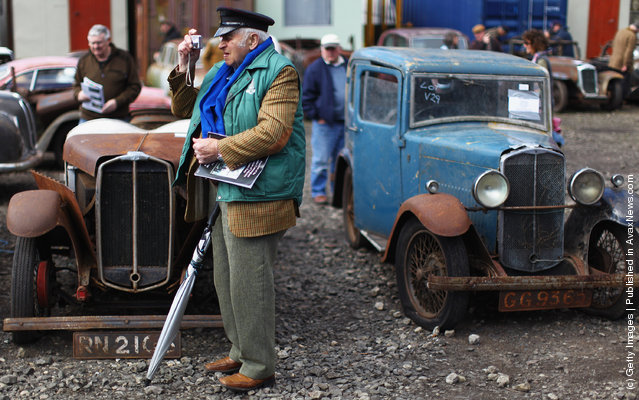
Vintage car enthusiast Peter Bett, attends a auction at Strathmore Vintage Vehicle Club on April 2, 2011 in Glamis, Scotland. Buyers from around the UK and Europe are attending the auction of cars collected by William Cunnigham. Among the many rare classics on sale is a 1939 McEvoy Steyr, thought to be the only one in existence along with a Hotchkiss Grand Sport Roadster from 1936. (Photo by Jeff J Mitchell/Getty Images)
Details
02 Apr 2011 14:02:00
Notting Hill Carnival

A performer is covered in chocolate sauce at the Notting Hill Carnival on August 28, 2011 in London, England. The annual carnival, which is the largest of it's kind in Europe and is expected to attract around 1 million revellers, has taken place every August Bank Holiday since 1966. (Photo by Oli Scarff/Getty Images)
Details
29 Aug 2011 13:34:00
Love Locks

People stop to look at the thousands of so-called “love locks”, or “love padlocks”, that hang from a fence across the Hohenzollernbruecke bridge on September 13, 2011 in Cologne, Germany. Love locks are a growing phenomenon in cities across Europe and are meant by the couples who leave them behind as a symbol of their powerful and undying love for one another. (Photo by Dennis Grombkowski/Getty Images)
Details
15 Sep 2011 11:12:00
Revellers attend the 25th edition of the Sziget Festival on August 9, 2017 in Budapest, Hungary. (Photo by Laszlo Mudra/Rockstar Photographers)

Revellers attend the 25th edition of the Sziget Festival on August 9, 2017 in Budapest, Hungary. The Sziget Festival, one of the largest music and cultural festivals in Europe, celebrates its 25th anniversary in 2017, taking place from August 9-16 on the Hajogyari Sziget in Budapest. (Photo by Laszlo Mudra/Rockstar Photographers)
Details
11 Aug 2017 07:41:00
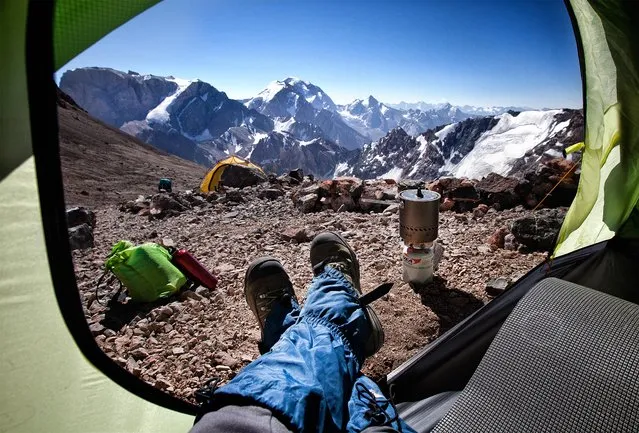
Chimtarga. (Photo by Caters News/Oleg Grigoriev)

“A happy camper has shown he has the world at his feet by capturing a series of breath-taking mountain views from his tent. Russian Photographer Oleg Grigoriev, 35, travels with little more than a tent and his camera taking snaps of the mountainous terrain of central Asia and Eastern parts of Europe. The adventurous lawyer, who lives in Ukraine, started camping in remote mountainous areas in 2007 but only came up with the concept of photographing views from his tent after a memorable trip to the Fann Mountains of Tajikistan”. – Caters News
Details
14 Sep 2014 11:00:00
Deadly Insects Hornet

Hornets are insects that are the largest eusocial wasps. Some species can reach up to 5.5 cm (2.2 in) in length. The true hornets make up the genus Vespa and are distinguished from other vespines by the width of the vertex (part of the head behind the eyes), which is proportionally larger in Vespa and by the anteriorly rounded gasters (the section of the abdomen behind the wasp waist). The best known species is the European hornet (Vespa crabro), about 2–3.5 cm in length, widely distributed throughout Europe, Russia, North America and Northeast Asia.
Details
13 Oct 2014 10:17:00
Chernobyl Disaster – Disaster Fighters

“The Chernobyl disaster was a catastrophic nuclear accident that occurred on 26 April 1986 at the Chernobyl Nuclear Power Plant in Ukrainian SSR, which was under the direct jurisdiction of the central authorities in Moscow. An explosion and fire released large quantities of radioactive contamination into the atmosphere, which spread over much of Western USSR and Europe. It is widely considered to have been the worst nuclear power plant accident in history, and is one of only two classified as a level 7 event on the International Nuclear Event Scale (the other being the Fukushima Daiichi nuclear disaster)”. – Wikipedia (Photos by Alexandr Strannik, August 1986; Source: LiveJournal)
Details
26 Apr 2012 13:20:00
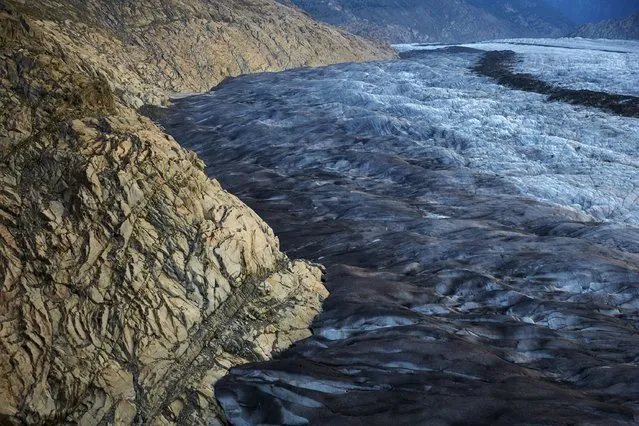
The Aletsch Glacier is pictured at dusk in Fiesch, Switzerland, August 11, 2015. (Photo by Denis Balibouse/Reuters)

The Aletsch Glacier is pictured at dusk in Fiesch, Switzerland, August 11, 2015. One of Europe's biggest glaciers, the Great Aletsch coils 23 km (14 miles) through the Swiss Alps – and yet this mighty river of ice could almost vanish in the lifetimes of people born today because of climate change. The glacier, 900 metres (2,950 feet) thick at one point, has retreated about 3 km (1.9 miles) since 1870 and that pace is quickening. (Photo by Denis Balibouse/Reuters)
Details
18 Oct 2015 08:05:00