Loading...
Done
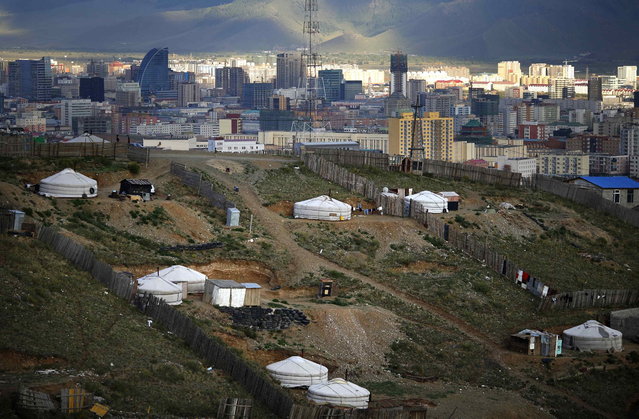
Gers, traditional Mongolian tents, are seen on a hill in an area known as a ger district in Ulan Bator June 26, 2013. (Photo by Carlos Barria/Reuters)

Gers, traditional Mongolian tents, are seen on a hill in an area known as a ger district in Ulan Bator June 26, 2013. Approximately 60 percent of the population of Ulan Bator live in settlements known as ger districts and in many cases residents have limited access to basic services such as water and sanitation. According to a 2010 National Population Center census, every year between thirty and forty thousand people migrate from the countryside to the capital Ulan Bator. Ger districts in the city have been expanding rapidly in recent years. Mongolia is the world's least densely populated country, with 2.8 million people spread across an area around three times the size of France. (Photo by Carlos Barria/Reuters)
Details
11 Aug 2013 11:45:00
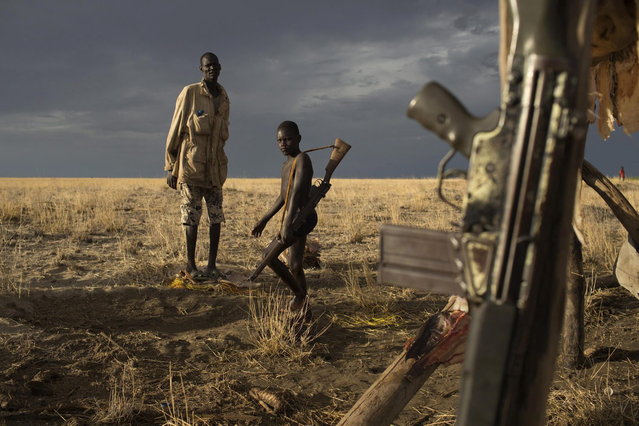
A Turkana man and a boy carrying a gun look on as a G3 battle rifle hangs from a structure used to dry fish at a fishing camp on the shores of Lake Turkana, some kilometres from Todonyang near the Kenya-Ethiopia border in northwestern Kenya October 12, 2013. (Photo by Siegfried Modola/Reuters)

A Turkana man and a boy carrying a gun look on as a G3 battle rifle hangs from a structure used to dry fish at a fishing camp on the shores of Lake Turkana, some kilometres from Todonyang near the Kenya-Ethiopia border in northwestern Kenya October 12, 2013The Turkana are traditionally nomadic pastoralists, but they have seen the pasture that they need to feed their herds suffer from recurring droughts and many have turned to fishing. However, Lake Turkana is overfished, and scarcity of food and pastureland is fuelling long-standing conflict with Ethiopian indigenous Dhaasanac, who have seen grazing grounds squeezed by large-scale government agricultural schemes in southern Ethiopia. The Dhaasanac now venture ever deeper into Kenyan territory in search of fish and grass, clashing with neighbours. Fighting between the communities has a long history, but the conflict has become ever more fatal as automatic weapons from other regional conflicts seep into the area. While the Turkana region is short of basics like grass and ground-water, it contains other resources including oil reserves and massive, newly discovered underground aquifers. (Photo by Siegfried Modola/Reuters)
Details
05 Dec 2013 12:08:00
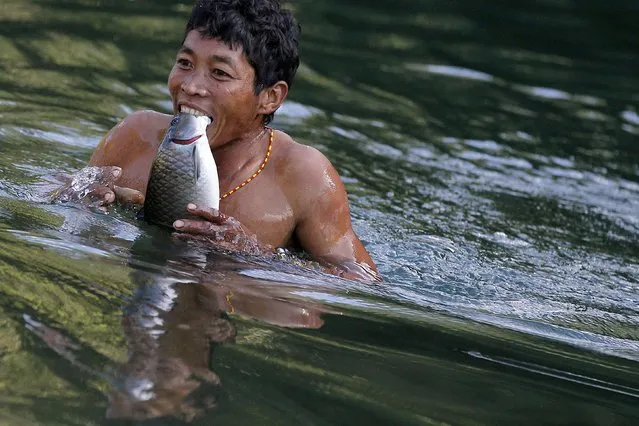
A Naga man carries fish in his teeth after it was stunned by dynamite, which fishermen threw in a creek between Donhe and Lahe township, in the Naga Self-Administered Zone in northwest Myanmar December 27, 2014. (Photo by Soe Zeya Tun/Reuters)

A Naga man carries fish in his teeth after it was stunned by dynamite, which fishermen threw in a creek between Donhe and Lahe township, in the Naga Self-Administered Zone in northwest Myanmar December 27, 2014. (Photo by Soe Zeya Tun/Reuters)
Details
11 Jan 2015 13:18:00
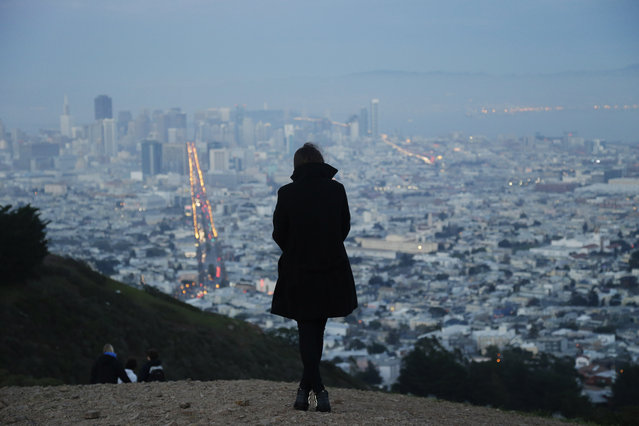
A visitor takes in a view of the downtown district from Twin Peaks on Friday, January 9, 2015, in San Francisco. (Photo by Marcio Jose Sanchez/AP Photo)

A visitor takes in a view of the downtown district from Twin Peaks on Friday, January 9, 2015, in San Francisco. (Photo by Marcio Jose Sanchez/AP Photo)
Details
19 Jan 2015 13:05:00
NASA's rover Opportunity visits Victoria Crater, viewed from orbit by the High Resolution Imaging Science Experiment on NASA's Mars Reconnaissance Orbiter in october of 2006. Opportunity is a small dot on the crater's lip, at top right. Opportunity first reached the crater's rim on September 27, 2006. (Photo by NASA/JPL-Caltech/University of Arizona/The Atlantic)

“NASA's Mars rover Opportunity just celebrated its ninth anniversary on Mars – a mission that was originally meant to last just 90 days...” – The Atlantic. Photo: NASA's rover Opportunity visits Victoria Crater, viewed from orbit by the High Resolution Imaging Science Experiment on NASA's Mars Reconnaissance Orbiter in october of 2006. Opportunity is a small dot on the crater's lip, at top right. Opportunity first reached the crater's rim on September 27, 2006. (Photo by NASA/JPL-Caltech/University of Arizona via The Atlantic)


Details
14 Feb 2013 10:58:00
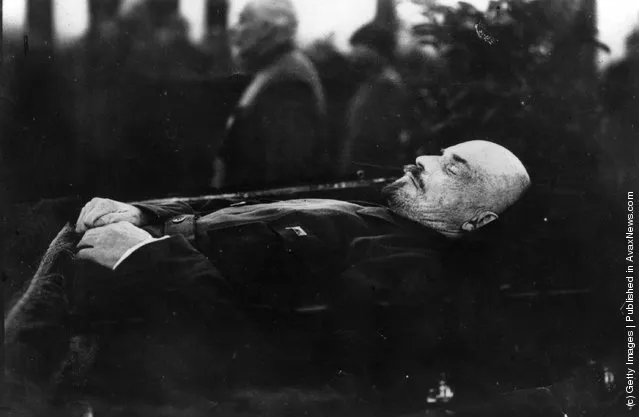
1924:  Vladimir Ilyich Lenin lying in state in the Kremlin

Photo: Vladimir Ilyich Lenin (1870 – 1924) lying in state in the Kremlin. (Photo by Hulton Archive/Getty Images). 1924

Important! For the same article in Russian language click here.

Something quite intriguing is happening within Russian-speaking internet during the last few – should you type a fully academic inquiry (at least, according to Russian academic requirements) in national search engines for "Lenin's mausoleum" – the first thing you get (even in top 10 searches) is website pages talking about black magic and occult. Website authors view this construction differently, but unconditionally agree on one thing: the mausoleum of the "leader of the world proletariat” – the essence of a magical artifact, a sort of “energy vampire”. It was built with a certain purpose: to drain the energy out of miserable Soviet citizens on one hand; and to poison the anthroposphere of one-sixth part of the earth with its vibes (the exact territory that was occupied by the former Soviet Union), depriving the Russian people of will to resist on the other hand. Complete nonsense? No doubt. Nevertheless, an intriguing one. Well, probably because some oddities do exist in mausoleum's history. These oddities are the thing we are going to discuss this time. First, let me refresh you memory on the subject.
Details
16 Oct 2011 11:27:00
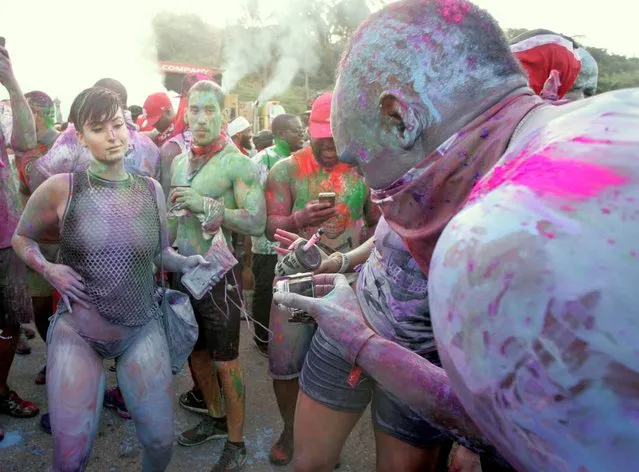
The world-famous sprinter Usain Bolt, 30, took a break from the track to celebrate Carnival as revellers doused each other with paint in Trinidad and Tobago on February 26, 2017. (Photo by David Wears/Splash News and Pictures)

The world-famous sprinter Usain Bolt, 30, took a break from the track to celebrate Carnival as revellers doused each other with paint in Trinidad and Tobago on February 26, 2017. (Photo by David Wears/Splash News and Pictures)
Details
27 Feb 2017 07:48:00
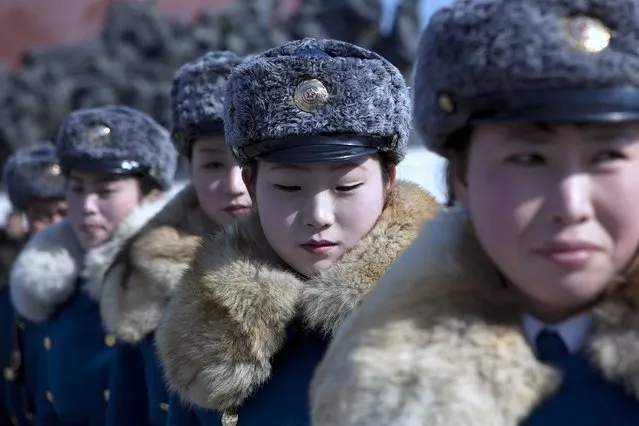
Female North Korean traffic police officers gather in front of bronze statues of the late leaders Kim Il Sung and Kim Jong Il to pay their respects in Pyongyang, North Korea on Saturday, February 16, 2013. North Koreans turned out to commemorate what would have been the 71th birthday of Kim Jong Il who died on December 17, 2011. (Photo by David Guttenfelder/AP Photo)

Female North Korean traffic police officers gather in front of bronze statues of the late leaders Kim Il Sung and Kim Jong Il to pay their respects in Pyongyang, North Korea on Saturday, February 16, 2013. North Koreans turned out to commemorate what would have been the 71th birthday of Kim Jong Il who died on December 17, 2011. (Photo by David Guttenfelder/AP Photo)
Details
31 Mar 2013 13:25:00