Loading...
Done
Gold medallist Rachelle Simpson of the U.S. celebrates after the women's 20m high dive competition during the Aquatics World Championships in Kazan, Russia  August 4, 2015. (Photo by Hannibal Hanschke/Reuters)

Gold medallist Rachelle Simpson of the U.S. celebrates after the women's 20m high dive competition during the Aquatics World Championships in Kazan, Russia August 4, 2015. (Photo by Hannibal Hanschke/Reuters)
Details
05 Aug 2015 13:40:00
Sun Rongchun, 57, exercises with an improvised cervical traction device attached to a high bar at a sports complex in Shenyang, Liaoning province, China on April 9, 2019. (Photo by Sheng Li/Reuters)

Sun Rongchun, 57, exercises with an improvised cervical traction device attached to a high bar at a sports complex in Shenyang, Liaoning province, China on April 9, 2019. (Photo by Sheng Li/Reuters)
Details
17 May 2019 00:03:00
United States' Inika McPherson prepares an attempt during the women' s high jump final during the World Athletics Championships in London Saturday, August 12, 2017. (Photo by Kai Pfaffenbach/Reuters)

United States' Inika McPherson prepares an attempt during the women' s high jump final during the World Athletics Championships in London Saturday, August 12, 2017. (Photo by Kai Pfaffenbach/Reuters)
Details
14 Aug 2017 07:18:00
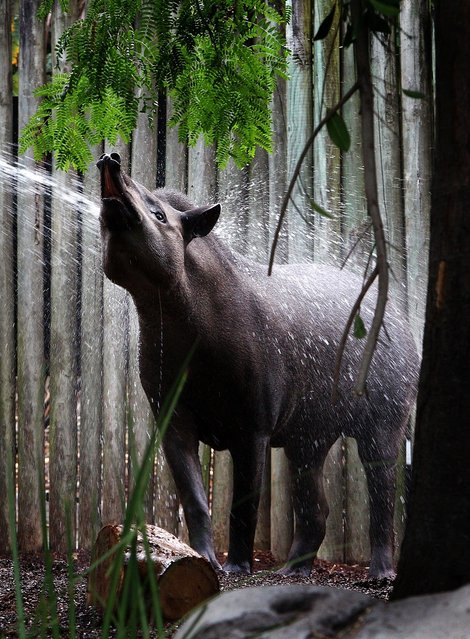
Brazilian Tapir Tique is treated to a nice cold shower by the zoo keeper at Taronga Zoo on January 8, 2013 in Sydney, Australia. Temperatures are expected to reach as high as 43 degrees around Sydney today.  (Photo by Marianna Massey)

Brazilian Tapir Tique is treated to a nice cold shower by the zoo keeper at Taronga Zoo on January 8, 2013 in Sydney, Australia. Temperatures are expected to reach as high as 43 degrees around Sydney today. (Photo by Marianna Massey)
Details
08 Jan 2013 10:08:00
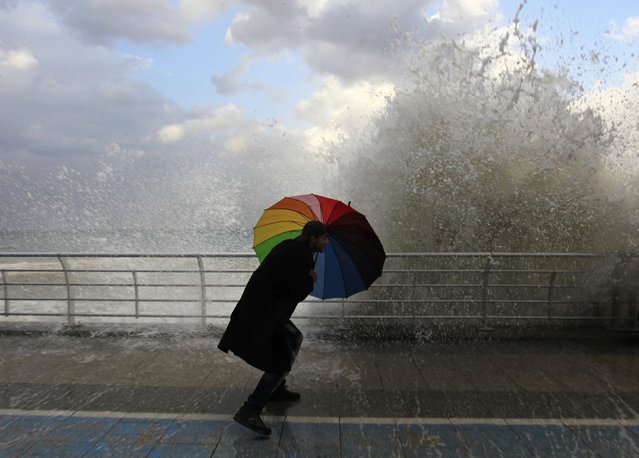
A man plays in front of a wave crashing into Beirut's Corniche, a seaside promenade, as high winds sweep through Lebanon ahead of an impending storm January 6, 2015. (Photo by Jamal Saidi/Reuters)

A man plays in front of a wave crashing into Beirut's Corniche, a seaside promenade, as high winds sweep through Lebanon ahead of an impending storm January 6, 2015. (Photo by Jamal Saidi/Reuters)
Details
02 Feb 2015 11:11:00
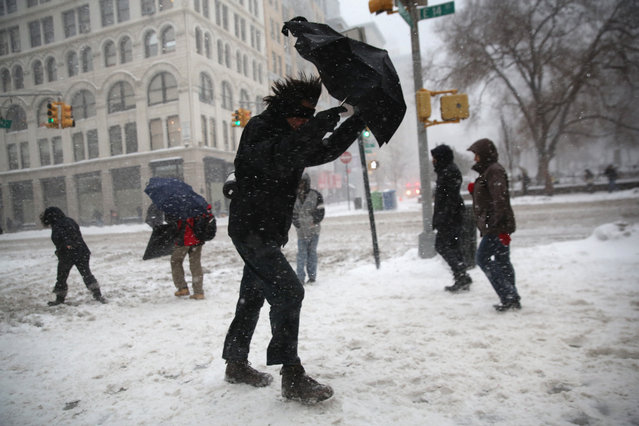
A man braces his umbrella while walking through the snow on February 13, 2014 in New York City. Heavy snow and high winds made for a hard morning commute in the city. (Photo by John Moore/Getty Images)

A man braces his umbrella while walking through the snow on February 13, 2014 in New York City. Heavy snow and high winds made for a hard morning commute in the city. (Photo by John Moore/Getty Images)
Details
06 May 2014 11:20:00
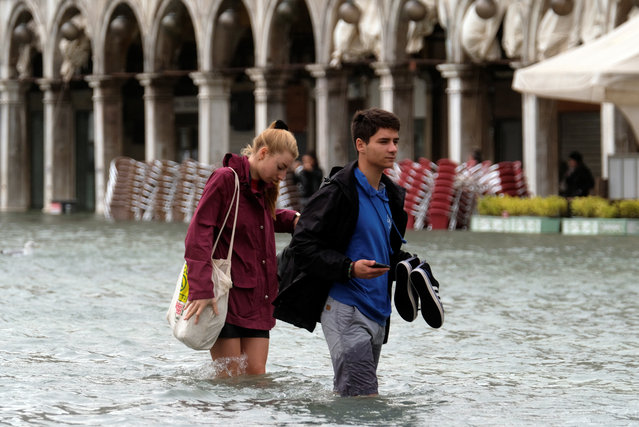
A couple walk on a catwalk in a flooded Saint Mark Square during a period of seasonal high water in Venice on October 29, 2018. (Photo by Manuel Silvestri/Reuters)

A couple walk on a catwalk in a flooded Saint Mark Square during a period of seasonal high water in Venice on October 29, 2018. Venice frequently floods when high winds push in water from the lagoon, but Monday's levels are exceptional and forecast to rise even higher, to 160 centimeters (nearly 63 inches) by mid-afternoon. (Photo by Manuel Silvestri/Reuters)
Details
31 Oct 2018 00:01:00
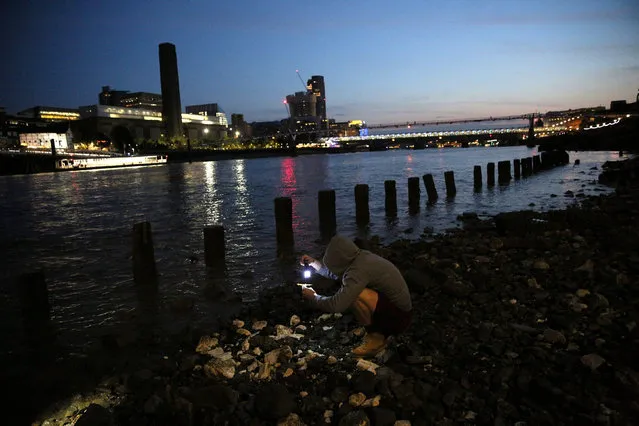
A mudlark uses a torch to look for items on the bank of the River Thames in London, Britain June 06, 2016. Mudlarking is believed to trace its origins to the 18th and 19th century, when scavengers searched the Thames' shores for items to sell. These days, history and archaeology fans are the ones hoping to find old relics such as coins, ceramics, artifacts or everyday items from across centuries. They wait for the low tide and then scour specific areas of exposed shores. "If you're in a field you could be out all day long, with the river you're restricted to about two or three hours," mudlark Nick Stevens said. While many just use the naked eye for their searches, others rely on metal detectors for which a permit from the Port of London Authority is needed. Digging also requires consent. (Photo by Neil Hall/Reuters)

A mudlark uses a torch to look for items on the bank of the River Thames in London, Britain June 06, 2016. Mudlarking is believed to trace its origins to the 18th and 19th century, when scavengers searched the Thames' shores for items to sell. These days, history and archaeology fans are the ones hoping to find old relics such as coins, ceramics, artifacts or everyday items from across centuries. their finds with the Portable Antiquities Scheme. Any item over 300 years old must be recorded. (Photo by Neil Hall/Reuters)

Details
27 Aug 2016 10:43:00