Loading...
Done
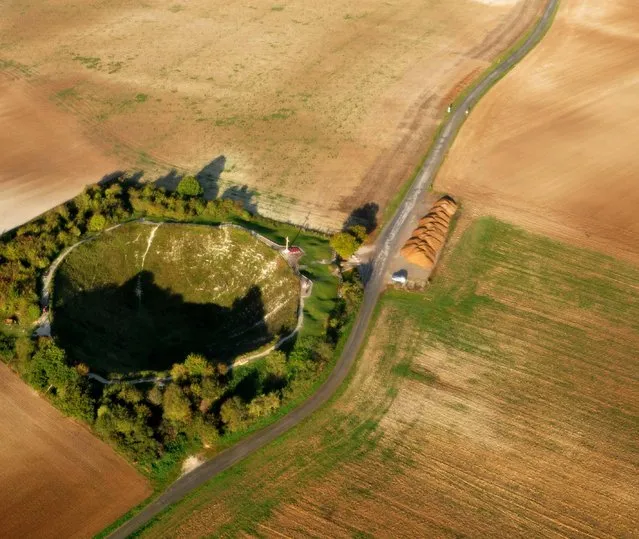
Lochnagar Crater Somme In France

It is amazing how much the humanity can change the face of the earth. Not only can it create huge craters, which look a lot like craters from meteors, they leave a big enough impact that it can be seen from space. Though this crater, caused by a massive explosion on 1 July 1916, looks large, being 90 feet deep and 300 feet across; it is nowhere big enough to be viewed for space. A common misconception is that the Great Wall of China can be seen from space. In reality, however, it is impossible. Not only is it of the same color as the earth near it, it is also not that wide. Deforestation, on the other hand, can be clearly seen from space. Also, at night, all the lights that the large cities produce are also very visible.
Details
17 Nov 2014 12:48:00


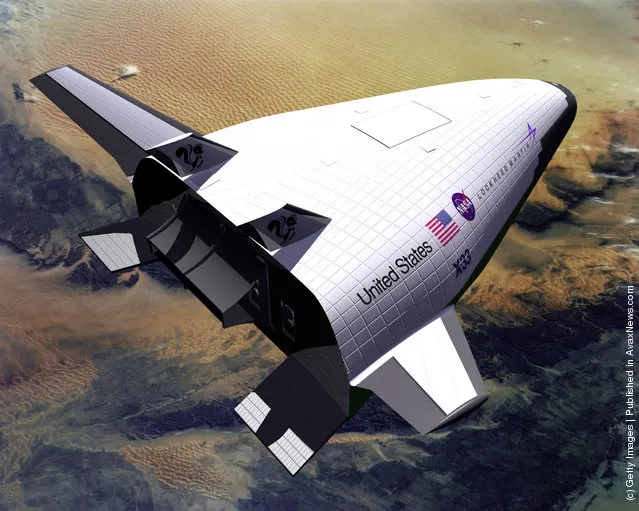
“The Lockheed Martin X-33 is an unmanned, sub-scale technology demonstrator suborbital spaceplane developed in the 1990s under the U.S. government-funded Space Launch Initiative program”. – Wikipedia

Photo: An Artist's Rendering Shows How Nasa's X-33 Technology Demonstrator, A Cost-Cutting Fully Reusable Single-Stage-To-Orbit Space Vehicle, Will Look Upon Completion. The 67 Foot-Long, 278,600 Pound, Twin Engine Space Vehicle, Capable Of Reaching Speeds In Excess Of Mach 15, Will Lead To The Construction Of A 127 Foot-Long, 2,186,000 Pound Version With Seven Engines And A 50,000 Pound Payload Capacity Called The “Venturestar”. (Photo By Nasa/Getty Images)
Details
22 Mar 2011 12:05:00
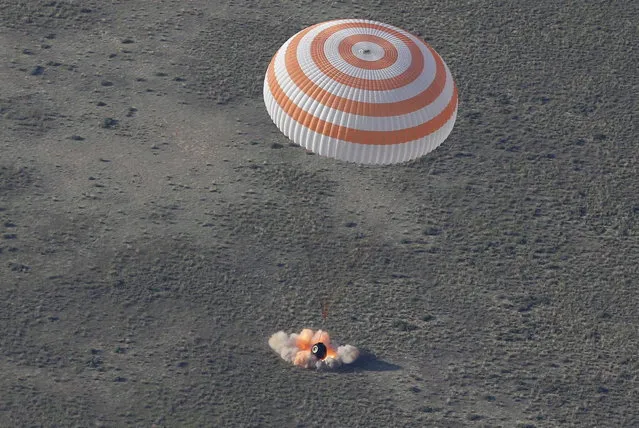
The Soyuz TMA-11M capsule with the International Space Station (ISS) crew members Japanese astronaut Koichi Wakata, Russian cosmonaut Mikhail Tyurin and U.S. astronaut Rick Mastracchio lands south-east of the town of Dzhezkazgan in central Kazakhstan, May 14, 2014. The first Japanese to command a space mission and crewmates from the United States and Russia landed safely in Kazakhstan on Wednesday, wrapping up a 188-day stay aboard the International Space Station. (Photo by Dmitry Lovetsky/Reuters)

The Soyuz TMA-11M capsule with the International Space Station (ISS) crew members Japanese astronaut Koichi Wakata, Russian cosmonaut Mikhail Tyurin and U.S. astronaut Rick Mastracchio lands south-east of the town of Dzhezkazgan in central Kazakhstan, May 14, 2014. The first Japanese to command a space mission and crewmates from the United States and Russia landed safely in Kazakhstan on Wednesday, wrapping up a 188-day stay aboard the International Space Station. (Photo by Dmitry Lovetsky/Reuters)
Details
15 May 2014 07:56:00
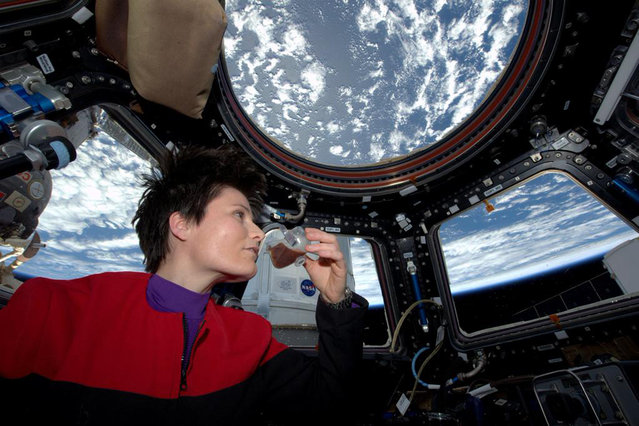
In this photo posted on Twitter, Sunday, May 3, 2015, and provided by NASA, Italian astronaut Samantha Cristoforetti sips espresso from a cup designed for use in zero-gravity, on the International Space Station. Cristoforetti, the first Italian woman in space, fired up the first espresso machine in space, which uses small capsules, or pods, of espresso coffee. (Photo by AP Photo/NASA)

In this photo posted on Twitter, Sunday, May 3, 2015, and provided by NASA, Italian astronaut Samantha Cristoforetti sips espresso from a cup designed for use in zero-gravity, on the International Space Station. Cristoforetti, the first Italian woman in space, fired up the first espresso machine in space, which uses small capsules, or pods, of espresso coffee. (Photo by AP Photo/NASA)
Details
09 May 2015 12:26:00
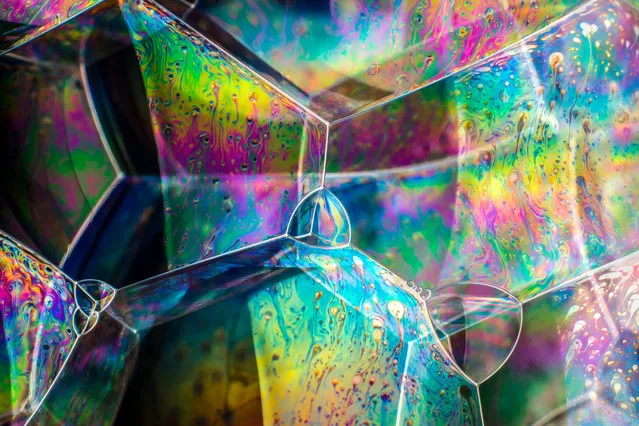
Soap Bubble Structures by Kym Cox. Bubbles optimise space and minimise their surface area for a given volume of air. This phenomenon makes them a useful tool in many areas of research, in particular, materials science and ‘packing’ – how things fit together. Bubble walls drain under gravity, thin at the top, thick at the bottom, which interferes with travelling lightwaves to create bands of colour. Black spots show the wall is too thin for interference colours, indicating the bubble is about to burst. (Photo by Kym Cox/2019 Science Photographer of the Year/RPS)

Soap Bubble Structures by Kym Cox. Bubbles optimise space and minimise their surface area for a given volume of air. This phenomenon makes them a useful tool in many areas of research, in particular, materials science and “packing” – how things fit together. Bubble walls drain under gravity, thin at the top, thick at the bottom, which interferes with travelling lightwaves to create bands of colour. Black spots show the wall is too thin for interference colours, indicating the bubble is about to burst. (Photo by Kym Cox/2019 Science Photographer of the Year/RPS)
Details
15 Aug 2019 00:03:00
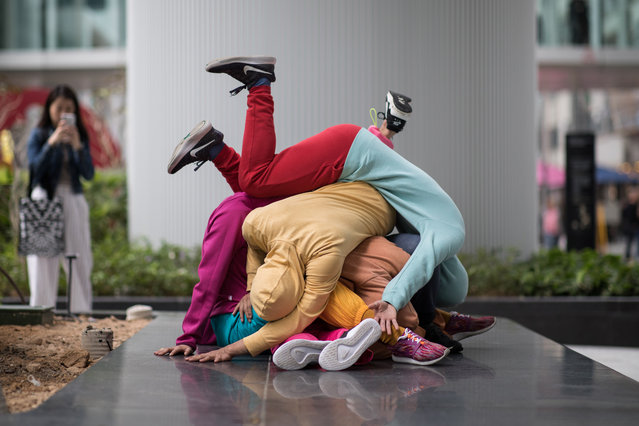
Dancers perform as human sculptures during an exhibition in Hong Kong, China, 26 March 2019. (Photo by Jerome Favre/EPA/EFE)

Dancers perform as human sculptures during an exhibition in Hong Kong, China, 26 March 2019. The exhibition entitled “Multisensory Exhibition Urban Playgrounds” shows how Austrian artist Willi Dorner uses urban spaces to interpret the relationship between bodies and objects. (Photo by Jerome Favre/EPA/EFE)
Details
30 Mar 2019 00:01:00
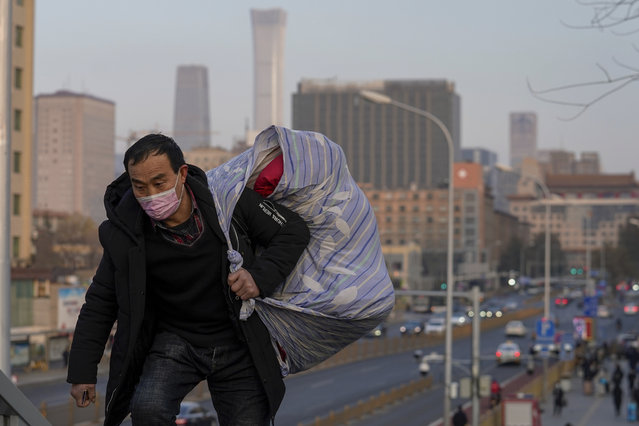
A migrant worker wearing face masks to help curb the spread of the coronavirus walks up to a pedestrian bridge in Beijing, Sunday, December 6, 2020. Provincial governments across China are placing orders for experimental, domestically made coronavirus vaccines, though health officials have yet to say how well they work or how they may reach the country's 1.4 billion people. (Photo by Andy Wong/AP Photo)

A migrant worker wearing face masks to help curb the spread of the coronavirus walks up to a pedestrian bridge in Beijing, Sunday, December 6, 2020. Provincial governments across China are placing orders for experimental, domestically made coronavirus vaccines, though health officials have yet to say how well they work or how they may reach the country's 1.4 billion people. (Photo by Andy Wong/AP Photo)
Details
14 Dec 2020 00:03:00


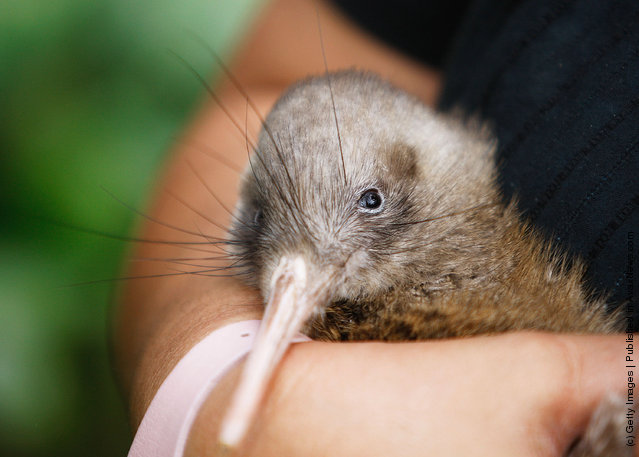
One of ten little spotted kiwi is released on Motuihe Island, a conservation pest-free island close to Auckland, on March 21, 2009 in Auckland, New Zealand. Eventually up to 40 endangered kiwi birds will be relocated to the island. (Photo by Hannah Johnston/Getty Images)
Details
03 Apr 2011 15:13:00