Loading...
Done
Renee LeGrand, of Foothill Ranch, Calif., takes a picture among wildflowers in bloom Monday, March 18, 2019, in Lake Elsinore, Calif. About 150,000 people flocked over the weekend to see this year's rain-fed flaming orange patches of poppies lighting up the hillsides near Lake Elsinore, a city of about 60,000 residents. The crowds became so bad Sunday that Lake Elsinore officials  closed access to poppy-blanketed Walker Canyon. By Monday the #poppyshutdown announced by the city on Twitter was over and the road to the canyon was re-opened. (Photo by Gregory Bull/AP Photo)

Renee LeGrand, of Foothill Ranch, Calif., takes a picture among wildflowers in bloom Monday, March 18, 2019, in Lake Elsinore, Calif. About 150,000 people flocked over the weekend to see this year's rain-fed flaming orange patches of poppies lighting up the hillsides near Lake Elsinore, a city of about 60,000 residents. The crowds became so bad Sunday that Lake Elsinore officials closed access to poppy-blanketed Walker Canyon. By Monday the #poppyshutdown announced by the city on Twitter was over and the road to the canyon was re-opened. (Photo by Gregory Bull/AP Photo)
Details
20 Mar 2019 00:07:00
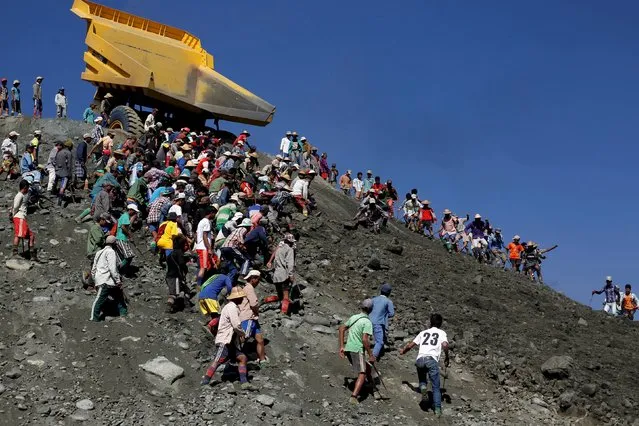
Miners search for jade stones at a mine dump at a Hpakant jade mine in Kachin state, Myanmar November 25, 2015. (Photo by Soe Zeya Tun/Reuters)

Miners search for jade stones at a mine dump at a Hpakant jade mine in Kachin state, Myanmar November 25, 2015. (Photo by Soe Zeya Tun/Reuters)
Details
27 Nov 2015 06:16:00
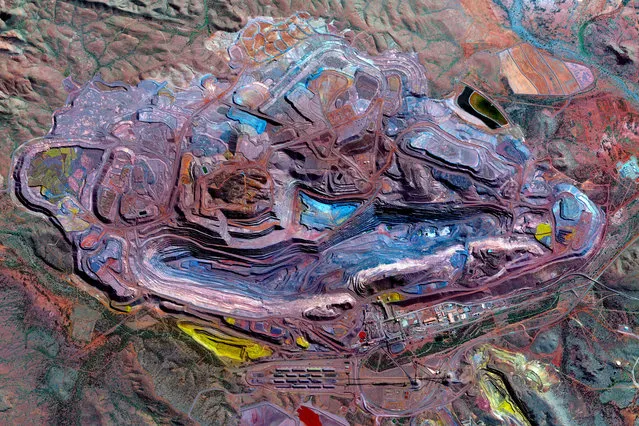
Mount Whaleback iron ore mine 23°21’32.3”S, 119°40’40.1”E. The Mount Whaleback Iron Ore Mine in the Pilbara region of Western Australia. Roughly 98% of the world’s mined iron ore is used to make steel and is thus a significant component in the construction of buildings, automobiles, and appliances such as refrigerators. (Photo by Daily Overview/DigitalGlobe, a Maxar Company)

Mount Whaleback iron ore mine 23°21’32.3”S, 119°40’40.1”E. The Mount Whaleback Iron Ore Mine in the Pilbara region of Western Australia. Roughly 98% of the world’s mined iron ore is used to make steel and is thus a significant component in the construction of buildings, automobiles, and appliances such as refrigerators. (Photo by Daily Overview/DigitalGlobe, a Maxar Company)
Details
16 Nov 2018 00:03:00
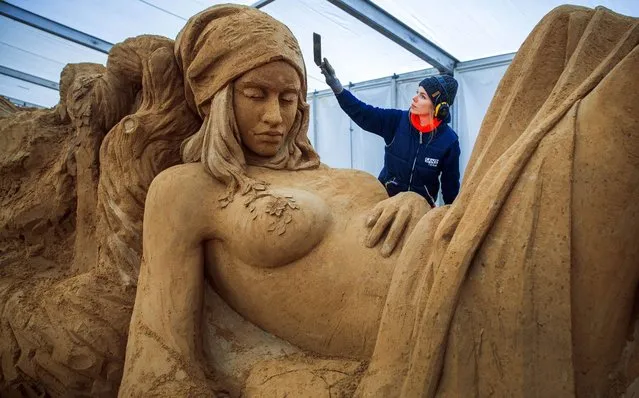
Marieke van der Meer from the Netherlands works on her sculpture “Flora” at the sand sculpture show in Binz on Ruegen island, Germany, 09 March 2016. With the motto “Fascination Nature”, 50 sand artists have created oversized sculptures. The sculptors use 16,000 tons of special sand that is pressed into big blocks first and then formed. The 7th sand sculpture show on 5,600 square meters of exhibition ground opens on 12 March 2016. (Photo by Ens Buettner/EPA)

Marieke van der Meer from the Netherlands works on her sculpture “Flora” at the sand sculpture show in Binz on Ruegen island, Germany, 09 March 2016. With the motto “Fascination Nature”, 50 sand artists have created oversized sculptures. The sculptors use 16,000 tons of special sand that is pressed into big blocks first and then formed. The 7th sand sculpture show on 5,600 square meters of exhibition ground opens on 12 March 2016. (Photo by Ens Buettner/EPA)
Details
10 Mar 2016 13:03:00
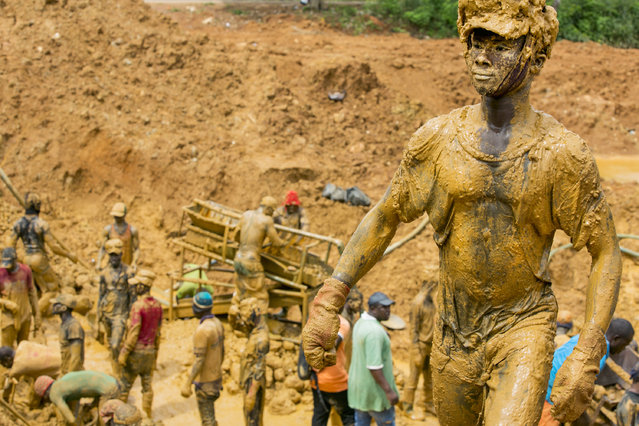
Miners work extremely long days under the hot sun and the hours are often longer in illegal mines in Ghana, West Africa, 2014. An Australian photographer has captured the harsh reality of illegal mining under the unforgiving sun with these Ghanaian miners. Heidi Woodman travelled to Ghana, West Africa to explore the regionís booming mining business, including the growing number of illegal mines. Using Accra as her base, Heidi visited the areas of Tarkwa, Kyebi, East Akim, Kumasi, Obuasi and Takoradi to find areas with a high concentration of galamsey – illegal mining activity. (Photo by Heidi Woodman/Barcroft Images)

Miners work extremely long days under the hot sun and the hours are often longer in illegal mines in Ghana, West Africa, 2014. An Australian photographer has captured the harsh reality of illegal mining under the unforgiving sun with these Ghanaian miners. (Photo by Heidi Woodman/Barcroft Images)
Details
24 Feb 2017 00:02:00
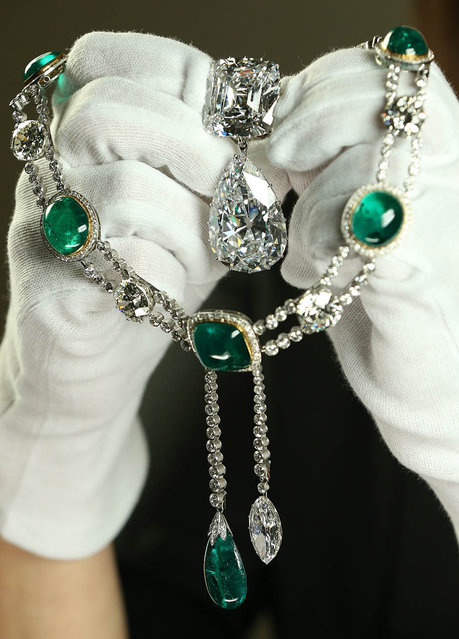
Caroline de Guitaut, Curator of Royal Collections, holds the Cullinan III and IV Broach and the Cullinan VII Delhi Durbar Necklace and Cullinan Pendant at The Queen's Gallery, Buckingham Palace

“A dazzling exhibition featuring jewelry made with the world’s largest diamond will be part of the celebrations marking the 60th anniversary of Queen Elizabeth II’s reign. The jewelry was made with a 3,106-carat diamond discovered in 1905 at the Cullinan Diamond Mine near Pretoria, the capital of South Africa. The diamond was so large that miners initially thought it was a worthless crystal and almost threw it away”... – Vidya Kauri via News.nationalpost.com

Photo: Caroline de Guitaut, Curator of Royal Collections, holds the Cullinan III and IV Broach and the Cullinan VII Delhi Durbar Necklace and Cullinan Pendant at The Queen's Gallery, Buckingham Palace on May 15, 2012 in London, England. (Photo by Peter Macdiarmid)
Details
17 May 2012 10:59:00
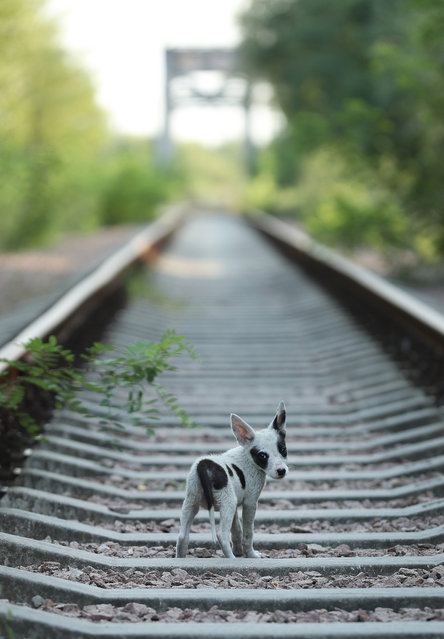
A stray puppy walks along abandoned train tracks near the Chernobyl nuclear power plant on August 19, 2017 near Chornobyl, Ukraine. (Photo by Sean Gallup/Getty Images)

A stray puppy walks along abandoned train tracks near the Chernobyl nuclear power plant on August 19, 2017 near Chornobyl, Ukraine. An estimated 900 stray dogs live in the exclusion zone, many of them likely the descendants of dogs left behind following the mass evacuation of residents in the aftermath of the 1986 nuclear disaster at Chernobyl. (Photo by Sean Gallup/Getty Images)
Details
24 Aug 2017 09:28:00
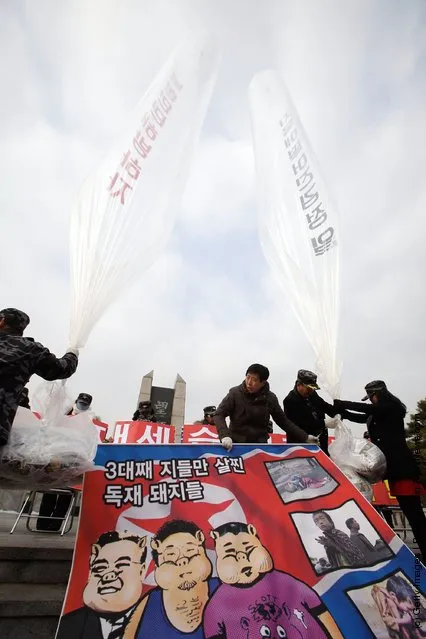
North Korean defectors, now living in South Korea, prepare to release balloons carrying propaganda leaflets denouncing North Korea's late leader Kim Jong-Il at Imjingak, near the Demilitarized zone

North Korean defectors, now living in South Korea, prepare to release balloons carrying propaganda leaflets denouncing North Korea's late leader Kim Jong-Il at Imjingak, near the Demilitarized zone (DMZ) separating South and North Korea on December 28, 2011 in Paju, South Korea. (Photo by Chung Sung-Jun/Getty Images)
Details
28 Dec 2011 07:58:00