Loading...
Done
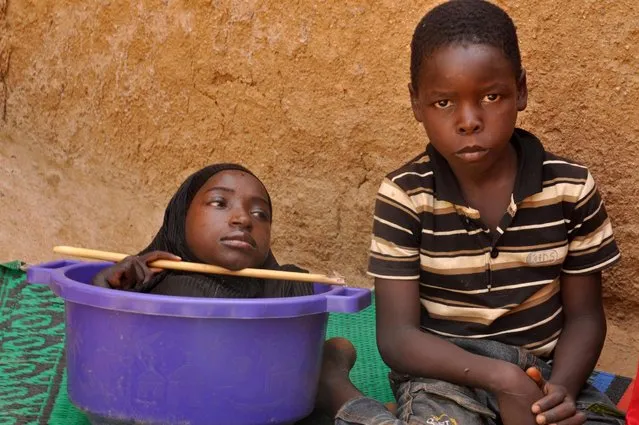
Rahma, 19, pictured with her 10-year old brother Fahad on June 21, 2016 in Kano, Nigeria. A teenage girl born without limbs lives her life in a plastic bowl. Rahma Haruna is a bright, happy girl, despite suffering from a mystery condition that stopped her arms and legs developing properly – leaving her practically limbless and in constant pain. The 19-year- old, from Kano, Nigeria, was born a healthy baby but when she turned six months old her growth came to a sudden halt and she stopped hitting key development milestones. Rahma’s family do their best to provide her with a fulfilling life and transport her around the village in a plastic bowl. Rahma said: “They help me a lot. How do they? They give me anything I need”. Rahma died on 25 December 2016. (Photo by Sani Maikatanga/Barcroft Images)

Rahma, 19 (L), pictured with her 10-year old brother Fahad on June 21, 2016 in Kano, Nigeria. A teenage girl born without limbs lives her life in a plastic bowl. Rahma Haruna is a bright, happy girl, despite suffering from a mystery condition that stopped her arms and legs developing properly – leaving her practically limbless and in constant pain. The 19-year- old, from Kano, Nigeria, was born a healthy baby but when she turned six months old her growth came to a sudden halt and she stopped hitting key development milestones. Rahma’s family do their best to provide her with a fulfilling life and transport her around the village in a plastic bowl. Rahma said: “They help me a lot. How do they? They give me anything I need”. Rahma died on 25 December 2016. (Photo by Sani Maikatanga/Barcroft Images)
Details
30 Dec 2016 10:52:00
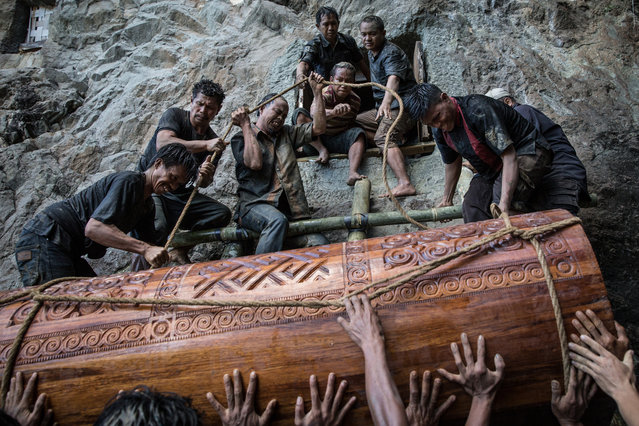
It is said that Torajans are people who “live to die”. For this Indonesian ethnic group, funerals are such extravagant events that they sometimes attract tourists. Families can postpone burials years (and the deceased are considered sick and hosted at home until the funeral) until the family can raise enough money and gather as many relatives as possible. And then it’s a jubilant multiday social event with a parade, dances and animal sacrifices. Agung Parameswara photographed these funerary practices when he traveled to South Sulawesi province, where the Torajans live. But often, their funeral isn’t the last time the dead are seen. In August, crypts are opened, coffins are slid back out and bodies delicately unsheathed. This tender ritual is known as Ma’Nene, which is customarily performed every few years. (Photo by Agung Parameswara/The Washington Post)

It is said that Torajans are people who “live to die”. For this Indonesian ethnic group, funerals are such extravagant events that they sometimes attract tourists. Families can postpone burials years (and the deceased are considered sick and hosted at home until the funeral) until the family can raise enough money and gather as many relatives as possible. And then it’s a jubilant multiday social event with a parade, dances and animal sacrifices. Agung Parameswara photographed these funerary practices when he traveled to South Sulawesi province, where the Torajans live. (Photo by Agung Parameswara/The Washington Post)
Details
06 Oct 2016 09:15:00
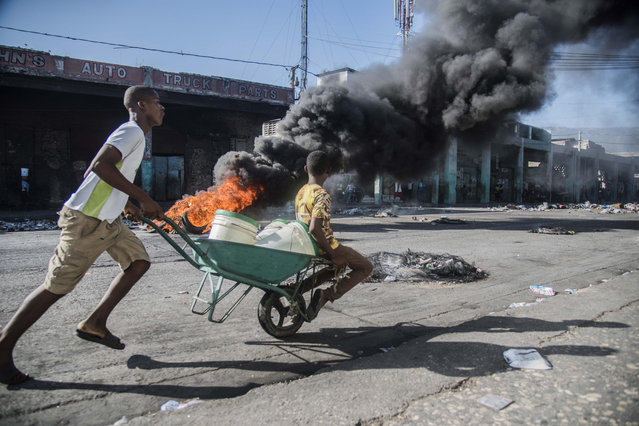
A man carries a child in a wheelbarrow near a burning tire barricade in the framework of the protests of the last three days due to the increase in fuel prices, in Port-au-Prince, Haiti, 09 July 2018. Haiti was today practically paralyzed by a transport strike after three days of violent riots due to an increase in fuel prices, which the Government left without effect shortly after the announcement. The Prime Minister, Jack Guy Lafontant, today heads a meeting with representatives of Parliament to assess the situation created after the violent protests, which have left at least three dead and several injured. (Photo by Jean Marc Hervé Abelard/EPA/EFE)

A man carries a child in a wheelbarrow near a burning tire barricade in the framework of the protests of the last three days due to the increase in fuel prices, in Port-au-Prince, Haiti, 09 July 2018. Haiti was today practically paralyzed by a transport strike after three days of violent riots due to an increase in fuel prices, which the Government left without effect shortly after the announcement. The Prime Minister, Jack Guy Lafontant, today heads a meeting with representatives of Parliament to assess the situation created after the violent protests, which have left at least three dead and several injured. (Photo by Jean Marc Hervé Abelard/EPA/EFE)
Details
22 Oct 2018 00:03:00
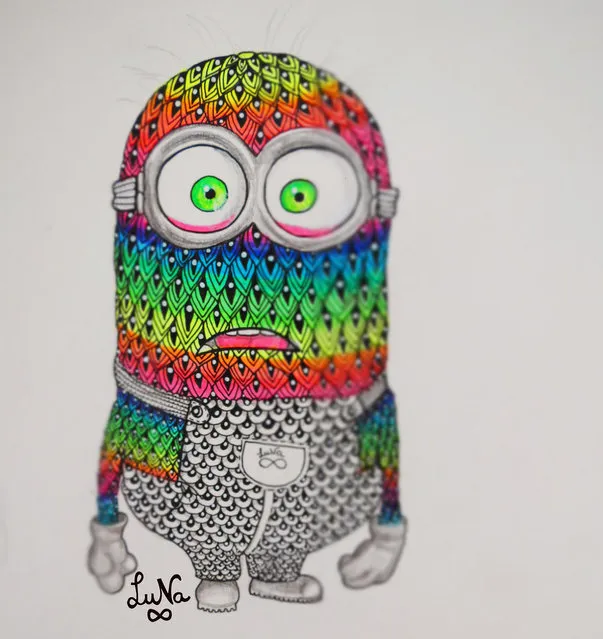
Illustration By Luna Portnoi Part 1

Luna Portnoi emerging Argentine Artist Luna Portnoi has been developing her practice in Buenos Aires for over five years. Her work is deeply connected to themes of color, nature, astronomy, childhood, magic, ancient civilizations, collaboration and the passions, openness and emotions we experience as children that are often left behind in adulthood. Already well known in Buenos Aires, the Artist has also received international press coverage.


See Also: Part 2 _ Part 3
Details
17 Sep 2014 07:47:00
Illustration By Luna Portnoi Part 3

Luna Portnoi emerging Argentine Artist Luna Portnoi has been developing her practice in Buenos Aires for over five years. Her work is deeply connected to themes of color, nature, astronomy, childhood, magic, ancient civilizations, collaboration and the passions, openness and emotions we experience as children that are often left behind in adulthood. Already well known in Buenos Aires, the Artist has also received international press coverage.


See Also: Part 1 _ Part 2
Details
22 Sep 2014 08:59:00
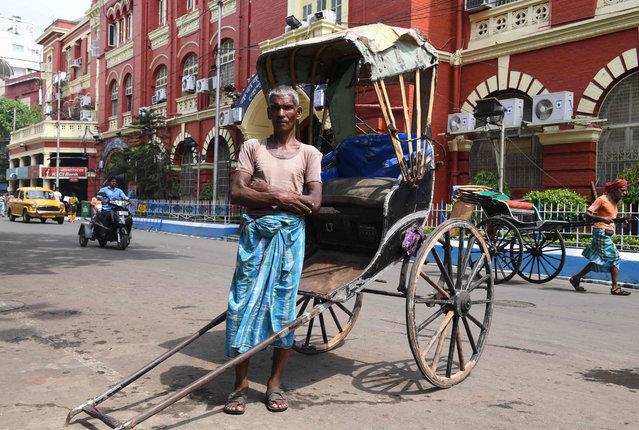
Mohammad Ashgar, 65, an Indian rickshaw puller, poses for a photograph next to his rickshaw in Kolkata on April 21, 2018. A mainstay of 19 th century transportation options, the hand- pulled rickshaw survives in India only in Kolkata after being outlawed elsewhere. The local puller's union puts the number of pullers in the city at 3,000. The union has resisted all previous attempts to ban their livelihood, previously organising mass protests of their members against moves to stamp out the practice. (Photo by Dibyangshu Sarkar/AFP Photo)

Ahead of May Day, AFP' s video and photo teams spoke to men and women around the globe whose jobs are becoming increasingly rare, particularly as technology transforms societies. Here: Mohammad Ashgar, 65, an Indian rickshaw puller, poses for a photograph next to his rickshaw in Kolkata on April 21, 2018. (Photo by Dibyangshu Sarkar/AFP Photo)
Details
02 May 2018 00:01:00
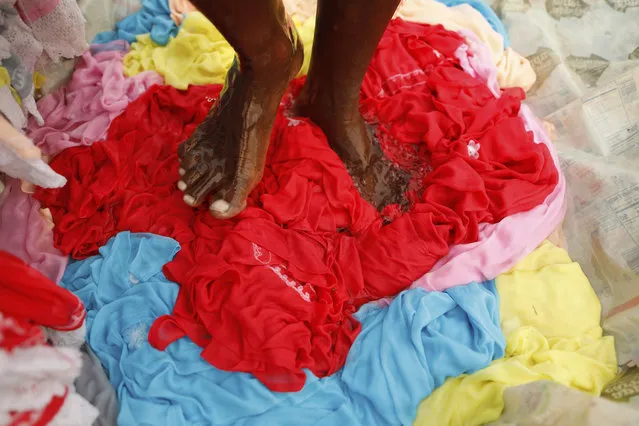
A dhobi, or a washerman washes cloths on the banks of the River Gomti in Lucknow, India, Saturday, September 12, 2020. Dhobis are traditional laundry workers who wash clothes by hand and dry them in the sun, an occupation which has been in existence for generations. Most cities in India have a Dhobi Ghat, or washermen's area, where the city's pile of clothes is laundered. This practice is still popular in India, despite of modern technology. Around 1,000 families work in Lucknow's Dhobi Ghat. However, in light of the novel coronavirus, their wages have decreased drastically. With each family earning around US$100-200 per month. (Photo by Rajesh Kumar Singh/AP Photo)

A dhobi, or a washerman washes cloths on the banks of the River Gomti in Lucknow, India, Saturday, September 12, 2020. Dhobis are traditional laundry workers who wash clothes by hand and dry them in the sun, an occupation which has been in existence for generations. Most cities in India have a Dhobi Ghat, or washermen's area, where the city's pile of clothes is laundered. This practice is still popular in India, despite of modern technology. Around 1,000 families work in Lucknow's Dhobi Ghat. However, in light of the novel coronavirus, their wages have decreased drastically. With each family earning around US$100-200 per month. (Photo by Rajesh Kumar Singh/AP Photo)
Details
25 Sep 2020 00:03:00
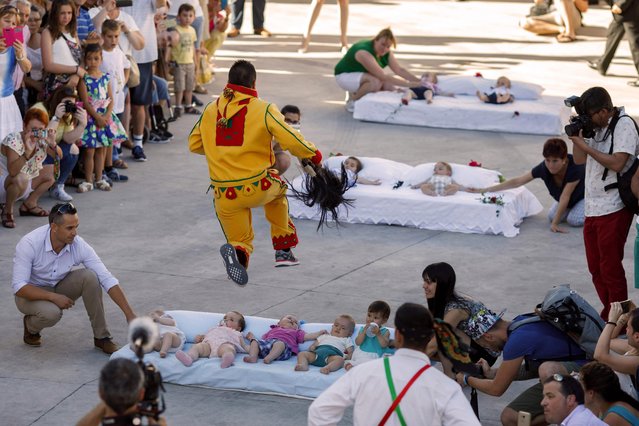
A man dressed up as the devil jumps over babies lying on a mattress in the street during “El Colacho”, the “baby jumping festival” in the village of Castrillo de Murcia, near Burgos on June 18, 2017. Baby jumping (El Colacho) is a traditional Spanish practice dating back to 1620 that takes place annually to celebrate the Catholic feast of Corpus Christi. During the act – known as El Salto del Colacho (the devil's jump) or simply El Colacho – men dressed as the Devil jump over babies born in the last twelve months of the year who lie on mattresses in the street. (Photo by Cesar Manso/AFP Photo)

A man dressed up as the devil jumps over babies lying on a mattress in the street during “El Colacho”, the “baby jumping festival” in the village of Castrillo de Murcia, near Burgos on June 18, 2017. Baby jumping (El Colacho) is a traditional Spanish practice dating back to 1620 that takes place annually to celebrate the Catholic feast of Corpus Christi. During the act – known as El Salto del Colacho (the devil's jump) or simply El Colacho – men dressed as the Devil jump over babies born in the last twelve months of the year who lie on mattresses in the street. (Photo by Cesar Manso/AFP Photo)
Details
20 Jun 2017 07:29:00