Loading...
Done


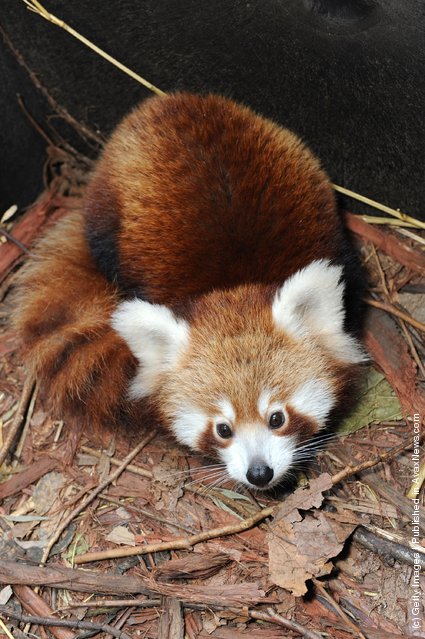
“The red panda (Ailurus fulgens, or shining-cat), is a small arboreal mammal native to the eastern Himalayas and southwestern China. It is the only species of the genus Ailurus. Slightly larger than a domestic cat, it has reddish-brown fur, a long, shaggy tail, and a waddling gait due to its shorter front legs. It feeds mainly on bamboo, but is omnivorous and may also eat eggs, birds, insects, and small mammals. It is a solitary animal, mainly active from dusk to dawn, and is largely sedentary during the day”. – Wikipedia

Photo: In this handout image provided by Taronga Zoo, Seba, a baby Red Panda, explores his new home at Taronga Zoo on April 7, 2011 in Sydney, Australia. The Red Panda cub was born at Christmas and is the 45th to be born at the zoo since 1977. (Photo by Peter Hardin/Taronga Zoo via Getty Images)
Details
07 Apr 2011 08:51:00
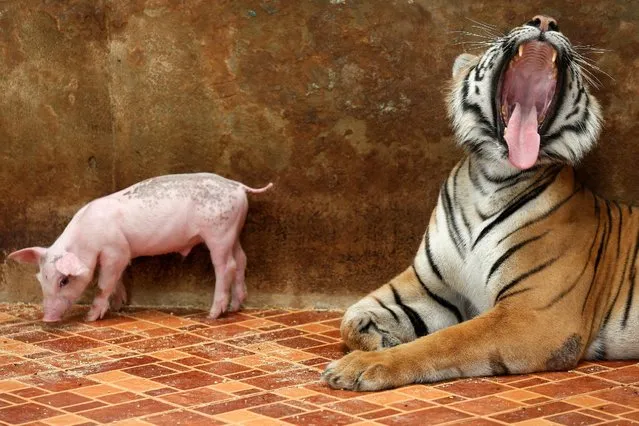
A tiger yawns next to a piglet at the Sriracha Tiger Zoo, in Chonburi province, Thailand, June 7, 2016. (Photo by Chaiwat Subprasom/Reuters)

A tiger yawns next to a piglet at the Sriracha Tiger Zoo, in Chonburi province, Thailand, June 7, 2016. (Photo by Chaiwat Subprasom/Reuters)
Details
10 Jun 2016 13:36:00
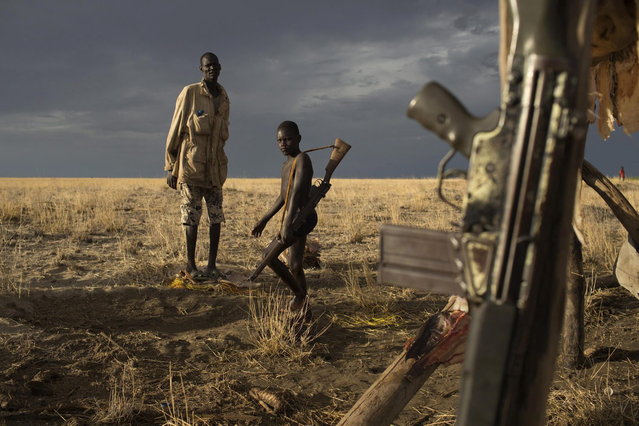
A Turkana man and a boy carrying a gun look on as a G3 battle rifle hangs from a structure used to dry fish at a fishing camp on the shores of Lake Turkana, some kilometres from Todonyang near the Kenya-Ethiopia border in northwestern Kenya October 12, 2013. (Photo by Siegfried Modola/Reuters)

A Turkana man and a boy carrying a gun look on as a G3 battle rifle hangs from a structure used to dry fish at a fishing camp on the shores of Lake Turkana, some kilometres from Todonyang near the Kenya-Ethiopia border in northwestern Kenya October 12, 2013The Turkana are traditionally nomadic pastoralists, but they have seen the pasture that they need to feed their herds suffer from recurring droughts and many have turned to fishing. However, Lake Turkana is overfished, and scarcity of food and pastureland is fuelling long-standing conflict with Ethiopian indigenous Dhaasanac, who have seen grazing grounds squeezed by large-scale government agricultural schemes in southern Ethiopia. The Dhaasanac now venture ever deeper into Kenyan territory in search of fish and grass, clashing with neighbours. Fighting between the communities has a long history, but the conflict has become ever more fatal as automatic weapons from other regional conflicts seep into the area. While the Turkana region is short of basics like grass and ground-water, it contains other resources including oil reserves and massive, newly discovered underground aquifers. (Photo by Siegfried Modola/Reuters)
Details
05 Dec 2013 12:08:00
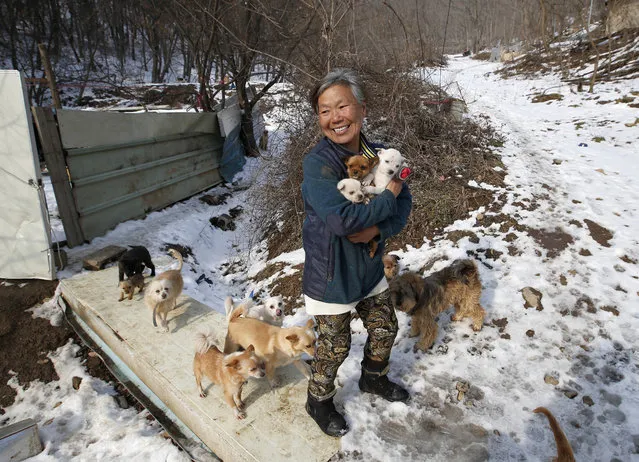
In this Wednesday, January 27, 2016 photo, Jung Myoung Sook, 61, holds her puppies she rescued at a shelter in Asan, South Korea. In the country, where dogs are considered a traditional delicacy and have only recently become popular as pets, Jung's love for her canine friends is viewed by some as odd. (Photo by Lee Jin-man/AP Photo)

In this Wednesday, January 27, 2016 photo, Jung Myoung Sook, 61, holds her puppies she rescued at a shelter in Asan, South Korea. In the country, where dogs are considered a traditional delicacy and have only recently become popular as pets, Jung's love for her canine friends is viewed by some as odd. But others see her as a champion of animal rights. (Photo by Lee Jin-man/AP Photo)
Details
03 Feb 2016 13:28:00
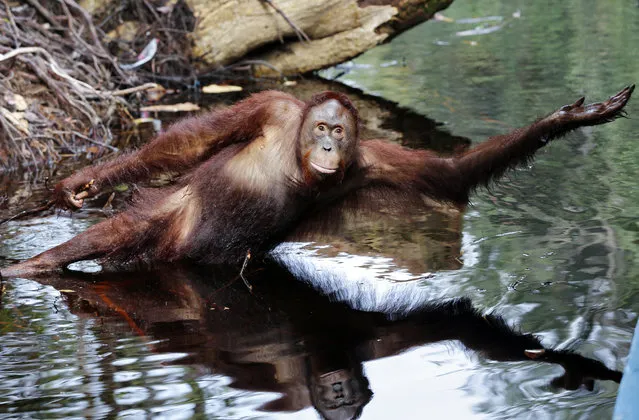
Male orangutan Percy is reflected in the Sekonyer River as he reaches over to try and touch a wooden klotok boat carrying crew and tourists, in Tanjung Puting National Park, in Kalimantan (Indonesian Borneo), Indonesia, September 4, 2013. Percy is a son, born and living in the wild, of a female orangutan named Princess, a freed former captive orangutan that anthropologist Dr Birute Galdikas rescued, rehabilitated and returned to the wild. (Photo by Barbara Walton/EPA)

Male orangutan Percy is reflected in the Sekonyer River as he reaches over to try and touch a wooden klotok boat carrying crew and tourists, in Tanjung Puting National Park, in Kalimantan (Indonesian Borneo), Indonesia, September 4, 2013. Percy is a son, born and living in the wild, of a female orangutan named Princess, a freed former captive orangutan that anthropologist Dr Birute Galdikas rescued, rehabilitated and returned to the wild. (Photo by Barbara Walton/EPA)
Details
03 Jul 2014 12:26:00
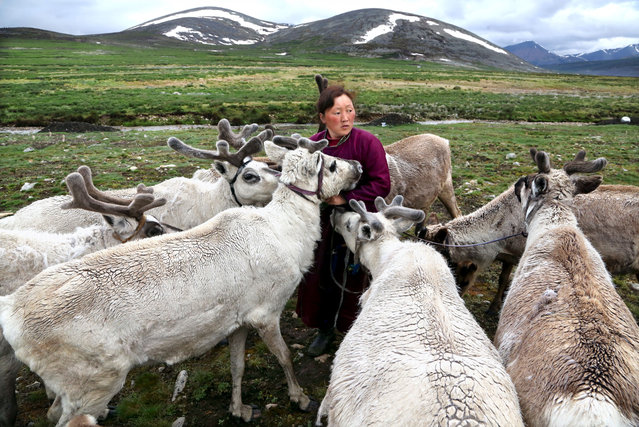
The Tsaatan people are one of the world’s last groups of nomadic reindeer herders and they live in Khövsgöl Aimag in northern Mongolia. They are originally from across the border in what is now the Tuva republic of Russia. (Photo by Pascal Mannaerts/Rex Feature/Shutterstock)

The Tsaatan people are one of the world’s last groups of nomadic reindeer herders and they live in Khövsgöl Aimag in northern Mongolia. They are originally from across the border in what is now the Tuva republic of Russia. (Photo by Pascal Mannaerts/Rex Feature/Shutterstock)
Details
04 Feb 2016 11:56:00
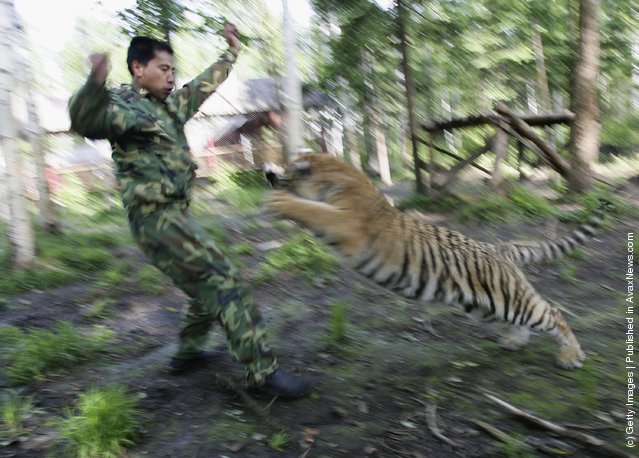
A feeder trains a Siberian tiger cub

A feeder trains a Siberian tiger cub at Erdaohe Tiger Park July 2, 2006 in Antu County of Yanbian Chaoxian Autonomous Prefecture, Jilin Province, China. About 15 artificially-fed Siberian tigers from Harbin Siberian Tiger Park are being trained to develop their ability to live in the wild. The wild Siberian tiger is listed as one of the most endangered species in the world, with its existing number estimated at around 400 worldwide, mainly in the northeastern part of China and the Far East of Russia. Reportedly there are more than 1,300 Siberian tigers which have been raised in China. (Photo by China Photos/Getty Images)
Details
01 Oct 2011 12:23:00
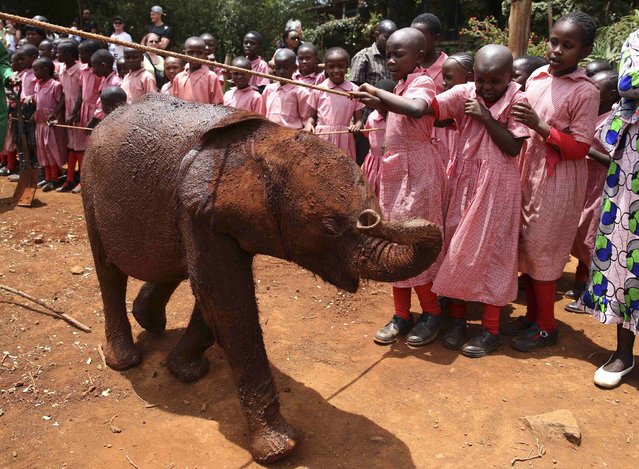
Pupils look at an orphaned baby elephant at the David Sheldrick Elephant Orphanage within the Nairobi National Park, near Kenya's capital Nairobi October 15, 2014. (Photo by Goran Tomasevic/Reuters)

Pupils look at an orphaned baby elephant at the David Sheldrick Elephant Orphanage within the Nairobi National Park, near Kenya's capital Nairobi October 15, 2014. The orphanage under the David Sheldrick Wildlife Trust is operated by Daphne Sheldrick, wife of late famous naturalist David William Sheldrick. The orphaned elephants raised by the trust will be returned to join the undomesticated elephant population in Tsavo National Park, where David was the founder warden from 1948 to 1976, when they mature, usually between eight to 10 years old. (Photo by Goran Tomasevic/Reuters)
Details
19 Oct 2014 12:47:00