Loading...
Done
Candy Cigarette, 1989. (Photo by Sally Mann)

“Sally Mann (born in Lexington, Virginia, 1951) is one of America’s most renowned photographers. She has received numerous awards, including NEA, NEH, and Guggenheim Foundation grants, and her work is held by major institutions internationally. Her many books include Second Sight (1983), At Twelve (1988), Immediate Family (1992), Still Time (1994), What Remains (2003), Deep South (2005), Proud Flesh (2009), and The Flesh and the Spirit (2010). A feature film about her work, What Remains, debuted to critical acclaim in 2006. Mann is represented by Gagosian Gallery, New York. She lives in Virginia”.

Photo: Candy Cigarette, 1989. (Photo by Sally Mann)
Details
28 Apr 2012 11:32:00
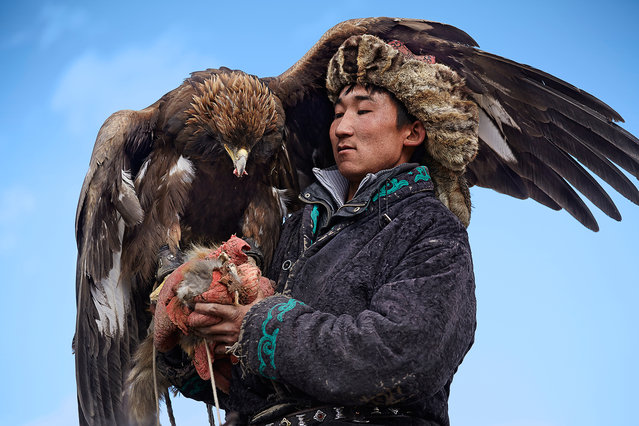
In one of the planet’s most desolate and harsh terrains, the Altai Mountains which run from Siberia in Russia down to Mongolia’s Gobi Desert, hunting with eagles is currently only practiced by a handful of Kyrgyz and Kazakhs. This form of falconry, the practice of hunting with the aid of birds of prey, can be traced back as far as 4,000 years in Central Asia. (Photo by Tariq Zaidi/The Washington Post)

In one of the planet’s most desolate and harsh terrains, the Altai Mountains which run from Siberia in Russia down to Mongolia’s Gobi Desert, hunting with eagles is currently only practiced by a handful of Kyrgyz and Kazakhs. This form of falconry, the practice of hunting with the aid of birds of prey, can be traced back as far as 4,000 years in Central Asia. Here: after a successful hunt, a proud hunter rewards his eagle by feeding it the lungs of the prey, which is considered the most highly prized part of the animal. (Photo by Tariq Zaidi/The Washington Post)
Details
22 Aug 2015 12:46:00
Bride Fan Huixiang (front R), a 25-year-old cancer patient, receives flowers from nurses on her bed before her wedding ceremony at a hospital in Zhengzhou, Henan province November 17, 2014. Fan was diagnosed with late stage adenocarcinoma, a type of cancerous tumor, at her thoracic vertebra this June. (Photo by Reuters/China Daily)

Bride Fan Huixiang (front R), a 25-year-old cancer patient, receives flowers from nurses on her bed before her wedding ceremony at a hospital in Zhengzhou, Henan province November 17, 2014. Fan was diagnosed with late stage adenocarcinoma, a type of cancerous tumor, at her thoracic vertebra this June. She and her 24-year-old husband Yu Haining held their wedding ceremony at the hospital on Monday after five years of relationship, local media reported. (Photo by Reuters/China Daily)
Details
19 Nov 2014 14:15:00
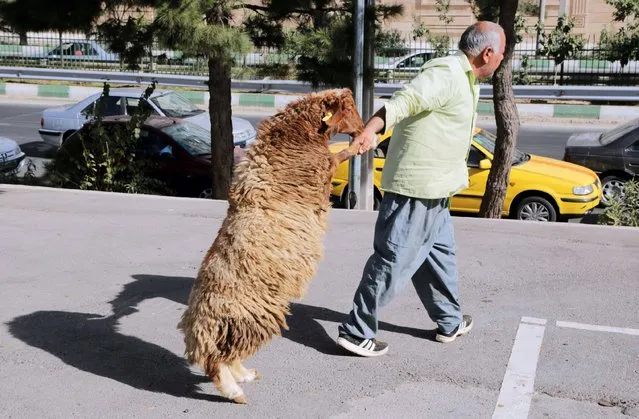
A Iranian man walks with a sheep he bought at a market in the capital Tehran on September 12, 2016, as Muslims mark the first day of the Eid al-Adha (Feast of the Sacrifice) holiday. Muslims across the world celebrate the annual festival of Eid al-Adha, or the festival of sacrifice, which marks the end of the Hajj pilgrimage to Mecca and commemorates prophet Abraham's readiness to sacrifice his son to show obedience to God. (Photo by AFP Photo/Stringer)

A Iranian man walks with a sheep he bought at a market in the capital Tehran on September 12, 2016, as Muslims mark the first day of the Eid al-Adha (Feast of the Sacrifice) holiday. Muslims across the world celebrate the annual festival of Eid al-Adha, or the festival of sacrifice, which marks the end of the Hajj pilgrimage to Mecca and commemorates prophet Abraham's readiness to sacrifice his son to show obedience to God. (Photo by AFP Photo/Stringer)
Details
13 Sep 2016 09:31:00
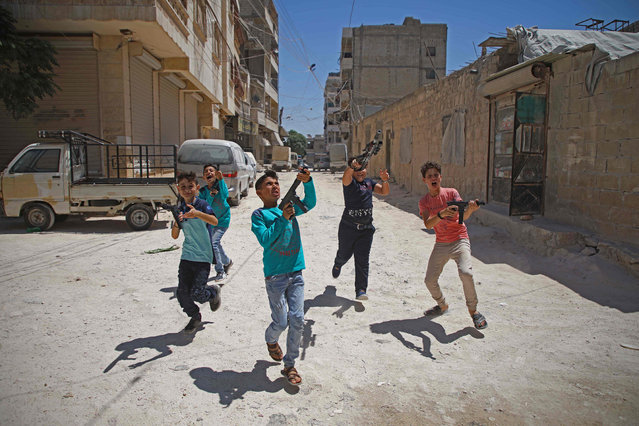
Syrian boys play with plastic guns on the first day of the Muslim religious festival of Eid al-Adha in al-Dana in Syria's rebel-controlled Idlib region, near the border with Turkey, on August 11, 2019. Muslims across the world are celebrating the first day of the Feast of Sacrifice, which marks the end of the hajj pilgrimage to Mecca and commemorates prophet Abraham's sacrifice of a lamb after God spared Ishmael, his son. (Photo by Aaref Watad/AFP Photo)

Syrian boys play with plastic guns on the first day of the Muslim religious festival of Eid al-Adha in al-Dana in Syria's rebel-controlled Idlib region, near the border with Turkey, on August 11, 2019. Muslims across the world are celebrating the first day of the Feast of Sacrifice, which marks the end of the hajj pilgrimage to Mecca and commemorates prophet Abraham's sacrifice of a lamb after God spared Ishmael, his son. (Photo by Aaref Watad/AFP Photo)
Details
13 Aug 2019 00:03:00
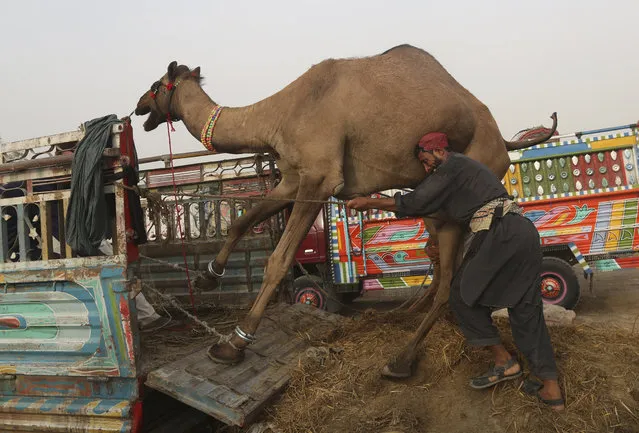
A Pakistani owner tries to load camel on a truck at a cattle market set up for the upcoming Muslim festival Eid al-Adha in Karachi, Pakistan, Friday, August 17, 2018. Eid al-Adha, or Feast of Sacrifice, most important Islamic holiday marks the willingness of the Prophet Ibrahim (Abraham to Christians and Jews) to sacrifice his son. (Photo by Shakil Adil/AP Photo)

A Pakistani owner tries to load camel on a truck at a cattle market set up for the upcoming Muslim festival Eid al-Adha in Karachi, Pakistan, Friday, August 17, 2018. Eid al-Adha, or Feast of Sacrifice, most important Islamic holiday marks the willingness of the Prophet Ibrahim (Abraham to Christians and Jews) to sacrifice his son. (Photo by Shakil Adil/AP Photo)
Details
20 Sep 2018 00:01:00
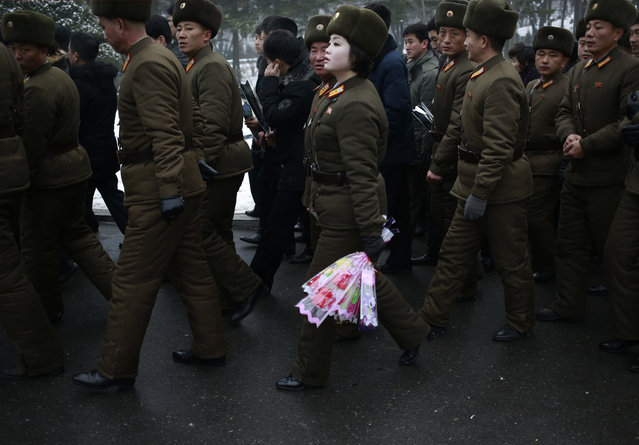
A member of North Korean military holds flowers to be laid at the bronze statues of the late leaders Kim Il Sung and Kim Jong Il at Mansu Hill Grand Monument in Pyongyang, North Korea, Monday, December 17, 2018. North Koreans are marking the seventh anniversary of the death of leader Kim Jong Il with visits to the statues and vows of loyalty to his son, Kim Jong Un. (Photo by Dita Alangkara/AP Photo)

A member of North Korean military holds flowers to be laid at the bronze statues of the late leaders Kim Il Sung and Kim Jong Il at Mansu Hill Grand Monument in Pyongyang, North Korea, Monday, December 17, 2018. North Koreans are marking the seventh anniversary of the death of leader Kim Jong Il with visits to the statues and vows of loyalty to his son, Kim Jong Un. (Photo by Dita Alangkara/AP Photo)
Details
19 Dec 2018 00:05:00
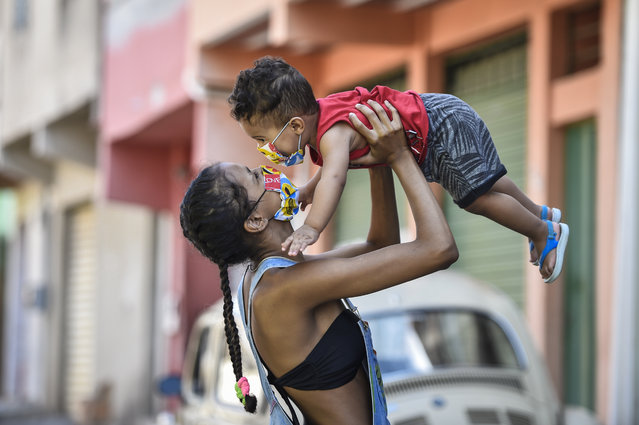
Carolaine Reis and her son Miguel Alves, residents of the Aglomerado da Serra favela, wear a protective mask against the spread of the new Coronavirus (COVID-19) made by the seamstresses of the Remexe Favelinha studio, in the Aglomerado da Serra favela, on April 13, 2020 in Belo Horizonte, Brazil. Facial masks follow the protocol and guidelines defined by the Ministry of Health. Around 6,000 masks have already been produced. The masks are being distributed to a part of the population and sold throughout the country, in the amount of 5 reais per unit. (Photo by Pedro Vilela/Getty Images)

Carolaine Reis and her son Miguel Alves, residents of the Aglomerado da Serra favela, wear a protective mask against the spread of the new Coronavirus (COVID-19) made by the seamstresses of the Remexe Favelinha studio, in the Aglomerado da Serra favela, on April 13, 2020 in Belo Horizonte, Brazil. Facial masks follow the protocol and guidelines defined by the Ministry of Health. Around 6,000 masks have already been produced. The masks are being distributed to a part of the population and sold throughout the country, in the amount of 5 reais per unit. (Photo by Pedro Vilela/Getty Images)
Details
16 Apr 2020 00:03:00