Loading...
Done
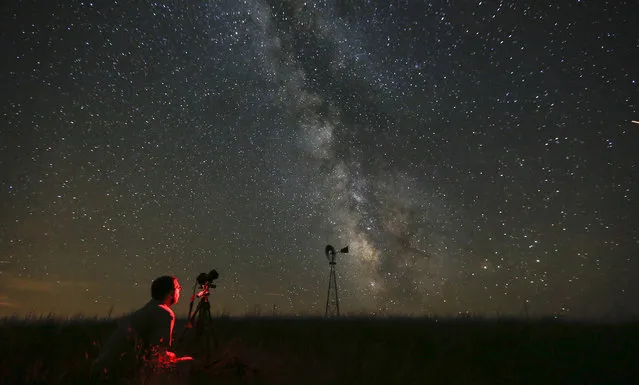
In this Wednesday, July 23, 2014 file photo, Omaha photographer Lane Hickenbottom photographs the night sky in a pasture near Callaway, Neb. With no moon in the sky, the Milky Way was visible to the naked eye. More than one-third of the world’s population can no longer see the Milky Way because of man-made lights, according to a scientific paper by Light Pollution Science and Technology Institute's Fabio Falchi and his team members, published on Friday, June 10, 2016. (Photo by Travis Heying/The Wichita Eagle via AP Photo)

In this Wednesday, July 23, 2014 file photo, Omaha photographer Lane Hickenbottom photographs the night sky in a pasture near Callaway, Neb. With no moon in the sky, the Milky Way was visible to the naked eye. More than one-third of the world’s population can no longer see the Milky Way because of man-made lights, according to a scientific paper by Light Pollution Science and Technology Institute's Fabio Falchi and his team members, published on Friday, June 10, 2016. (Photo by Travis Heying/The Wichita Eagle via AP Photo)
Details
11 Jun 2016 12:37:00
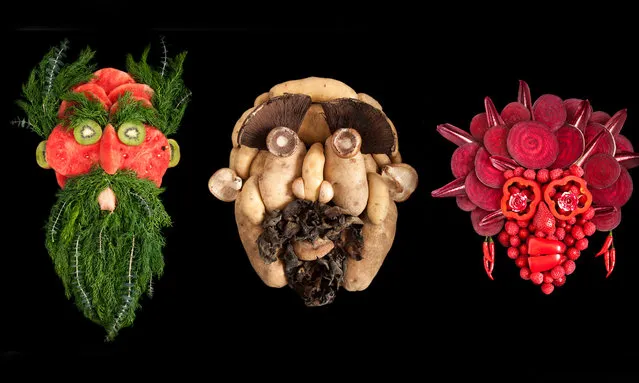
Photographer Emily Dryden and sculptor/actor Zahydé Pietri combine theatricality and organic produce to compose the photographs for their series Fresh Faces. The portraits are made from a wide range of fruit and vegetables and aim to highlight humanity’s diversity – Pietri is from Puerto Rico and Dryden is from New York. Each face has its own name and identity: “We have stories for them, which you can see in the expressions”, says Dryden, “but we decided to keep them to ourselves. We didn’t want to spoil that”. (Photo by Emily Dryden and Zahydé Pietri/The Guardian)

Photographer Emily Dryden and sculptor/actor Zahydé Pietri combine theatricality and organic produce to compose the photographs for their series Fresh Faces. The portraits are made from a wide range of fruit and vegetables and aim to highlight humanity’s diversity – Pietri is from Puerto Rico and Dryden is from New York. Each face has its own name and identity: “We have stories for them, which you can see in the expressions”, says Dryden, “but we decided to keep them to ourselves. We didn’t want to spoil that”. (Photo by Emily Dryden and Zahydé Pietri/The Guardian)
Details
25 Jul 2016 11:08:00
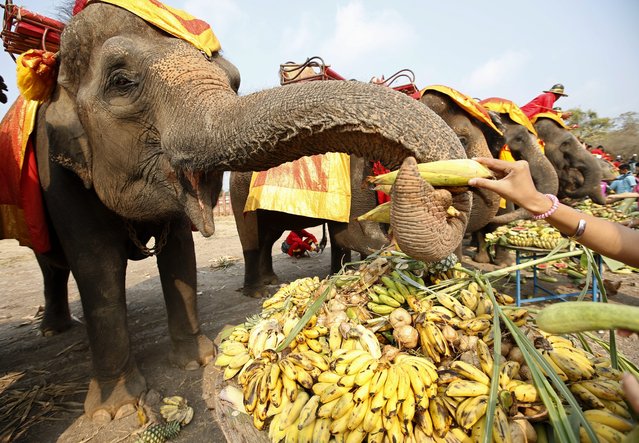
Elephants enjoy various kinds of fruits and vegetables during an all-you-can-eat elephant buffet held to mark the National Elephant Day at the ancient historical city of Ayutthaya, Thailand, 13 March 2014. The annual National Thai Elephant Day is held on 13 March to celebrate and drawing public attention for more concerted effort to save the species and protect its habitat. Thailand sees a severe decline with less than 3,000 wild elephants left in the kingdom. (Photo by Rungroj Yongrit/EPA)

Elephants enjoy various kinds of fruits and vegetables during an all-you-can-eat elephant buffet held to mark the National Elephant Day at the ancient historical city of Ayutthaya, Thailand, 13 March 2014. The annual National Thai Elephant Day is held on 13 March to celebrate and drawing public attention for more concerted effort to save the species and protect its habitat. Thailand sees a severe decline with less than 3,000 wild elephants left in the kingdom. (Photo by Rungroj Yongrit/EPA)
Details
14 Mar 2014 07:16:00
A combination photo shows some of the colourful doors seen in Rabat's Medina and Kasbah of the Udayas, September 2014. UNESCO made Rabat a World Heritage Site two years ago and media and tour operators call it a “must-see destination”. (Photo by Damir Sagolj/Reuters)

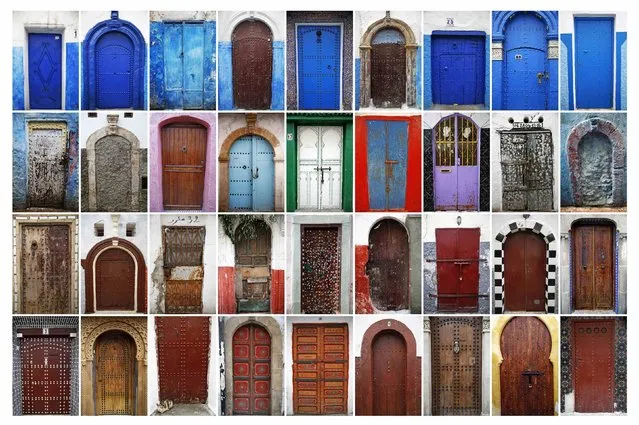
A combination photo shows some of the colourful doors seen in Rabat's Medina and Kasbah of the Udayas, September 2014. UNESCO made Rabat a World Heritage Site two years ago and media and tour operators call it a “must-see destination”. But it seems the tourist hordes have yet to find out. While visitors are getting squeezed through the better-known sites of Marrakesh and Fez, the old part of Rabat - with its beautiful Medina and Kasbah of the Udayas - remains an almost unspoiled oasis of calm. Smaller and more compact, its labyrinths of streets, passages and dead ends are a treasure trove of shapes and colours, of moments begging to be caught by the photographer's lens. (Photo by Damir Sagolj/Reuters)
Details
08 Oct 2014 12:08:00
Merit: A Night at Deadvlei. The night before returning to Windhoek, we spent several hours at Deadveli. The moon was bright enough to illuminate the sand dunes in the distance, but the skies were still dark enough to clearly see the milky way and magellanic clouds. Deadveli means “dead marsh. (Photo and caption by Beth McCarley/National Geographic Traveler Photo Contest)

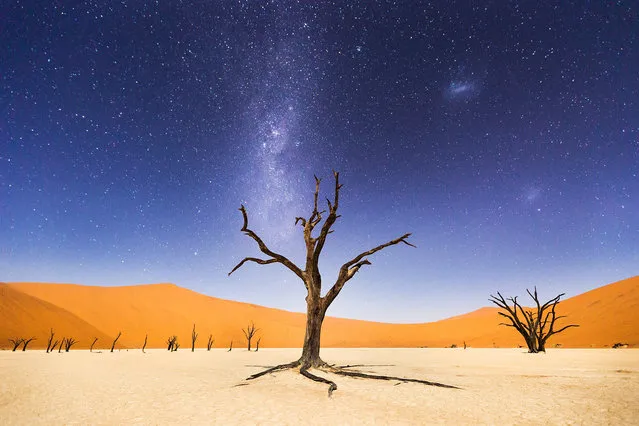
Merit: A Night at Deadvlei. The night before returning to Windhoek, we spent several hours at Deadveli. The moon was bright enough to illuminate the sand dunes in the distance, but the skies were still dark enough to clearly see the milky way and magellanic clouds. Deadveli means “dead marsh. The camelthorn trees are believed to be about 900 years old, but have not decomposed because the environment is so dry. (Photo and caption by Beth McCarley/National Geographic Traveler Photo Contest)
Details
04 Aug 2015 11:50:00
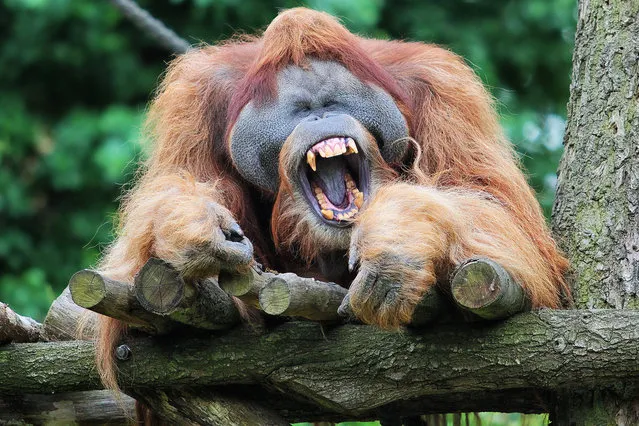
This huge male orangutan is having a right old laugh as he squints his eyes and shows his huge teeth.  The orangutan, called Bimbo, was relaxing on a platform around 5m high in his enclosure when he broke out into a laugh. But his happy smile soon disappeared when another orangutan came over to see what was going on.  Bimbo – the only male in the group of five apes at Leipzig Zoo, in Germany - appears to be laughing in much the same way as a human would. (Photo by Martina Radtke/Solent News)

This huge male orangutan is having a right old laugh as he squints his eyes and shows his huge teeth. The orangutan, called Bimbo, was relaxing on a platform around 5m high in his enclosure when he broke out into a laugh. But his happy smile soon disappeared when another orangutan came over to see what was going on. Bimbo – the only male in the group of five apes at Leipzig Zoo, in Germany - appears to be laughing in much the same way as a human would. (Photo by Martina Radtke/Solent News)
Details
29 Aug 2015 11:10:00
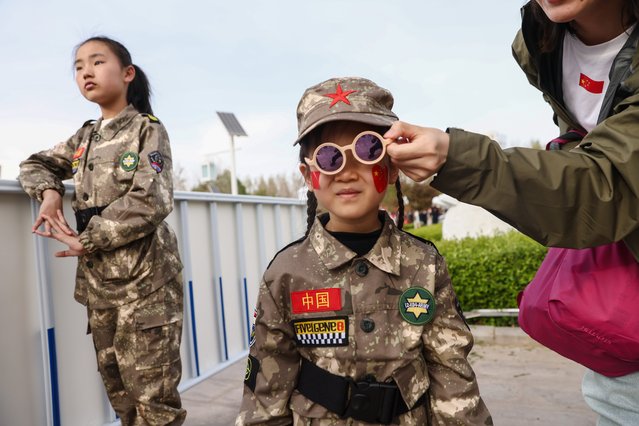
A girl in a military uniform poses for a photo after the see-off ceremony before the launch in Jiuquan, Gansu province, China, 25 April 2024. China's Shenzhou-18 manned spaceflight mission with three astronauts is the third manned spaceflight mission of China Space Station's development phase. The mission will last for about six months and the crew will carry out tasks such as installation, commissioning, maintenance, repair, and experiments in space. (Photo by Wu Hao/EPA/EFE)

A girl in a military uniform poses for a photo after the see-off ceremony before the launch in Jiuquan, Gansu province, China, 25 April 2024. China's Shenzhou-18 manned spaceflight mission with three astronauts is the third manned spaceflight mission of China Space Station's development phase. The mission will last for about six months and the crew will carry out tasks such as installation, commissioning, maintenance, repair, and experiments in space. (Photo by Wu Hao/EPA/EFE)
Details
20 May 2024 02:15:00
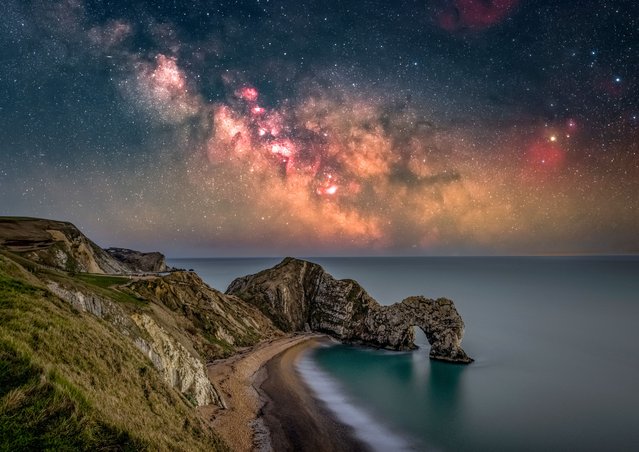
The Milky Way rising above Durdle Door in Dorset, United Kingdom on Saturday night, March 18, 2023. The image consists of 19 two-minute exposures, ten of the foreground and nine of the sky which needed a motorised star tracker to ensure the Milky Way wasn't blurry. All the photos were merged together to reveal more detail than what the naked eye can see. (Photo by Nick Bull/Picture Exclusive)

The Milky Way rising above Durdle Door in Dorset, United Kingdom on Saturday night, March 18, 2023. The image consists of 19 two-minute exposures, ten of the foreground and nine of the sky which needed a motorised star tracker to ensure the Milky Way wasn't blurry. All the photos were merged together to reveal more detail than what the naked eye can see. (Photo by Nick Bull/Picture Exclusive)
Details
24 Aug 2023 02:47:00