Loading...
Done


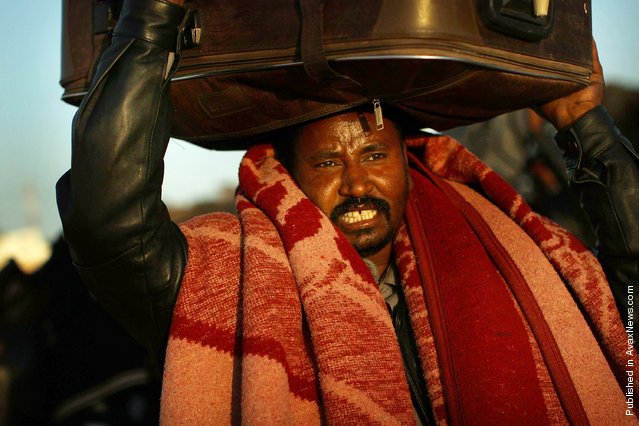
A Sudanese man walks to a United Nations displacement camp after crossing into Tunisia from Libya on March 06, 2011 in Ras Jdir, Tunisia. As fighting continues in and around the Libyan capital of Tripoli, tens of thousands of guest workers from Egypt, Tunisia, Bangladesh and other countries are fleeing to the border of Tunisia to escape the violence. The situation has turned into a humanitarian emergency as fledgling Tunisia is overwhelmed with the workers. Libyan leader Muammar Gaddafi has vowed to fight to the end. (Photo by Spencer Platt/Getty Images). RAS JDIR, TUNISIA – MARCH 06 2011
Details
10 Mar 2011 11:44:00
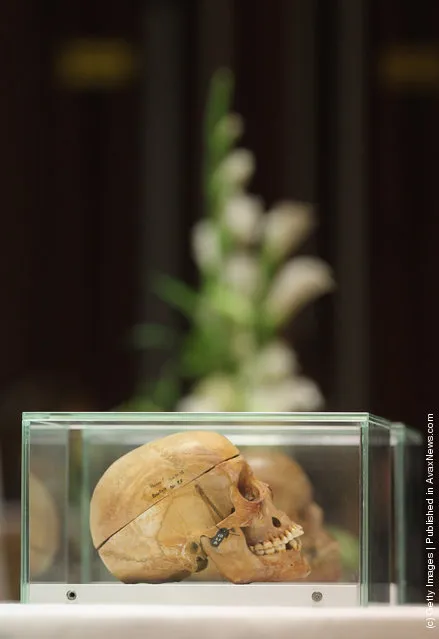
Charite Hospital Returns Herero Skulls To Namibia

Two of 20 skulls to be taken possession of by a delegation from Namibia stand on display at a ceremony at Charite hospital on September 30, 2011 in Berlin, Germany. The skulls are from Herero and Nama tribespeople taken by German colonial forces between 1904 and 1908, when the Germans violently suppressed an uprising in what was then German Southwest Africa, which is today's Namibia, and in the process killed tens of thousand of Herero and Nama. German scientists at the time took the skulls back to Berlin to demonstrate the racial superiority of Europeans over black Africans. Many Namibians demand a formal apology from the German government. (Photo by Sean Gallup/Getty Images)
Details
02 Oct 2011 11:42:00
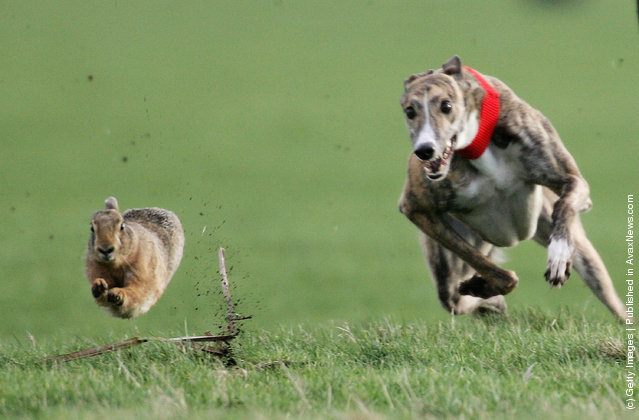
Greyhounds race after a Hare at the last Waterloo Cup Hare coursing event

“The Waterloo Cup was a coursing event. The three day event was run annually at Great Altcar in Lancashire, England from 1836 to 2005 and it used to attract tens of thousands of spectators to watch and gamble on the coursing matches. It was founded by William Philip Molyneux, 2nd Earl of Sefton, and, originally, was supported by his patronage”. – Wikipedia

Photo: A Greyhound races after Hare at the last Waterloo Cup Hare coursing event, February 14, 2005, near Liverpool, England. (Photo by Christopher Furlong/Getty Images)
Details
18 Feb 2012 11:26:00
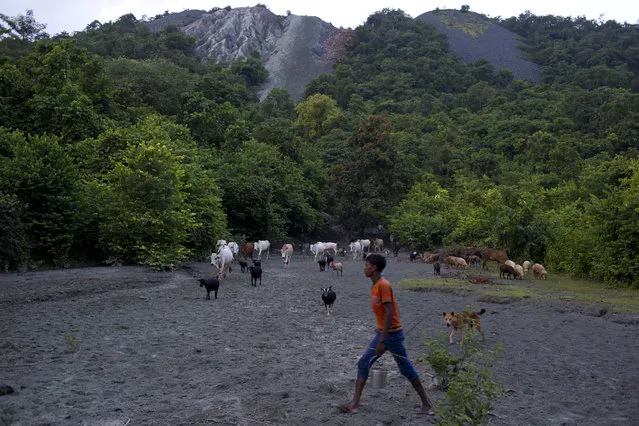
In this September 11, 2014 photo, villagers climb down the side of a hill used earlier as a dumping ground of asbestos waste on Roro hills in Roro, India. (Photo by Saurabh Das/AP Photo)

In this September 11, 2014 photo, villagers climb down the side of a hill used earlier as a dumping ground of asbestos waste on Roro hills in Roro, India. An asbestos mine, abandoned nearly three decades ago still affects the people around it and 18 along with Jema were diagnosed with asbestosis in 2012. Tens of thousands more, some former mine workers, remain untested and at risk. (Photo by Saurabh Das/AP Photo)
Details
26 Dec 2014 14:44:00
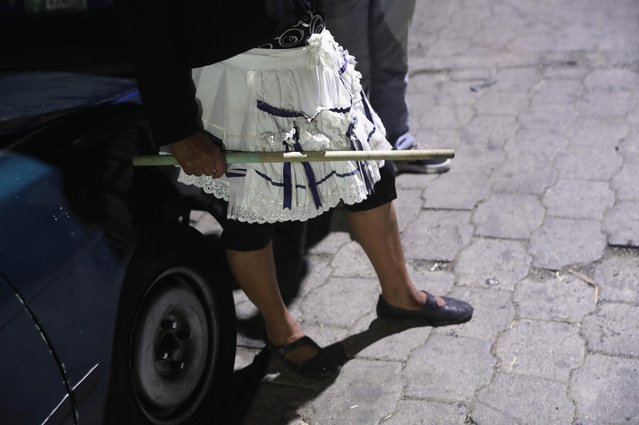
A neighborhood watch volunteer stands guard on her street on February 9, 2017 in Peronia, Guatemala. (Photo by John Moore/Getty Images)

A neighborhood watch volunteer stands guard on her street on February 9, 2017 in Peronia, Guatemala. Residents of Peronia, south of Guatemala City organized block by block to secure their community after ten of their neighbors in January were killed, they say, for refusing to pay extortion money to gangs. Armed with machetes and sticks, residents take turns each night, baring strangers' entry into their neighborhoods. Violence and poverty continue to drive emigration from Central America to the United States, even as the Trump administration moves to tighten border security. (Photo by John Moore/Getty Images)
Details
11 Feb 2017 00:00:00
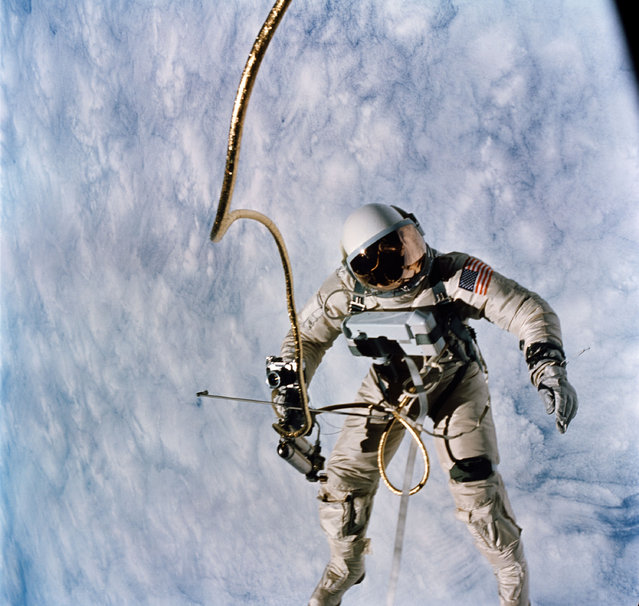
Astronaut Edward H. White II, pilot for the Gemini-Titan 4 (GT-4) spaceflight, floats in the zero-gravity of space during the third revolution of the GT-4 spacecraft on June 3, 1965. White wears a specially designed spacesuit. His face is shaded by a gold-plated visor to protect him from unfiltered rays of the sun. (Photo by NASA)

Astronaut Edward H. White II, pilot for the Gemini-Titan 4 (GT-4) spaceflight, floats in the zero-gravity of space during the third revolution of the GT-4 spacecraft on June 3, 1965. White wears a specially designed spacesuit. His face is shaded by a gold-plated visor to protect him from unfiltered rays of the sun. In his right hand he carries a Hand-Held Self-Maneuvering Unit (HHSMU) that gives him control over his movements in space. White also wears an emergency oxygen chest pack; and he carries a camera mounted on the HHSMU for taking pictures of the sky, Earth and the GT-4 spacecraft. He is secured to the spacecraft by a 25-feet umbilical line and a 23-feet tether line. Both lines are wrapped together in gold tape to form one cord. Astronaut James A. McDivitt, command pilot, remained inside the spacecraft during the extravehicular activity (EVA). Astronaut White died in the Apollo/Saturn 204 fire at Cape Kennedy on January 27, 1967. (Photo by NASA)
Details
22 Jul 2014 12:05:00
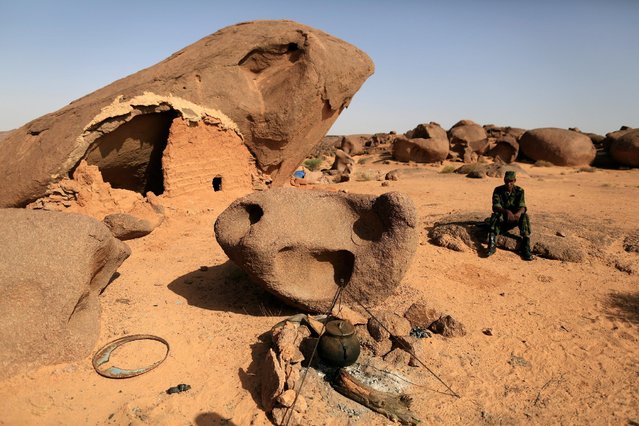
A Polisario fighter sits on a rock at a forward base on the outskirts of Tifariti, Western Sahara, September 9, 2016. At a rocky outpost in Western Sahara, a new generation of soldiers who have never known war are mobilising as tensions resurface in one of Africa's oldest disputes after a quarter century of uneasy peace. Young Sahrawi troops man new desert posts for the Polisario Front, which for more than 40 years has sought independence for the vast desert region - first in a guerrilla war against Morocco and then politically since a ceasefire deal in 1991. Now a standoff with Morocco, which controls the majority of Western Sahara, is renewing pressure for a diplomatic solution to ensure foot soldiers don't return to fighting as the last generation of commanders once did. The standoff since August has brought Moroccan and Polisario forces within 200 metres of each other in a narrow strip of land near the Mauritanian border. Rich in phosphate, Western Sahara has been contested since 1975 when Spanish colonial powers left. Morocco claimed the territory and fought the 16-year war with Polisario. (Photo by Zohra Bensemra/Reuters)

A Polisario fighter sits on a rock at a forward base on the outskirts of Tifariti, Western Sahara, September 9, 2016. At a rocky outpost in Western Sahara, a new generation of soldiers who have never known war are mobilising as tensions resurface in one of Africa's oldest disputes after a quarter century of uneasy peace. (Photo by Zohra Bensemra/Reuters)
Details
04 Nov 2016 12:09:00
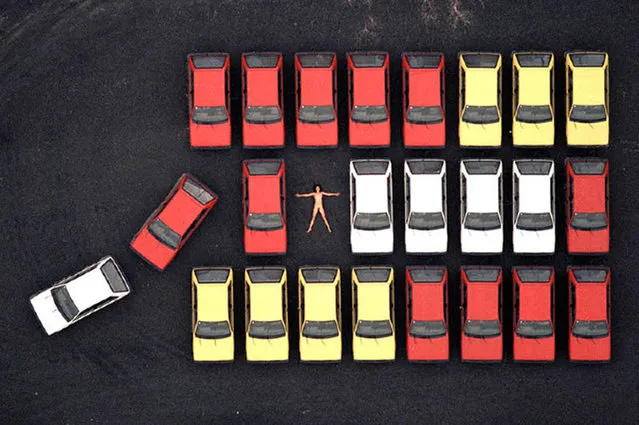
Aerial Nudes by John Crawford

John Crawford was always fascinated of a birds eye view, looking straight down in a vertical perspective. In his series ‘Aerial Nudes’ he is photographing single naked bodies from a high elevation. Perfectly timed photographs show a distant nude body laying down in a series of interesting locations. On each selected shoot day Crawford would deliver his model Carina to the location in the helicopter, positioning her in the carefully arranged set-up, then flying to 600 feet and capturing the image, which would take no more than ten minutes.
Details
09 Aug 2012 11:35:00