Loading...
Done
Komodo National Park

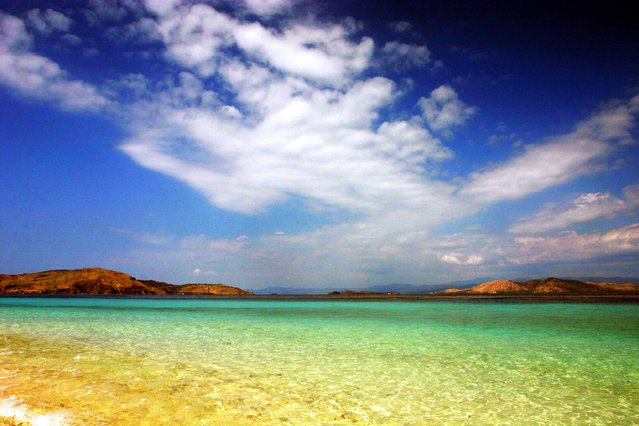
The Komodo National Park is a national park in Indonesia located within the Lesser Sunda Islands in the border region between the provinces of East Nusa Tenggara and West Nusa Tenggara. The park includes the three larger islands Komodo, Padar and Rinca, and 26 smaller ones, with a total area of 1,733 km² (603 km² of it land). The national park was founded in 1980 to protect the Komodo dragon, the world's largest lizard. Later it was dedicated to protecting other species, including marine species. In 1991 the national park was declared a UNESCO World Heritage Site and later as Man and Biosphere Reserve.
Details
12 Aug 2013 12:28:00
Guests spend the evening in the beach bars in Berlin, Germany

Guests spend the night in the beach bar so called club of the visionairs in the early morning hours of August 21, 2011 in Berlin, Germany. Berlin, which is among Europe's most popular travel destinations, is crisscrossed with canals and rivers over which lead a total of 564 bridges. The city's ample access to water has encouraged many bar and restaurant owners to create beach atmosphere as a growing summer day- and nightlife institution. (Photo by Carsten Koall/Getty Images)
Details
21 Aug 2011 11:16:00
A reveller plays with tomato pulp during the annual Tomatina festival in Bunol, near Valencia, Spain on August 29, 2018. (Photo by Heino Kalis/Reuters)

A reveller plays with tomato pulp during the annual Tomatina festival in Bunol, near Valencia, Spain on August 29, 2018. As every year on the last Wednesday of August, thousands of people visit the small village of Bunol to attend the Tomatina, a battle in which tons of ripe tomatoes are used as weapons. This year, a total of 145 tons of ripe tomatoes will be thrown between more than 22,000 participants. (Photo by Heino Kalis/Reuters)
Details
05 Sep 2018 09:00:00
American actress Nicola Peltz poses on the red carpet as she arrives for the world premiere of the movie “Transformers 4: Age of Extinction” in Hong Kong Thursday, June 19, 2014. The latest installment in the blockbuster series of “Transformers” films is making its world premier not in the usual entertainment hubs of Los Angeles or New York but in the wealthy Chinese metropolis of Hong Kong, the latest sign of Hollywood's increasing focus on China's booming film market. (Photo by Kin Cheung/AP Photo)

American actress Nicola Peltz poses on the red carpet as she arrives for the world premiere of the movie “Transformers 4: Age of Extinction” in Hong Kong Thursday, June 19, 2014. The latest installment in the blockbuster series of “Transformers” films is making its world premier not in the usual entertainment hubs of Los Angeles or New York but in the wealthy Chinese metropolis of Hong Kong, the latest sign of Hollywood's increasing focus on China's booming film market. (Photo by Kin Cheung/AP Photo)
Details
21 Jun 2014 12:26:00
Buddy the dog peers from a vehicle before the start of a movie at a drive in cinema in Snagov, Romania, Monday, June 1, 2020. Romania further loosened the measures imposed during a nationwide lockdown in order to limit the spread of the COVID-19 infections, with museums, open air restaurants, cinemas and beaches opening for public on Monday. (Photo by Andreea Alexandru/AP Photo)

Buddy the dog peers from a vehicle before the start of a movie at a drive in cinema in Snagov, Romania, Monday, June 1, 2020. Romania further loosened the measures imposed during a nationwide lockdown in order to limit the spread of the COVID-19 infections, with museums, open air restaurants, cinemas and beaches opening for public on Monday. (Photo by Andreea Alexandru/AP Photo)
Details
21 Jun 2020 00:05:00
Pineapple

“One Third” – a project on food waste by an Austrian photography Klaus Pichler. According to a UN study one third of the world's food goes to waste – the largest part thereof in the industrialized nations of the global north. Equally, 925 million people around the world are threatened by starvation. The series “One Third” describes the connection between individual wastage of food and globalized food production.

Photo: Pineapple. Place of production: Guayaquil, Ecuador. Cultivation method: Outdoor plantation • Time of harvest: All- season. Transporting distance: 10.666 km (linear distance) • Means of transportation: Aircraft, truck. Carbon footprint (total) per kg: 11,94 kg • Water requirement (total) per kg: 360 l. Price: 2,10 € / kg. (Photo by Klaus Picher)
Details
02 May 2012 11:01:00
A receptionist dinosaur robot performs at the new robot hotel, aptly called Henn na Hotel or Weird Hotel, in Sasebo, southwestern Japan, Wednesday, July 15, 2015. From the receptionist that does the check-in and check-out to the porter that’s a stand-on-wheels taking luggage up to the room, the hotel, that is run as part of Huis Ten Bosch amusement park, is “manned” almost totally by robots to save labor costs. (Photo by Shizuo Kambayashi/AP Photo)

A receptionist dinosaur robot performs at the new robot hotel, aptly called Henn na Hotel or Weird Hotel, in Sasebo, southwestern Japan, Wednesday, July 15, 2015. From the receptionist that does the check-in and check-out to the porter that’s a stand-on-wheels taking luggage up to the room, the hotel, that is run as part of Huis Ten Bosch amusement park, is “manned” almost totally by robots to save labor costs. (Photo by Shizuo Kambayashi/AP Photo)
Details
16 Jul 2015 11:18:00
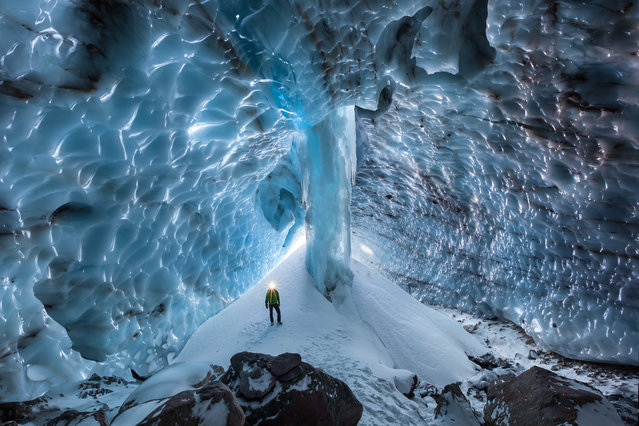
On the western side of Mount Hood lies the longest glacier cave system in the contiguous United States. In 2012, these caves were mapped to a combined length of 7,166.8 feet by cave explorers Brent McGregor and Eddy Cartaya. Currently, the total passage length is hundreds of feet less. Glaciers are frozen rivers; they are always moving and changing. In the past five years, we have seen the caves melt, shrink and collapse in a dramatic way. The caves are formed by water carving away at the ice. (Photo and caption by Josh Hydeman)

On the western side of Mount Hood lies the longest glacier cave system in the contiguous United States. In 2012, these caves were mapped to a combined length of 7,166.8 feet by cave explorers Brent McGregor and Eddy Cartaya. Currently, the total passage length is hundreds of feet less. Glaciers are frozen rivers; they are always moving and changing... (Photo and caption by Josh Hydeman)
Details
22 Mar 2015 11:05:00