Loading...
Done
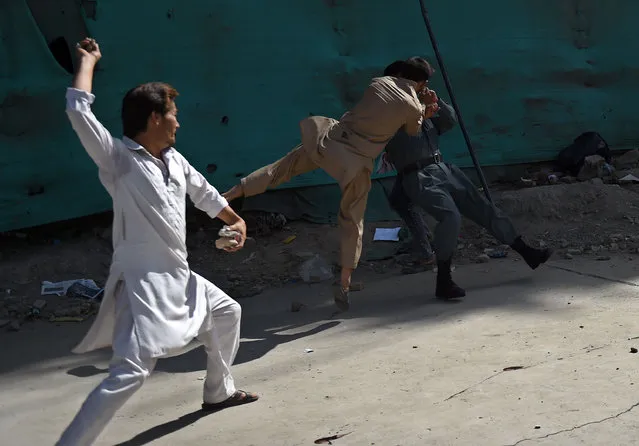
Afghan protesters beat a policeman after a suicide attack that targeted crowds of minority Shiite Hazaras during a demonstration at the Deh Mazang Circle of Kabul on July 23, 2016. Islamic State jihadists claimed responsibility for twin explosions July 23 that ripped through crowds of Shiite Hazaras in Kabul, killing at least 61 people and wounding 207 others in apparently their deadliest attack in the Afghan capital. The bombings during a huge protest over a power transmission line could deepen sectarian divisions in a country well known for communal harmony despite decades of war. (Photo by Wakil Kohsar/AFP Photo)

Afghan protesters beat a policeman after a suicide attack that targeted crowds of minority Shiite Hazaras during a demonstration at the Deh Mazang Circle of Kabul on July 23, 2016. Islamic State jihadists claimed responsibility for twin explosions July 23 that ripped through crowds of Shiite Hazaras in Kabul, killing at least 61 people and wounding 207 others in apparently their deadliest attack in the Afghan capital. The bombings during a huge protest over a power transmission line could deepen sectarian divisions in a country well known for communal harmony despite decades of war. (Photo by Wakil Kohsar/AFP Photo)
Details
25 Jul 2016 11:46:00
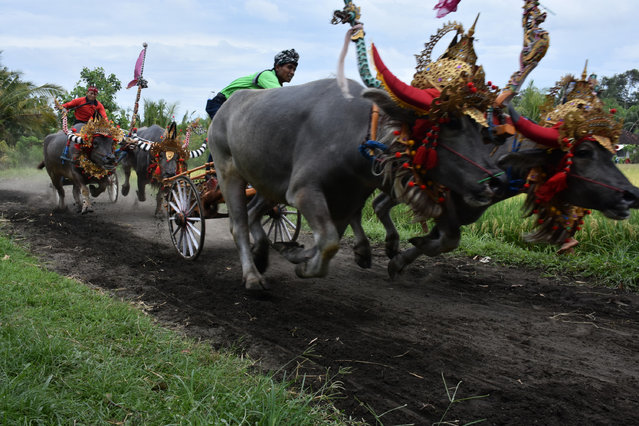
Jockeys spur buffalos during the Makepung buffalo races at Jembrana in Bali, Indonesia on October 23, 2016. Makepung is a tradition for farmers to celebrate a bumper harvest in Bali. (Photo by Kadek Raharja/Xinhua/Barcroft Images)

Jockeys spur buffalos during the Makepung buffalo races at Jembrana in Bali, Indonesia on October 23, 2016. Makepung is a tradition for farmers to celebrate a bumper harvest in Bali. (Photo by Kadek Raharja/Xinhua/Barcroft Images)
Details
25 Oct 2016 10:50:00
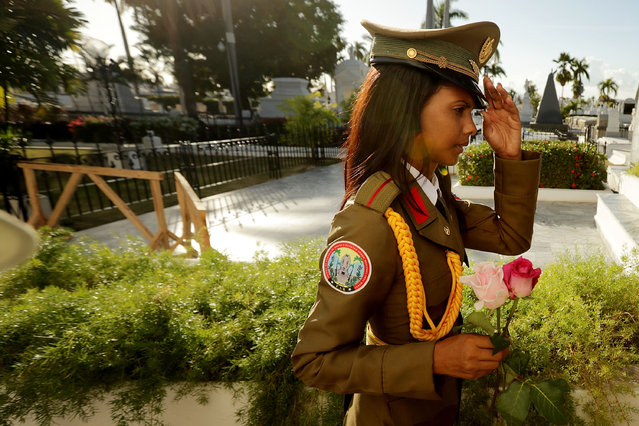
A military guard carries flowers through the Cementerio Santa Ifigenia where the remains of former Cuban President Fidel Castro were entombed December 4, 2016 in Santiago de Cuba, Cuba. The tomb stands to the side of a memorial to the rebel soldiers killed in an attack that Castro led on Santiago's Moncada barracks on July 26, 1953, and in front of the mausoleum of Cuban national hero Jose Marti. (Photo by Chip Somodevilla/Getty Images)

A military guard carries flowers through the Cementerio Santa Ifigenia where the remains of former Cuban President Fidel Castro were entombed December 4, 2016 in Santiago de Cuba, Cuba. The tomb stands to the side of a memorial to the rebel soldiers killed in an attack that Castro led on Santiago's Moncada barracks on July 26, 1953, and in front of the mausoleum of Cuban national hero Jose Marti. (Photo by Chip Somodevilla/Getty Images)
Details
06 Dec 2016 10:50:00
A visitor looks at a creation by Russian artist Irina Nakhova presented at the Russia's pavilion during the 56th International Art Exhibition (Biennale d'Arte) titled “All the Worlds Futures” on May 5, 2015 in Venice. (Photo by Gabriel Bouys/AFP Photo)

A visitor looks at a creation by Russian artist Irina Nakhova presented at the Russia's pavilion during the 56th International Art Exhibition (Biennale d'Arte) titled “All the Worlds Futures” on May 5, 2015 in Venice. (Photo by Gabriel Bouys/AFP Photo)
Details
09 May 2015 11:25:00
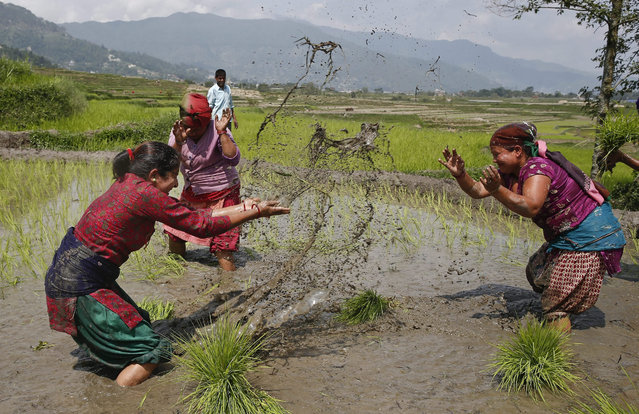
Nepalese women farmers spray mud water at each other while planting rice in a paddy field during the National Paddy Day in the village of Jitpur in Kathmandu, Nepal, 30 June 2015. On this day, known as Asar Pandra, farmers begin the annual rice planting season and mark the day with various festivities such as preparing rice meals with muddy water, spreads mud among farmers. (Photo by Narendra Shrestha/EPA)

Nepalese women farmers spray mud water at each other while planting rice in a paddy field during the National Paddy Day in the village of Jitpur in Kathmandu, Nepal, 30 June 2015. On this day, known as Asar Pandra, farmers begin the annual rice planting season and mark the day with various festivities such as preparing rice meals with muddy water, spreads mud among farmers. The Mud being a symbol for a prosperous season. The agricultural sector contributes about 60 per cent to Nepal's gross domestic product. (Photo by Narendra Shrestha/EPA)
Details
01 Jul 2015 13:16:00
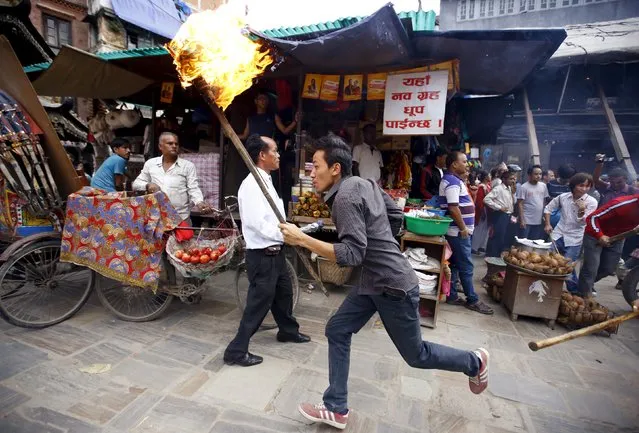
A protester holding a torch runs past police (not pictured) trying to stop the protesters from marching in a rally organised by a 30-party alliance led by a hardline faction of former Maoist rebels, who are protesting against the draft of the new constitution, in Kathmandu August 15, 2015. (Photo by Navesh Chitrakar/Reuters)

A protester holding a torch runs past police (not pictured) trying to stop the protesters from marching in a rally organised by a 30-party alliance led by a hardline faction of former Maoist rebels, who are protesting against the draft of the new constitution, in Kathmandu August 15, 2015. The group says that the draft is not inclusive and does not protect the rights of the marginalised and underprivileged groups in the country. (Photo by Navesh Chitrakar/Reuters)

Details
16 Aug 2015 13:24:00
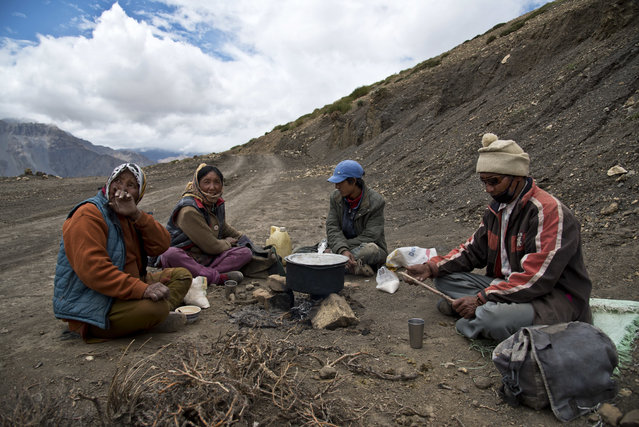
In this August 17, 2016, photo, from left to right, Chhering Chodom, 60, Tashi Yangzom, 50, Lobsang Chhering, 27, and Dorje Tandup, 58, drink milk tea on the side of the road. For centuries, the sleepy valley nestled in the Indian Himalayas remained a hidden Buddhist enclave forbidden to outsiders. Enduring the harsh year-round conditions of the high mountain desert, the people of Spiti Valley lived by a simple communal code – share the Earth's bounty, be hospitable to neighbors, and eschew greed and temptation at all turns. That's all starting to change, for better or worse. Since India began allowing its own citizens as well as outsiders to visit the valley in the early 1990s, tourism and trade have boomed. And the marks of modernization, such as solar panels, asphalt roads and concrete buildings, have begun to appear around some of the villages that dot the remote landscape at altitudes above 4,000 meters (13,000 feet). (Photo by Thomas Cytrynowicz/AP Photo)

In this August 17, 2016, photo, from left to right, Chhering Chodom, 60, Tashi Yangzom, 50, Lobsang Chhering, 27, and Dorje Tandup, 58, drink milk tea on the side of the road. For centuries, the sleepy valley nestled in the Indian Himalayas remained a hidden Buddhist enclave forbidden to outsiders. Enduring the harsh year-round conditions of the high mountain desert, the people of Spiti Valley lived by a simple communal code – share the Earth's bounty, be hospitable to neighbors, and eschew greed and temptation at all turns. That's all starting to change, for better or worse. (Photo by Thomas Cytrynowicz/AP Photo)
Details
15 Sep 2016 09:22:00
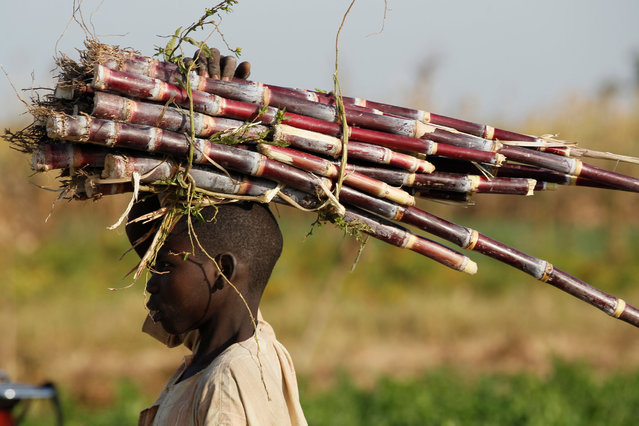
A boy carries sugar cane through a farm on the outskirt of Zaria in Nigeria's northern state of Kaduna November 15, 2016. (Photo by Akintunde Akinleye/Reuters)

A boy carries sugar cane through a farm on the outskirt of Zaria in Nigeria's northern state of Kaduna November 15, 2016. (Photo by Akintunde Akinleye/Reuters)
Details
05 Dec 2016 11:17:00