Loading...
Done
In this Sept. 29, 2013 photo, nine-year-old twin sisters Camila, left, and Carla Rodriguez pose for a portrait along their street in Havana, Cuba. 12 sets of twins live along two consecutive blocks in western Havana, ranging in age from newborns to senior citizens. “We love living on this block because we have twin friends”, said Carla. (Photo by Ramon Espinosa/AP Photo)

A street in the Cuban capital, Havana, is home to 12 sets of twins, ranging from toddlers to senior citizens. Some say it could be something in the water. Others point to a tree with mystical significance for locals. And maybe it's just chance. Photo: In this September 29, 2013 photo, nine-year-old twin sisters Camila, left, and Carla Rodriguez pose for a portrait along their street in Havana, Cuba. 12 sets of twins live along two consecutive blocks in western Havana, ranging in age from newborns to senior citizens. “We love living on this block because we have twin friends”, said Carla. (Photo by Ramon Espinosa/AP Photo)
Details
07 Oct 2013 06:44:00
Floralis Generica - Buenos Aires

Floralis Genérica is a sculpture made of steel and aluminum located in Plaza de las Naciones Unidas, Avenida Figueroa Alcorta, Buenos Aires, a gift to the city by the Argentine architect Eduardo Catalano. Catalano once said that the flower "is a synthesis of all the flowers and is both a hope that is reborn every day to open." It was created in 2002. The sculpture moves closing its petals in the evening and opening them in the morning, although this mechanism is currently disabled. The sculpture is located in the center of a park of four acres of wooded boundaries, surrounded by paths that get closer and provide different perspectives of the monument, and placed above a reflecting pool, which apart from fulfilling its aesthetic function, protects it. It represents a large flower made of stainless steel with aluminum skeleton and reinforced concrete, which looks at the sky, extending to it its six petals. Weighs eighteen tons and is 23 meters high.
Details
20 Oct 2013 18:32:00
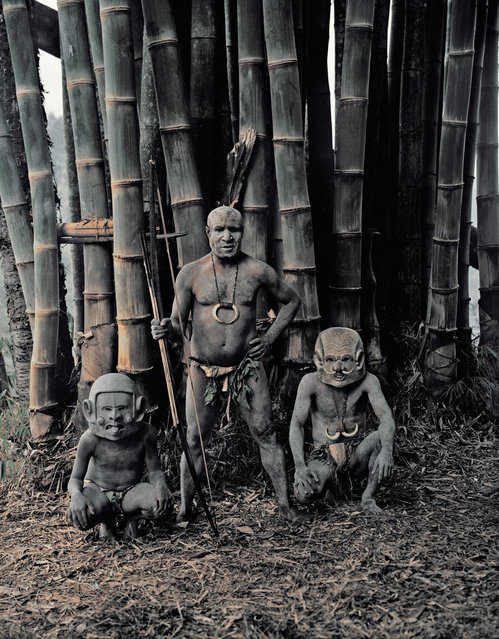
“Asaro from the Eastern Highlands”. The mudmen could not cover their faces with mud because the people of Papua New Guinea thought that the mud from the Asaro river was poisonous. So instead of covering their faces with this alleged poison, they made masks from pebbles that they heated and water from the waterfall, with unusual designs such as long or very short ears either going down to the chin or sticking up at the top, long joined eyebrows attached to the top of the ears, horns and sideways mouths. (Jimmy Nelson)

“Asaro from the Eastern Highlands”. The mudmen could not cover their faces with mud because the people of Papua New Guinea thought that the mud from the Asaro river was poisonous. So instead of covering their faces with this alleged poison, they made masks from pebbles that they heated and water from the waterfall, with unusual designs such as long or very short ears either going down to the chin or sticking up at the top, long joined eyebrows attached to the top of the ears, horns and sideways mouths. (Photo and caption by Jimmy Nelson)
Details
20 Oct 2013 08:54:00
Owlets By Inga Paltser

Inga Paltser is a young painter from Severodvinsk known for her watercolor illustrations and paintings of owls. Inga prefers working with paper, but sometimes also creates on textile, wood, and canvas. She started painting in her childhood at the local school of arts. However, after high school Inga decided to become a biologist and now she works as a researcher. Even though art hasn’t become her profession, Inga finds time to create wonderful paintings presented on this website. Her first owls were painted spontaneously – Inga decided to utilize small pieces of watercolor and pastel paper and created two cute owls called “Friends”. Inga’s owls instantly received recognition across the web and social networks and now are greatly loved by thousands of people around the world.
Details
18 Nov 2013 10:08:00
A model poses with “The Wellbeing Toilet” the winning entry from a Dyno-Rod Initiative to create a new design for the domestic toilet at Central Saint Martins on November 18, 2013 in London, England. The concept was commissioned to mark 50 years of Dyno-Rod and World Toilet Day on November 19th, 2013 The “Wellbeing Toilet” looks at the health and wellbeing aspect of getting rid of your bodily waste by being sculpted to enhance the position of your body by enabling you to squat rather than sit. (Photo by Miles Willis/Getty Images for Dyno-Rod)

A model poses with “The Wellbeing Toilet” the winning entry from a Dyno-Rod Initiative to create a new design for the domestic toilet at Central Saint Martins on November 18, 2013 in London, England. The concept was commissioned to mark 50 years of Dyno-Rod and World Toilet Day on November 19th, 2013 The “Wellbeing Toilet” looks at the health and wellbeing aspect of getting rid of your bodily waste by being sculpted to enhance the position of your body by enabling you to squat rather than sit. (Photo by Miles Willis/Getty Images for Dyno-Rod)
Details
20 Nov 2013 07:54:00
City buildings stand beyond the giant excavated hole left by the Mir mine, a former open pit diamond mine, in Mirny, Russia, on Tuesday, November 12, 2013. OAO Alrosa, the world's largest diamond producer, raised about $1.3 billion in an oversubscribed share sale from investors including Oppenheimer Funds Inc. and Lazard Ltd.'s asset-management unit, First Deputy Prime Minister Igor Shuvalov said. (Photo by Andrey Rudakov/Bloomberg)

City buildings stand beyond the giant excavated hole left by the Mir mine, a former open pit diamond mine, in Mirny, Russia, on Tuesday, November 12, 2013. OAO Alrosa, the world's largest diamond producer, raised about $1.3 billion in an oversubscribed share sale from investors including Oppenheimer Funds Inc. and Lazard Ltd.'s asset-management unit, First Deputy Prime Minister Igor Shuvalov said. (Photo by Andrey Rudakov/Bloomberg)
Details
22 Nov 2013 09:52:00
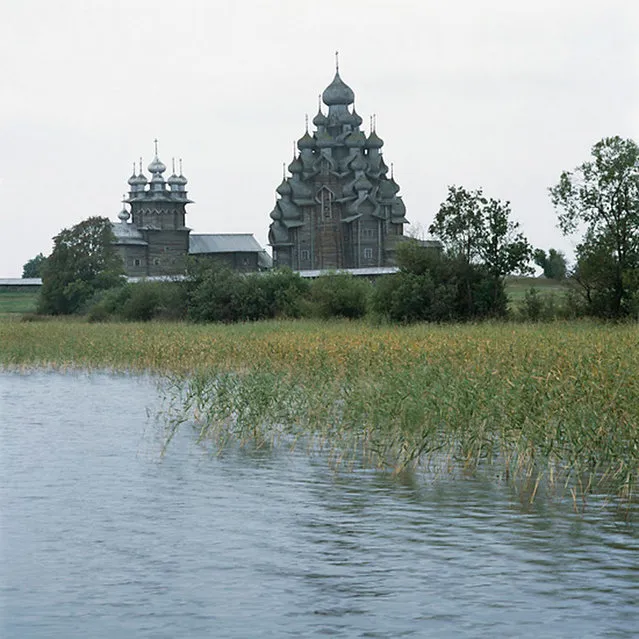
Wooden Churches - Travelling In The Russian North By Richard Davies Part 1

While communism, collectivism, worms, dry rot and casual looting failed to destroy the majestic wooden churches of Russia, it may be ordinary neglect that finally does them in. Dwindled now to several hundred remaining examples, these glories of vernacular architecture lie scattered amid the vastness of the world’s largest country. Just over a decade ago, Richard Davies, a British architectural photographer, struck out on a mission to record the fragile and poetic structures. Austerely beautiful and haunting, “Wooden Churches: Traveling in the Russian North” (White Sea Publishing; $132) is the result. Covering thousands of miles, Mr. Davies described how he and the writer Matilda Moreton tracked down the survivors from among the thousands of onion-domed structures built after Prince Vladimir converted to Christianity in 988.
Details
25 Nov 2013 12:47:00
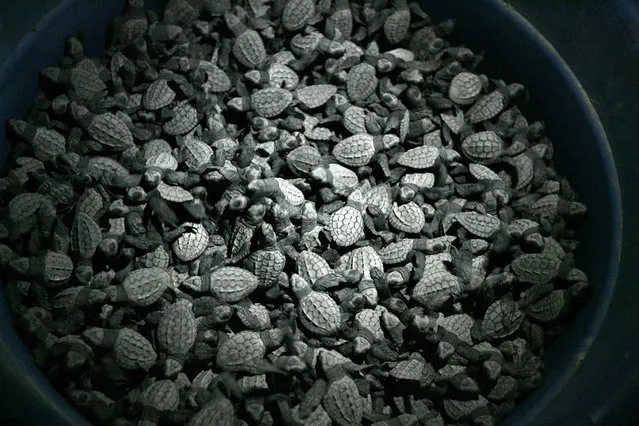
Olive Ridley turtle hatchlings (Lepidochelys olivacea) sit in baskets and trays at the turtle camp La Gloria, before their release into the ocean in Tomatlan November 15, 2013. (Photo by Alejandro Acosta/Reuters)

Olive Ridley turtle hatchlings (Lepidochelys olivacea) sit in baskets and trays at the turtle camp La Gloria, before their release into the ocean in Tomatlan November 15, 2013. Twenty years ago, Mexico's government implemented ecological plans to protect the sea turtles from being hunted for their leather and meat and established conservation areas and a pay system for local residents to protect turtle nests. Millions of baby turtles hatch on the shores in November and December, according to an environmental group. It is estimated that in 2012, there were 20 million newborns. Hatching season is still underway, but officials say they expect there will be even more turtles born this year. (Photo by Alejandro Acosta/Reuters)
Details
25 Nov 2013 08:54:00