Loading...
Done
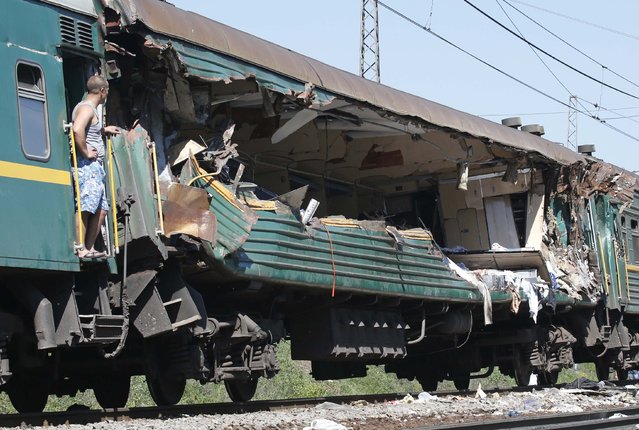
A man stands at a passenger train damaged in a collision with a freight train in Moscow region May 20, 2014. The passenger train on its way to Moldova collided with a freight train near Moscow on Tuesday, killing at least four people and injuring 15, a spokeswoman for Russia's Emergencies Ministry said. The reason for the collision, near the town of Naro-Fominsk 55 km (34 miles) southwest of Moscow, was not immediately clear. (Photo by Grigory Dukor/Reuters)

A man stands at a passenger train damaged in a collision with a freight train in Moscow region May 20, 2014. The passenger train on its way to Moldova collided with a freight train near Moscow on Tuesday, killing at least four people and injuring 15, a spokeswoman for Russia's Emergencies Ministry said. The reason for the collision, near the town of Naro-Fominsk 55 km (34 miles) southwest of Moscow, was not immediately clear. (Photo by Grigory Dukor/Reuters)
Details
21 May 2014 11:27:00
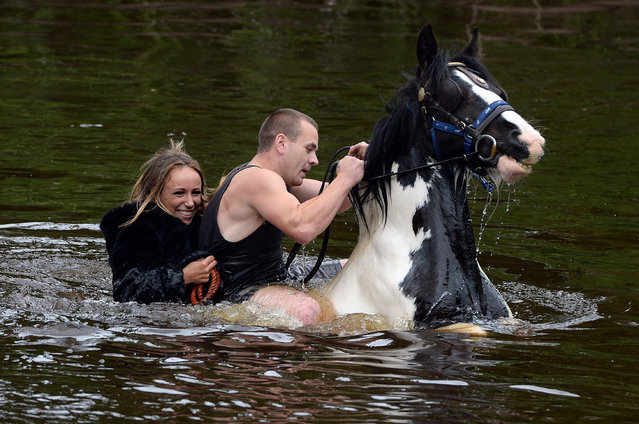
Travellers ride their horse through the river during the Appleby Horse Fair on June 5, 2014 in Appleby, England. The Appleby Horse Fair has existed under the protection of a charter granted by James II since 1685 and is one of the key gathering points for the Romany, gypsy and traveling community. The fair is attended by about 5,000 travellers who come to buy and sell horses. The animals are washed and groomed before being ridden at high speed along the “mad mile” for the viewing of potential buyers. (Photo by Nigel Roddis/Getty Images)

Travellers ride their horse through the river during the Appleby Horse Fair on June 5, 2014 in Appleby, England. The Appleby Horse Fair has existed under the protection of a charter granted by James II since 1685 and is one of the key gathering points for the Romany, gypsy and traveling community. The fair is attended by about 5,000 travellers who come to buy and sell horses. The animals are washed and groomed before being ridden at high speed along the “mad mile” for the viewing of potential buyers. (Photo by Nigel Roddis/Getty Images)
Details
15 Jun 2014 11:33:00
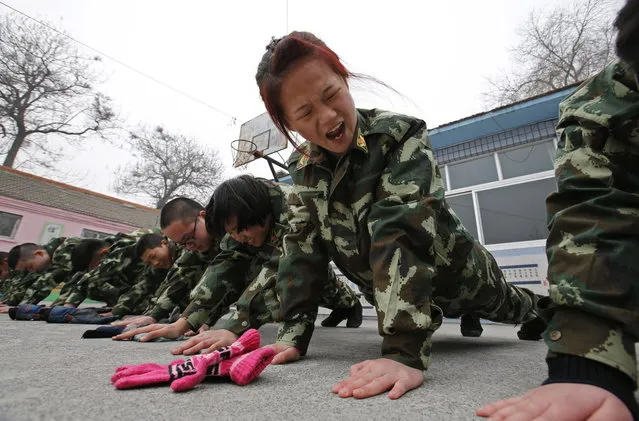
Students receive a group punishment during a military-style close-order drill class at the Qide Education Center in Beijing February 19, 2014. The Qide Education Center is a military-style boot camp which offers treatment for internet addiction. (Photo by Kim Kyung-Hoon/Reuters)

Students receive a group punishment during a military-style close-order drill class at the Qide Education Center in Beijing February 19, 2014. The Qide Education Center is a military-style boot camp which offers treatment for internet addiction. As growing numbers of young people in China immerse themselves in the cyber world, spending hours playing games online, worried parents are increasingly turning to boot camps to crush addiction. Military-style boot camps, designed to wean young people off their addiction to the internet, number as many as 250 in China alone. (Photo by Kim Kyung-Hoon/Reuters)
Details
03 Jul 2014 12:12:00
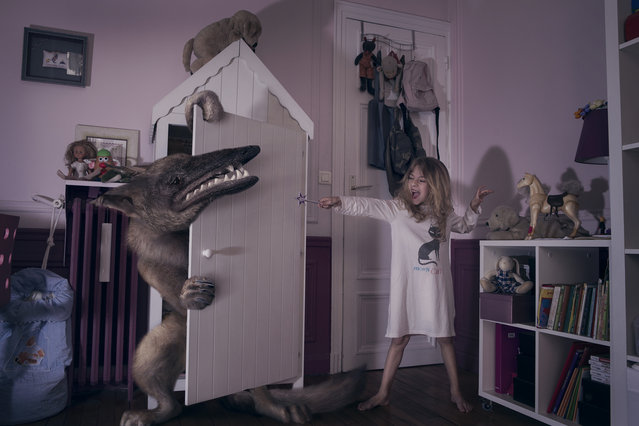
Charlotte fights a monster with a “wand” in her bedroom in Laure Fauvel's “Terreurs”, 2014, in Paris, France. An imaginative photographer has brought to life monsters that haunt children's nightmares. Armed with sticks, wands and swords the eight and nine year-olds appear to be getting the upper-hand against the villains. Parisian photographer Laure Fauvel, 22, said: I wanted the children not be victims and to fight the monsters. (Photo by Laure Fauvel/Barcroft Media)

Charlotte fights a monster with a “wand” in her bedroom in Laure Fauvel's “Terreurs”, 2014, in Paris, France. An imaginative photographer has brought to life monsters that haunt children's nightmares. Armed with sticks, wands and swords the eight and nine year-olds appear to be getting the upper-hand against the villains. Parisian photographer Laure Fauvel, 22, said: I wanted the children not be victims and to fight the monsters. (Photo by Laure Fauvel/Barcroft Media)
Details
25 Jul 2014 11:53:00
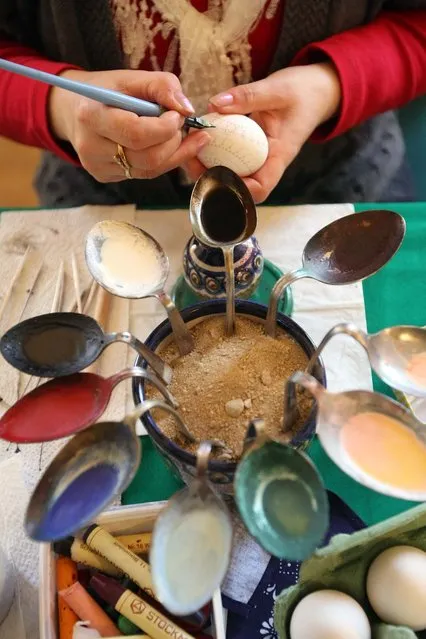
A Sorb egg painter decorates an Easter egg while using bent spoons full of melted wax as coloring at the annual Easter egg market on March 16, 2013 in Schleife, Germany. Easter is a particularly important time of year for Sorbs, a Slavic minority in eastern Germany, and the period includes the tradition of painting Easter eggs that include visual elements intended to ward off evil. Many Sorbs still speak Sorbian, a language closely related to Polish and Czech.  (Photo by Adam Berry)

A Sorb egg painter decorates an Easter egg while using bent spoons full of melted wax as coloring at the annual Easter egg market on March 16, 2013 in Schleife, Germany. Easter is a particularly important time of year for Sorbs, a Slavic minority in eastern Germany, and the period includes the tradition of painting Easter eggs that include visual elements intended to ward off evil. Many Sorbs still speak Sorbian, a language closely related to Polish and Czech. (Photo by Adam Berry)
Details
19 Mar 2013 06:41:00
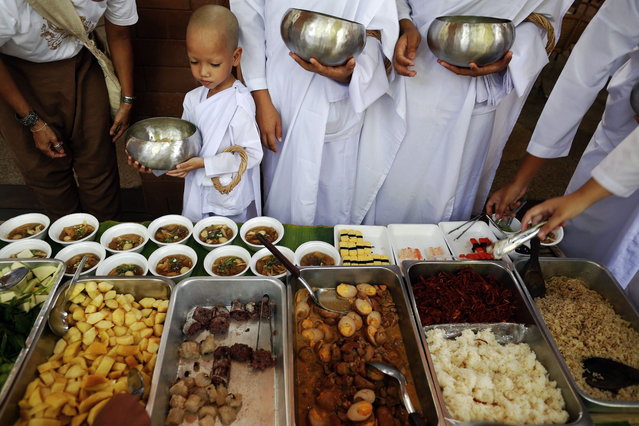
A girl joins other novice nuns for a lunch at the Sathira-Dhammasathan Buddhist meditation centre in Bangkok April 21, 2013. A group of Thai girls are choosing to spend part of their school holidays as Buddhist nuns, down to having their heads shaven at the meditation centre. The centre, founded in 1987, is a learning community for peace and harmony that has programs open to people regardless of age and gender. (Photo by Damir Sagolj/Reuters)

A girl joins other novice nuns for a lunch at the Sathira-Dhammasathan Buddhist meditation centre in Bangkok April 21, 2013. A group of Thai girls are choosing to spend part of their school holidays as Buddhist nuns, down to having their heads shaven at the meditation centre. The centre, founded in 1987, is a learning community for peace and harmony that has programs open to people regardless of age and gender. (Photo by Damir Sagolj/Reuters)
Details
25 Apr 2013 12:41:00
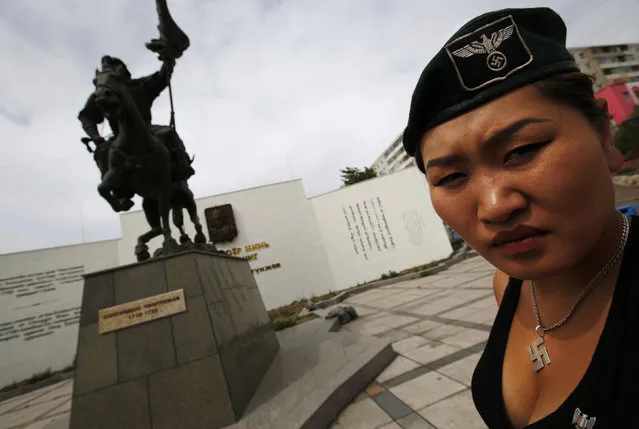
Uranjargal, a leader of the Mongolian neo-Nazi group Tsagaan Khass, stands next to a statue of Chingunjav, a Mongolian national hero, in Ulan Bator June 22, 2013. (Photo by Carlos Barria/Reuters)

Uranjargal, a leader of the Mongolian neo-Nazi group Tsagaan Khass, stands next to a statue of Chingunjav, a Mongolian national hero, in Ulan Bator June 22, 2013. The group has rebranded itself as an environmentalist organisation fighting pollution by foreign-owned mines, seeking legitimacy as it sends Swastika-wearing members to check mining permits. Over the past years, ultra-nationalist groups have expanded in the country and among those garnering attention is Tsagaan Khass, which has recently shifted its focus from activities such as attacks on women it accuses of consorting with foreign men to environmental issues, with the stated goal of protecting Mongolia from foreign mining interests. This ultra-nationalist group was founded in the 1990s and currently has 100-plus members. (Photo by Carlos Barria/Reuters)
Details
09 Jul 2013 07:23:00
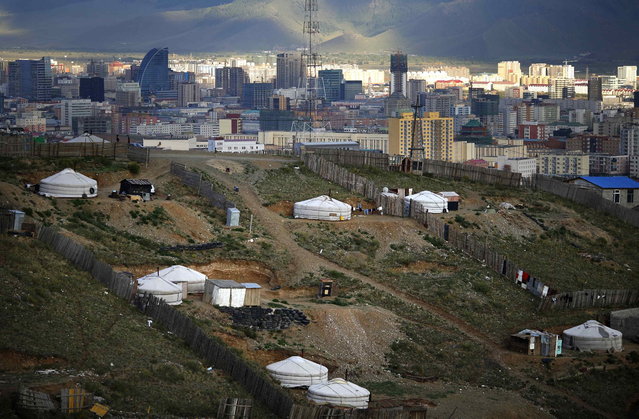
Gers, traditional Mongolian tents, are seen on a hill in an area known as a ger district in Ulan Bator June 26, 2013. (Photo by Carlos Barria/Reuters)

Gers, traditional Mongolian tents, are seen on a hill in an area known as a ger district in Ulan Bator June 26, 2013. Approximately 60 percent of the population of Ulan Bator live in settlements known as ger districts and in many cases residents have limited access to basic services such as water and sanitation. According to a 2010 National Population Center census, every year between thirty and forty thousand people migrate from the countryside to the capital Ulan Bator. Ger districts in the city have been expanding rapidly in recent years. Mongolia is the world's least densely populated country, with 2.8 million people spread across an area around three times the size of France. (Photo by Carlos Barria/Reuters)
Details
11 Aug 2013 11:45:00