Brazilian navy soldiers watch a woman as they patrol the area at the Copacabana Beach before carnival festivities in Rio de Janeiro, Brazil February 14, 2017. (Photo by Sergio Moraes/Reuters)
British model and actress Rosie Huntington-Whiteley arrives for the Versace's fall-winter 2015/2016 Haute Couture fashion collection presented in Paris, France, Sunday, July 5, 2015. (Photo by Thibault Camus/AP Photo)
A plastinated body presented as a pole vaulter is exhibited at the Menschen Museum, Museum of Humans, in Berlin, August 29, 2016. The museum was caught up in a legal dispute with the district office of Berlin-Mitte for years before it was able to meet the requirements made by the court. (Photo by Sophia Kembowski/DPA Photo via Newscom)
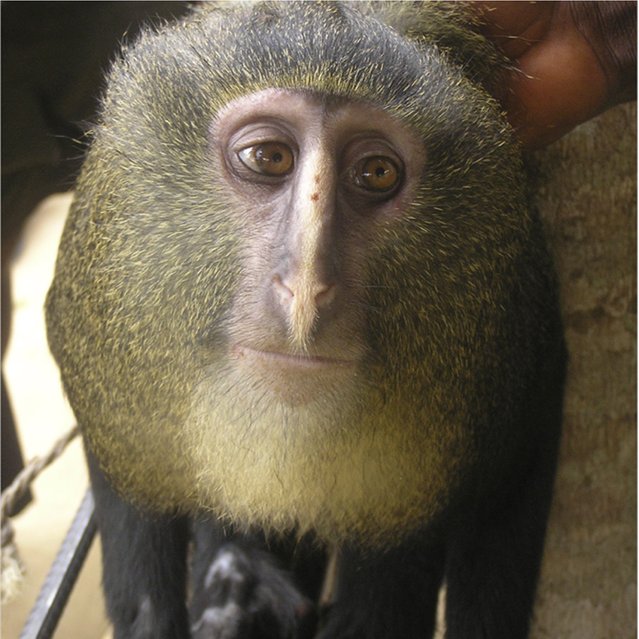
A new species of monkey found in the Democratic Republic of the Congo and identified as Lesula (Cercopithecus lomamiensis) is seen in this undated photograph from an article published September 12, 2012 in the science journal PLOS One. The monkey was first seen in 2007 by researchers John and Terese Hart of the Peabody Museum of Natural History at Yale Research Project. The finding of C. lomamiensis represents only the second new species of African monkey to be discovered in the past 28 years, according to the research article. (Photo by Hart J. A., Detwiler K. M., Gilbert C. C./Reuters)
Visitors review their cell phone photos of an installation called “Plexus A1” by artist Gabriel Dawe, one of nine large-scale art installations displayed at the “Wonders” exhibit at the Renwick Art Gallery in Washington, DC, Wednesday, January 13, 2016. Built in the 1860s, the Renwick was the first American building to be designed specifically as an art museum; it recently reopened after a two year renovation. (Photo by Jim Lo Scalzo/EPA)
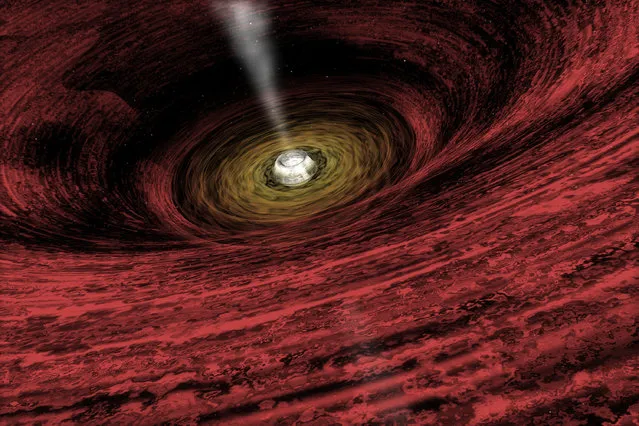
An artist's impression of a growing supermassive black hole located in the early Universe is seen in this NASA handout illustration released on June 15, 2011. Using the deepest X-ray image ever taken, astronomers found the first direct evidence that massive black holes were common in the early universe. This discovery from NASA's Chandra X-Ray Observatory shows that very young black holes grew more aggressively than previously thought, in tandem with the growth of their host galaxies. (Photo by Reuters/NASA/Chandra X-Ray Observatory/A.Hobart)