Loading...
Done
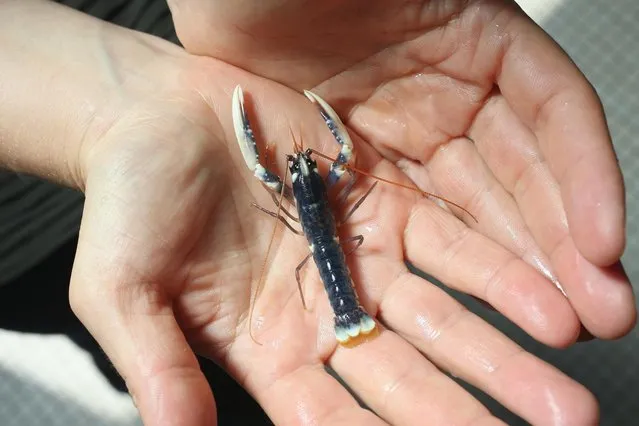
Isabel Schmalenbach, an environmental scientist with the Helgoland Biological Institute (Biologische Anstalt Helgoland), part of the Alfred Wegener Institute for Polar and Marine Research, holds a one-year old baby European lobster (Homarus gammarus) raised at the institute on August 3, 2013 on Helgoland Island, Germany. (Photo by Sean Gallup/Getty Images)

Isabel Schmalenbach, an environmental scientist with the Helgoland Biological Institute (Biologische Anstalt Helgoland), part of the Alfred Wegener Institute for Polar and Marine Research, holds a one-year old baby European lobster (Homarus gammarus) raised at the institute on August 3, 2013 on Helgoland Island, Germany. Later in the day Schmalenbach and her colleagues released a total of 415 one-year old lobsters into the North Sea as part of an effort to repopulate the lobster population around Helgoland (also called Heligoland). In the 19th century local fishermen caught up to 80,000 lobsters a year in the surrounding waters, combined with the heavy allied bombing of the island during and after World War II, as well as other environmental factors, decimated the lobster population. (Photo by Sean Gallup)
Details
05 Aug 2013 08:39:00
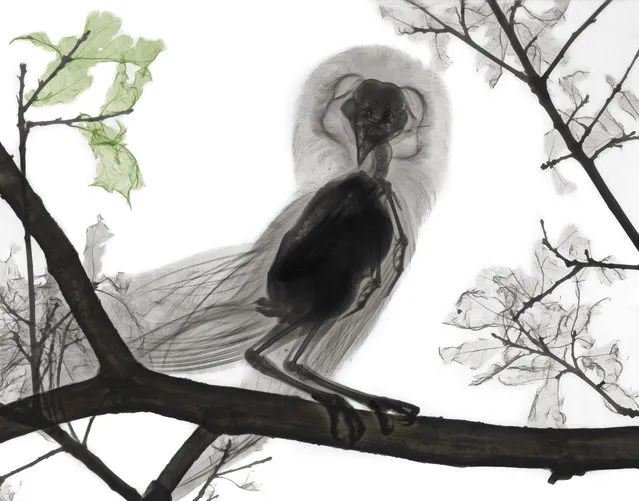
Coloured X-ray of a barn owl. A physicist has used X-ray to create an extraordinary collection of artwork. Arie van't Riets pictures reveal birds, fish, monkeys and flowers in an incredible new light. The 66-year-old, from Bathmen in the Netherlands, began X-raying flowers as a means to teach radiographers and physicians how the machine worked. But after adding a bit of colour to the pictures, the retired medical physicist realised the potential for an exciting new collection of art. (Photo by Arie van't Riet/Barcroft Media)

Coloured X-ray of a barn owl. A physicist has used X-ray to create an extraordinary collection of artwork. Arie van't Riets pictures reveal birds, fish, monkeys and flowers in an incredible new light. The 66-year-old, from Bathmen in the Netherlands, began X-raying flowers as a means to teach radiographers and physicians how the machine worked. But after adding a bit of colour to the pictures, the retired medical physicist realised the potential for an exciting new collection of art. (Photo by Arie van't Riet/Barcroft Media)
Details
08 Jul 2014 13:25:00
In this handout image supplied by Qatar 2022  The Al-Rayyan stadium  is pictured in this artists impression as Qatar 2022 World Cup bid unveils it's stadiums on September 16, 2010 in Doha, Qatar. It has been designed to include a “media facade” that includes a membrane that acts as a screen for projections; news, commercials, sports updates and current tournament information and matches. (Photo by Qatar 2022 via Getty Images)

In this handout image supplied by Qatar 2022 The Al-Rayyan stadium is pictured in this artists impression as Qatar 2022 World Cup bid unveils it's stadiums on September 16, 2010 in Doha, Qatar. It has been designed to include a “media facade” that includes a membrane that acts as a screen for projections; news, commercials, sports updates and current tournament information and matches. (Photo by Qatar 2022 via Getty Images)
Details
13 Jul 2014 10:29:00
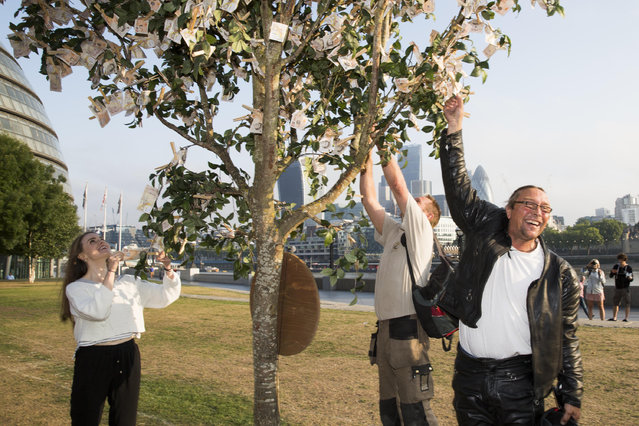
Londoners walking through Potters Field Park were surprised to see a “money tree” blooming with £9820 in £10 notes, the average amount a working British family has in savings, on July 24, 2014 in London, England. The tree was planted by Sunlife to encourage the nation to start saving at least £10 a month for a brighter future. (Photo by Tristan Fewings/Getty Images for SunLife)

Londoners walking through Potters Field Park were surprised to see a “money tree” blooming with £9820 in £10 notes, the average amount a working British family has in savings, on July 24, 2014 in London, England. The tree was planted by Sunlife to encourage the nation to start saving at least £10 a month for a brighter future. (Photo by Tristan Fewings/Getty Images for SunLife)
Details
25 Jul 2014 11:50:00
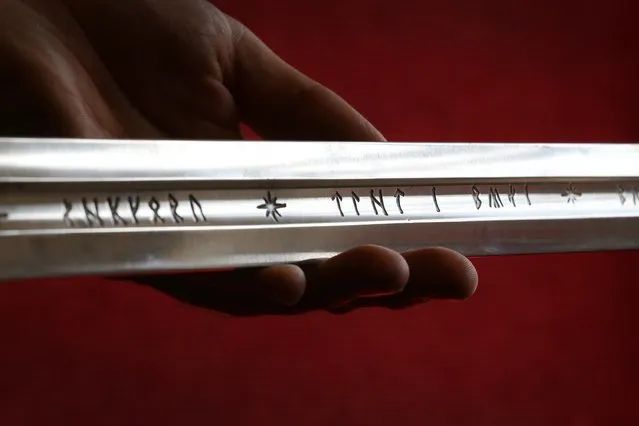
Elvish writing is seen on “Anduril”, a prop sword belonging to Aragorn, hero of “The Lord of the Rings” movie trilogy on July 31, 2014 in London, England. The sword, belonging to actor Sir Christopher Lee and estimated at $150,000-250,000, forms part of Bonhams “There's No Place Like Hollywood” movie memorabilia auction taking place in New York on November 24, 2014. (Photo by Peter Macdiarmid/Getty Images)

Elvish writing is seen on “Anduril”, a prop sword belonging to Aragorn, hero of “The Lord of the Rings” movie trilogy on July 31, 2014 in London, England. The sword, belonging to actor Sir Christopher Lee and estimated at $150,000-250,000, forms part of Bonhams “There's No Place Like Hollywood” movie memorabilia auction taking place in New York on November 24, 2014. (Photo by Peter Macdiarmid/Getty Images)
Details
01 Aug 2014 12:04:00
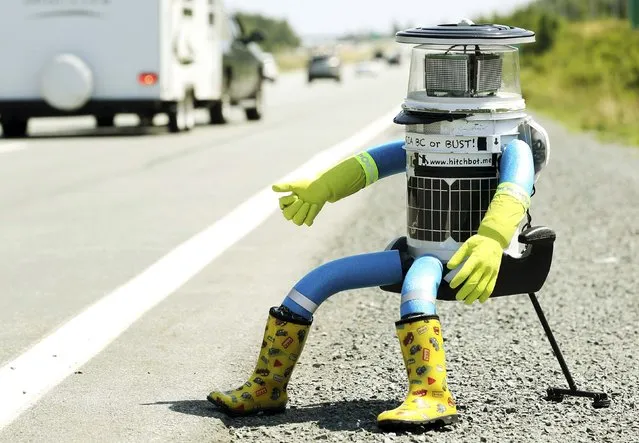
The anthropomorphic robot named hitchBOT sits on the shoulder of Highway 102 to begin its 6000 kilometer cross country journey outside of Halifax, Nova Scotia, July 27, 2014. The hitch hiking robot is part of a social experiment to see if drivers will pick up and drop off the robot in one piece to an art gallery in Victoria, British Columbia. (Photo by Paul Darrow/Reuters)

The anthropomorphic robot named hitchBOT sits on the shoulder of Highway 102 to begin its 6000 kilometer cross country journey outside of Halifax, Nova Scotia, July 27, 2014. The hitch hiking robot is part of a social experiment to see if drivers will pick up and drop off the robot in one piece to an art gallery in Victoria, British Columbia. (Photo by Paul Darrow/Reuters)
Details
02 Aug 2014 13:12:00
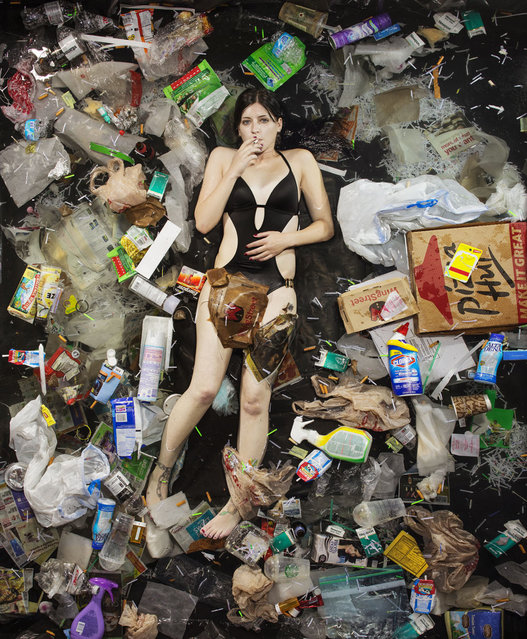
Dan surrounded by seven days of her own rubbish in Pasadena, California. (Photo by Gregg Segal/Barcroft Media)

Dan surrounded by seven days of her own rubbish in Pasadena, California. If you've never thought about how much rubbish you throw away an honest photographic series will open your eyes. Men, women, couples and families with young children have been photographed lying on their backs surrounded by a week's worth of their own rubbish – from old cartons of milk, used nappies and even tampons. The startling series “Seven Days of Garbage” by Californian photographer Gregg Segal is an unforgettable reminder of the amount of waste a human collects in just seven days. (Photo by Gregg Segal/Barcroft Media)
Details
16 Jul 2014 14:41:00
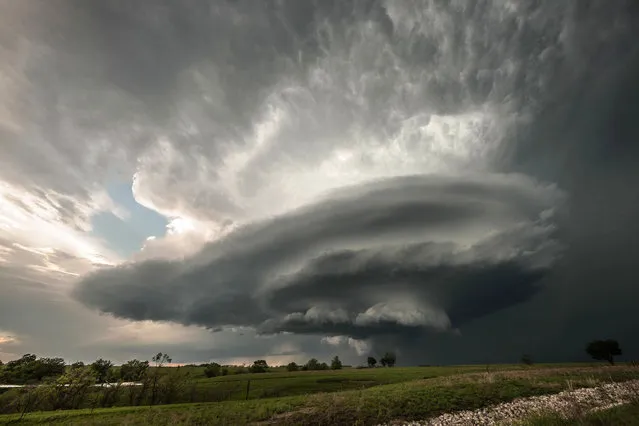
The rotating updraft base of a supercell thunderstorm, and a rear flank downdraft containing rain and hail, backlit by the setting sun, on May 10, 2014, in Climax, Kansas, United States. To most of us, dark clouds on the horizon usually means rain – but here in Kansas, they can also signal the start of a supercell. The huge formations, also known as rotating thunderstorms, are among the most powerful weather phenomenon found over land. (Photo by Stephen Locke/Barcroft Media)

The rotating updraft base of a supercell thunderstorm, and a rear flank downdraft containing rain and hail, backlit by the setting sun, on May 10, 2014, in Climax, Kansas, United States. To most of us, dark clouds on the horizon usually means rain – but here in Kansas, they can also signal the start of a supercell. The huge formations, also known as rotating thunderstorms, are among the most powerful weather phenomenon found over land. They can occur anywhere where the conditions are right, but are normally found in more arid climates. These awe-inspiring supercells were captured south of Climax city by storm chaser Stephen Locke. (Photo by Stephen Locke/Barcroft Media)
Details
18 Jul 2014 12:01:00