Loading...
Done
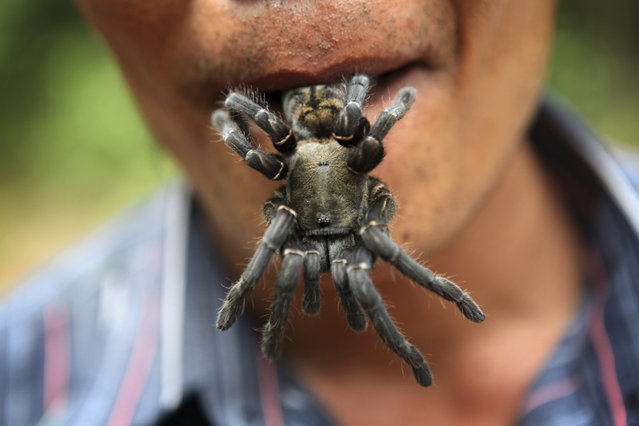
A Cambodian tuk tuk driver and guide with a tarantula in his mouth shortly after is was dug from the ground on June 7, 2010 in Skuon, Kampong Cham Province, Cambodia. The trade for spiders and other insects as food and for medicinal purposes has been in effect since the 1970's in Cambodia but only very recently have tourists been finding a way to see where the spiders are hunted in the nearby countryside. One guide, who can be found in Kampong Cham Town has started offering tours to tourists who can find him. (Photo by Tim Whitby/Getty Images)

A Cambodian tuk tuk driver and guide with a tarantula in his mouth shortly after is was dug from the ground on June 7, 2010 in Skuon, Kampong Cham Province, Cambodia. The trade for spiders and other insects as food and for medicinal purposes has been in effect since the 1970's in Cambodia but only very recently have tourists been finding a way to see where the spiders are hunted in the nearby countryside. One guide, who can be found in Kampong Cham Town has started offering tours to tourists who can find him. (Photo by Tim Whitby/Getty Images)
Details
04 Sep 2016 09:27:00
Shen Yuxi (L), introduces analysis software to investors at a “street stock salon” in central Shanghai, China, September 5, 2015. Shen carries a TV screen on his electronic bike to the "salon" every weekends where he sets it up on the wall outside a brokerage house. Shen's been selling analysis software at "the salon" for more than 10 years. (Photo by Aly Song/Reuters)

Some are in it just for the money, others to help buy a meal. Then there are those who trade for fun or to spend time among friends. Millions of investors – pensioners, security guards, high-school students – dominate China's stock markets, conducting about 80 percent of all trades. Retirees gather in brokerage houses dotted around China also to enjoy some company and savour the air conditioning on hot days. Some start as young as 13, trading from home with an eye on future careers in finance. Winning isn't guaranteed. This year, among the most turbulent in China's financial history, its stock markets more than doubled in the six months to May, only to crash amid concerns that growth in the country, which makes everything from cars to steel, is slowing faster than previously thought. (Photo by Aly Song/Reuters)
Details
13 Oct 2015 08:00:00
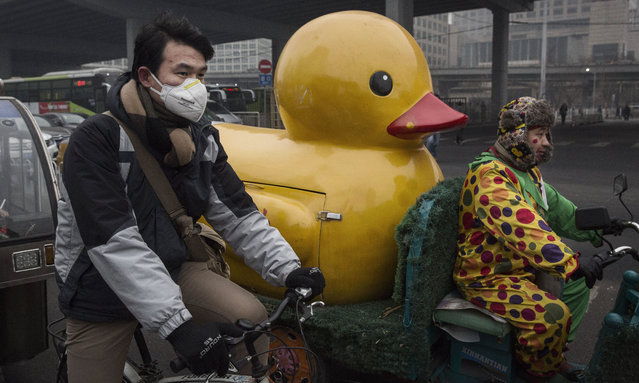
A Chinese man wears a mask to protect against pollution as he waits at a red light while commuting to work in heavy smog on December 8, 2015 in Beijing, China. The Beijing government issued a 'red alert' for the first time since new standards were introduced earlier this year as the city and many parts of northern China were shrouded in heavy pollution. (Photo by Kevin Frayer/Getty Images)

A Chinese man wears a mask to protect against pollution as he waits at a red light while commuting to work in heavy smog on December 8, 2015 in Beijing, China. The Beijing government issued a 'red alert' for the first time since new standards were introduced earlier this year as the city and many parts of northern China were shrouded in heavy pollution. Levels of PM 2.5, considered the most hazardous, crossed 400 units in Beijing, lower than last week, but still nearly 20 times the acceptable standard set by the World Health Organization. The governments of more than 190 countries are meeting in Paris to set targets on reducing carbon emissions in an attempt to forge a new global agreement on climate change. (Photo by Kevin Frayer/Getty Images)
Details
11 Dec 2015 08:01:00
Clay "caganers" representing Spanish Prime Minister Mariano Rajoy (2nd L), Podemos's candidate Pablo Iglesias (R), Socialist Party (PSOE) leader Pedro Sanchez (2nd R) and Ciudadanos party leader Albert Rivera (L) are seen on display at the Santa Llucia Christmas market in central Barcelona, Spain, December 16, 2015. Catalans hide "caganers" or defecators, in Christmas Nativity scenes to let friends hunt for them during Christmas celebrations. The "caganers", which symbolise defecation and fertilization of the earth, are believed to bring prosperity and luck for the coming year. (Photo by Albert Gea/Reuters)

Clay "caganers" representing Spanish Prime Minister Mariano Rajoy (2nd L), Podemos's candidate Pablo Iglesias (R), Socialist Party (PSOE) leader Pedro Sanchez (2nd R) and Ciudadanos party leader Albert Rivera (L) are seen on display at the Santa Llucia Christmas market in central Barcelona, Spain, December 16, 2015. Catalans hide “caganers” or defecators, in Christmas Nativity scenes to let friends hunt for them during Christmas celebrations. The “caganers”, which symbolise defecation and fertilization of the earth, are believed to bring prosperity and luck for the coming year. (Photo by Albert Gea/Reuters)
Details
18 Dec 2015 08:00:00
An astonishing set of snaps of a thrill-seeker's sky-high catwalk show on the edge of some of the world's tallest buildings has turned her into a social media sensation. Daredevil Angelina Nikolau, 23, from Russia, has spent weeks travelling around China and Hong Kong posing for jaw-dropping skyscraper selfies hundreds of feet above the ground. Her vertigo inducing results – uploaded to Instagram – have made her an instant star on the internet. Angelina is described by Russian media as “self-taught photographer, adventurer and roofer from Moscow”. Roofing – also known as rooftopping – is where people get as close as possible to the edge of a skyscraper's highest point to take selfies. (Photo by Kirill Oreshkin/CEN)

An astonishing set of snaps of a thrill-seeker's sky-high catwalk show on the edge of some of the world's tallest buildings has turned her into a social media sensation. Daredevil Angelina Nikolau, 23, from Russia, has spent weeks travelling around China and Hong Kong posing for jaw-dropping skyscraper selfies hundreds of feet above the ground. Her vertigo inducing results – uploaded to Instagram – have made her an instant star on the internet. (Photo by Kirill Oreshkin/CEN)
Details
22 Sep 2016 09:52:00
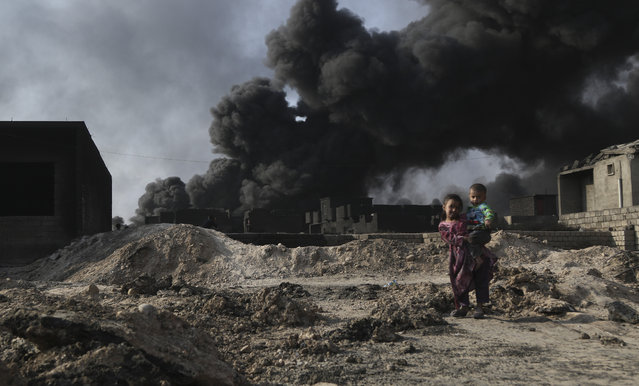
A girl holds her brother in her arm as black smoke rises after an oil well set on fire in the center of al-Kayyara town to the south of Daesh terror organization-held Mosul in Iraq on October 25, 2016. The oil well in the center of al-Kayyara town, which was set alight by retreating Daesh militants in advance of the Iraqi army's takeover of the town on August 24, 2016 has still not entirely been put out. The raw petrol which is still alight is creating black clouds above the city. The residents and wildlife beneath this polluting smoke cloud may find their health at risk. The effects of the fire in the town center on unprotected civilians' health can easily be seen on the hands and faces of children playing on the street. (Photo by dris Okuducu/Anadolu Agency/Getty Images)

A girl holds her brother in her arm as black smoke rises after an oil well set on fire in the center of al-Kayyara town to the south of Daesh terror organization-held Mosul in Iraq on October 25, 2016. The oil well in the center of al-Kayyara town, which was set alight by retreating Daesh militants in advance of the Iraqi army's takeover of the town on August 24, 2016 has still not entirely been put out. The raw petrol which is still alight is creating black clouds above the city. The residents and wildlife beneath this polluting smoke cloud may find their health at risk. The effects of the fire in the town center on unprotected civilians' health can easily be seen on the hands and faces of children playing on the street. (Photo by dris Okuducu/Anadolu Agency/Getty Images)
Details
27 Oct 2016 11:54:00
People release floating lanterns during the festival of Yee Peng in the northern capital of Chiang Mai, Thailand November 14, 2016. Yi Peng refers to the full moon day in the second month according to the Lanna lunar calendar (the twelfth month according to the Thai lunar calendar). Swarms of Lanna-style sky lanterns are launched into the air where they resemble large shoals of giant fluorescent jellyfish gracefully floating through the sky. The festival is meant as a time for tham bun, to make merit. Khom loi are made from a thin fabric, such as rice paper, stretched over a bamboo or wire frame, to which a candle or fuel cell is attached. When the fuel cell is lit, the resulting hot air is trapped inside the lantern and creates enough lift for the khom loi to float up into the sky. (Photo by Athit Perawongmetha/Reuters)

People release floating lanterns during the festival of Yee Peng in the northern capital of Chiang Mai, Thailand November 14, 2016. Yi Peng refers to the full moon day in the second month according to the Lanna lunar calendar (the twelfth month according to the Thai lunar calendar). Swarms of Lanna-style sky lanterns are launched into the air where they resemble large shoals of giant fluorescent jellyfish gracefully floating through the sky. The festival is meant as a time for tham bun, to make merit. Khom loi are made from a thin fabric, such as rice paper, stretched over a bamboo or wire frame, to which a candle or fuel cell is attached. When the fuel cell is lit, the resulting hot air is trapped inside the lantern and creates enough lift for the khom loi to float up into the sky. (Photo by Athit Perawongmetha/Reuters)
Details
15 Nov 2016 11:54:00
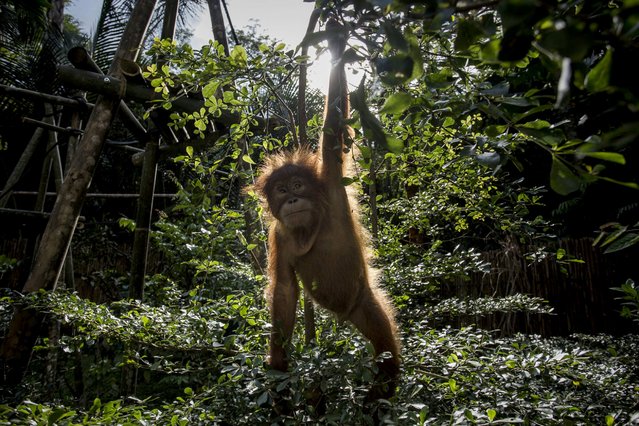
A Baby sumatran orangutan (Pongo abelii) plays around in a tree as they train at Sumatran Orangutan Conservation Programme's rehabilitation center on November 12, 2016 in Kuta Mbelin, North Sumatra, Indonesia. The Orangutans in Indonesia have been known to be on the verge of extinction as a result of deforestation and poaching. Found mostly in South-East Asia, where they live on the islands of Sumatra and Borneo, the endangered species continue to lose their habitat as a result of corporate expansion in a developing economy. Indonesia approved palm oil concessions on nearly 15 million acres of peatlands over the past years and thousands of square miles have been cleared for plantations, including the lowland areas that are the prime habitat for orangutans. (Photo by Ulet Ifansasti/Getty Images)

A Baby sumatran orangutan (Pongo abelii) plays around in a tree as they train at Sumatran Orangutan Conservation Programme's rehabilitation center on November 12, 2016 in Kuta Mbelin, North Sumatra, Indonesia. The Orangutans in Indonesia have been known to be on the verge of extinction as a result of deforestation and poaching. Found mostly in South-East Asia, where they live on the islands of Sumatra and Borneo, the endangered species continue to lose their habitat as a result of corporate expansion in a developing economy. Indonesia approved palm oil concessions on nearly 15 million acres of peatlands over the past years and thousands of square miles have been cleared for plantations, including the lowland areas that are the prime habitat for orangutans. (Photo by Ulet Ifansasti/Getty Images)
Details
16 Nov 2016 11:14:00