Loading...
Done
Baldwin Street - The World's Steepest Street

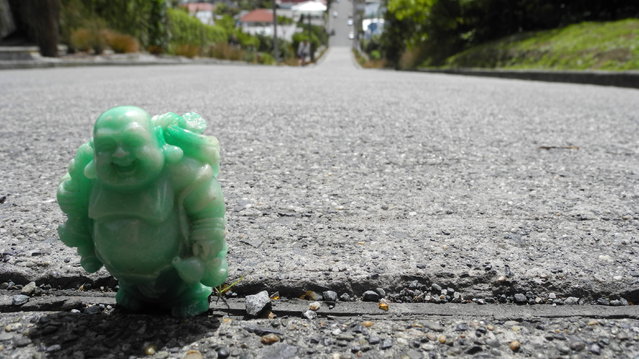
Baldwin Street, in Dunedin, New Zealand, is considered the world's steepest residential street. It is located in the residential suburb of North East Valley, 3.5 kilometres (2.2 mi) northeast of Dunedin's city centre.
Details
19 Jan 2014 15:26:00
Spectacular Tree By Wang Yue

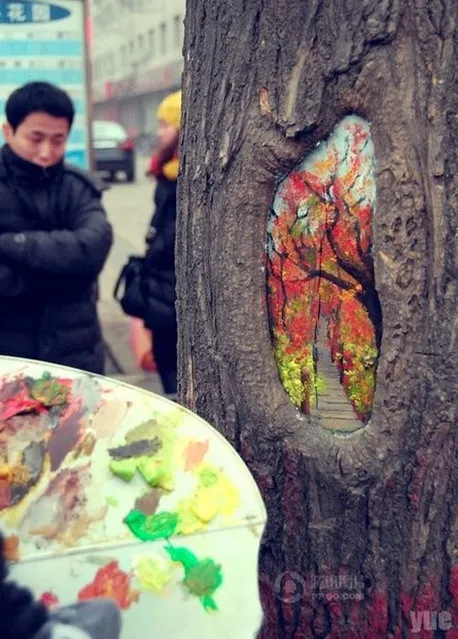
Wang Yue, a senior at Dalian Industry University, uses her paintbrush to turn ugly tree holes into lovely views in Shijiazhuang, capital city of Hebei Province.
Details
06 Jul 2013 16:48:00
Tam Coc - Bich Dong

Tam Coc – Bich Dong is a popular tourist destination near the city of Ninh Binh in northern Vietnam.
Details
08 Jul 2013 09:33:00
Day to Night By Stephen Wilkes

Photographer Stephen Wilkes spent a minimum of ten hours taking hundreds of shots to create each one of his Day to Night. Weaving and blending thirty to fifty parts, the photo-collagist extraordinaire created seamless, surrealist scenes of New York City life.
Details
18 Jul 2013 09:49:00
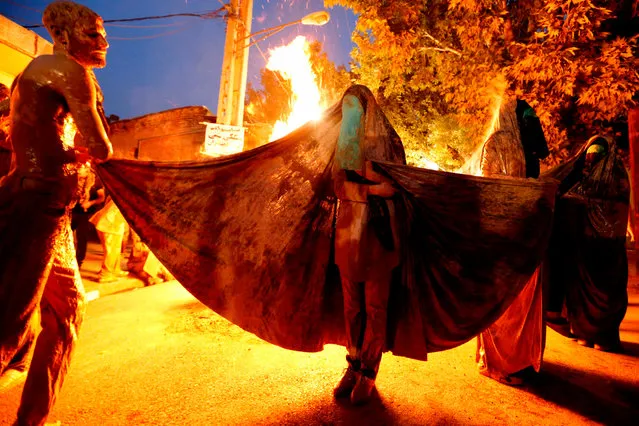
Iranian Shiite Muslim women gather around a bonfire after rubbing mud on their body during the “Kharrah Mali” (Mud Rubbing) ritual to mark the Ashura religious ceremony in the city of Khorramabad, some 470 kms southwest of Tehran, early in the morning on October 1, 2017. “Khrreh Mali” or “Mud Rubbing” is a ritual that is held in the city of Khorramabad every year to commemorate the seventh century slaying of Prophet Mohammed' s grandson Imam Hussein, in which Iranian men roll over in mud and dry themselves by gathering around the bonfires before flagellating themselves. (Photo by Atta Kenare/AFP Photo)

Iranian Shiite Muslim women gather around a bonfire after rubbing mud on their body during the “Kharrah Mali” (Mud Rubbing) ritual to mark the Ashura religious ceremony in the city of Khorramabad, some 470 kms southwest of Tehran, early in the morning on October 1, 2017. “Khrreh Mali” or “Mud Rubbing” is a ritual that is held in the city of Khorramabad every year to commemorate the seventh century slaying of Prophet Mohammed' s grandson Imam Hussein, in which Iranian men roll over in mud and dry themselves by gathering around the bonfires before flagellating themselves. (Photo by Atta Kenare/AFP Photo)
Details
02 Oct 2017 08:38:00
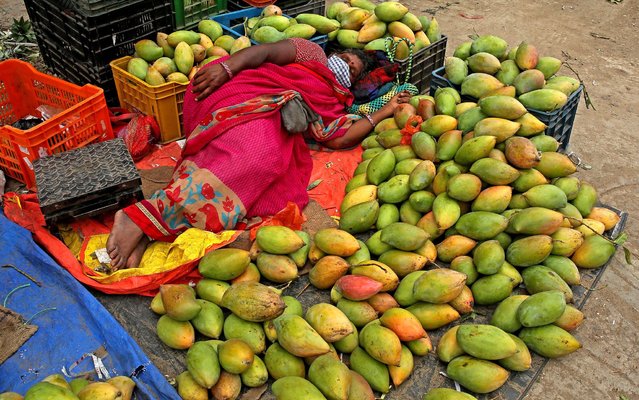
A woman taking a nap on mangoes at city market area after the city eased the lockdown in Bangalore, India 12 July 2021. The Karnataka government eases in covid-19 related lockdown restrictions in the wake of lower coronavirus cases and positivity rate falling below 5% percent. The Karnataka state government administering record 2.5-crore doses till date since the vaccination drive was launched across the state on January 16, Karnataka ranked first in South India in inoculating maximum number of its eligible population, said state Health Minister K. Sudhakar. (Photo by Jagadeesh N.V./EPA/EFE)

A woman taking a nap on mangoes at city market area after the city eased the lockdown in Bangalore, India 12 July 2021. The Karnataka government eases in covid-19 related lockdown restrictions in the wake of lower coronavirus cases and positivity rate falling below 5% percent. The Karnataka state government administering record 2.5-crore doses till date since the vaccination drive was launched across the state on January 16, Karnataka ranked first in South India in inoculating maximum number of its eligible population, said state Health Minister K. Sudhakar. (Photo by Jagadeesh N.V./EPA/EFE)
Details
19 Jul 2021 09:24:00
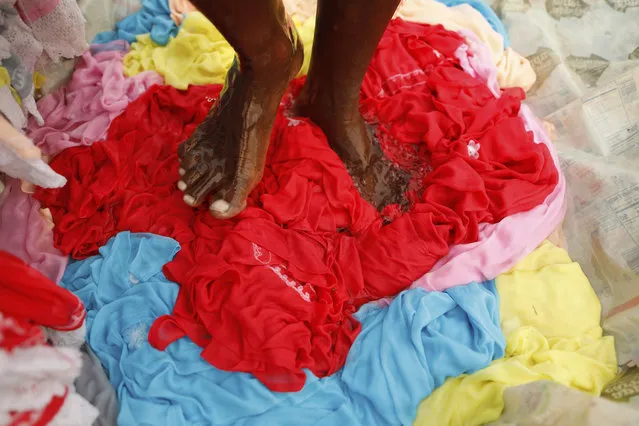
A dhobi, or a washerman washes cloths on the banks of the River Gomti in Lucknow, India, Saturday, September 12, 2020. Dhobis are traditional laundry workers who wash clothes by hand and dry them in the sun, an occupation which has been in existence for generations. Most cities in India have a Dhobi Ghat, or washermen's area, where the city's pile of clothes is laundered. This practice is still popular in India, despite of modern technology. Around 1,000 families work in Lucknow's Dhobi Ghat. However, in light of the novel coronavirus, their wages have decreased drastically. With each family earning around US$100-200 per month. (Photo by Rajesh Kumar Singh/AP Photo)

A dhobi, or a washerman washes cloths on the banks of the River Gomti in Lucknow, India, Saturday, September 12, 2020. Dhobis are traditional laundry workers who wash clothes by hand and dry them in the sun, an occupation which has been in existence for generations. Most cities in India have a Dhobi Ghat, or washermen's area, where the city's pile of clothes is laundered. This practice is still popular in India, despite of modern technology. Around 1,000 families work in Lucknow's Dhobi Ghat. However, in light of the novel coronavirus, their wages have decreased drastically. With each family earning around US$100-200 per month. (Photo by Rajesh Kumar Singh/AP Photo)
Details
25 Sep 2020 00:03:00
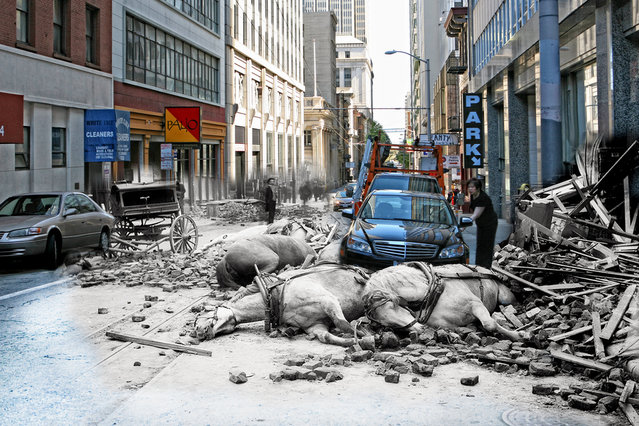
San Francisco Earthquake Mashup 1906 – 2010 by Shawn Clover

Shawn Clover has been blending images taken in the aftermath of the 1906 earthquake that devastated the city with photos of San Francisco today — and the results are eerie and striking.

Details
30 Nov 2012 11:01:00