Loading...
Done
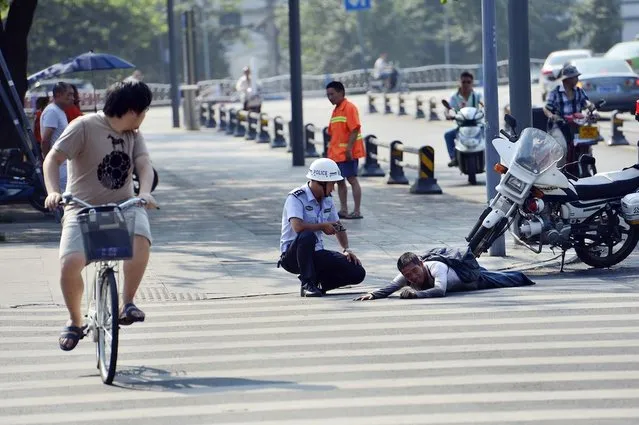
A beggar who lay at the side of a road pretending he had no legs was moved on by police who made him stand up and walk away. The man lay slumped on his front in Chengdu, in Sichuan Province, China, with his legs tucked under him, and his jeans stretched out to make it appear he had no legs. He is approached by a police officer, who bends down and talks to him for some moments. (Photo by Rex Features)

A beggar who lay at the side of a road pretending he had no legs was moved on by police who made him stand up and walk away. The man lay slumped on his front in Chengdu, in Sichuan Province, China, with his legs tucked under him, and his jeans stretched out to make it appear he had no legs. He is approached by a police officer, who bends down and talks to him for some moments. The officer then reaches out and helps the man to his feet before guiding him across the road. Chengdu is one of a number of cities where officials have tried to clamp down on begging. (Photo by Rex Features)
Details
29 Jul 2014 11:25:00
“Cats”. I really love animals and I think they are often overlooked or underestimated.  Sometimes I can see the feelings and emotions in animals when I can’t see them in humans, so it’s easier for me to express the feelings in a lot of my animal characters. (Photo and caption by Mike Stilkey)

Los Angeles native Mike Stilkey has always been attracted to painting and drawing not only on vintage paper, record covers and book pages, but on the books themselves. Using a mix of ink, colored pencil, paint and lacquer, Stilkey depicts a melancholic and at times a whimsical cast of characters inhabiting ambiguous spaces and narratives of fantasy and fairy tales. A lingering sense of loss and longing hints at emotional depth and draws the viewer into their introspective thrall with a mixture of capricious poetry, wit, and mystery. (Photo by Mike Stilkey)
Details
31 Jul 2014 10:17:00
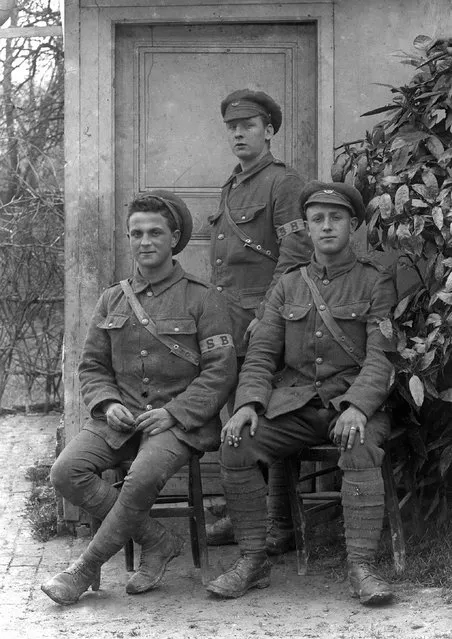
These images, scanned from old glass negatives which had surfaced in northern France, were believed to have been taken by a local amateur photographer in 1916. They showed British and a few Australian soldiers, in formal or informal poses, during or just before the most murderous battle in the history of the British Empire – Battle of the Somme. Who are these British and British Empire soldiers? The identity of the soldiers is, and may always remain, a mystery. (Property of Bernard Gardin/Dominique Zanardi/Joel Scribe/The Independent Magazine)

These images, scanned from old glass negatives which had surfaced in northern France, were believed to have been taken by a local amateur photographer in 1916. They showed British and a few Australian soldiers, in formal or informal poses, during or just before the most murderous battle in the history of the British Empire – Battle of the Somme. Who are these British and British Empire soldiers? The identity of the soldiers is, and may always remain, a mystery... (Property of Bernard Gardin/Dominique Zanardi/Joel Scribe/The Independent Magazine)
Details
04 Aug 2014 14:06:00
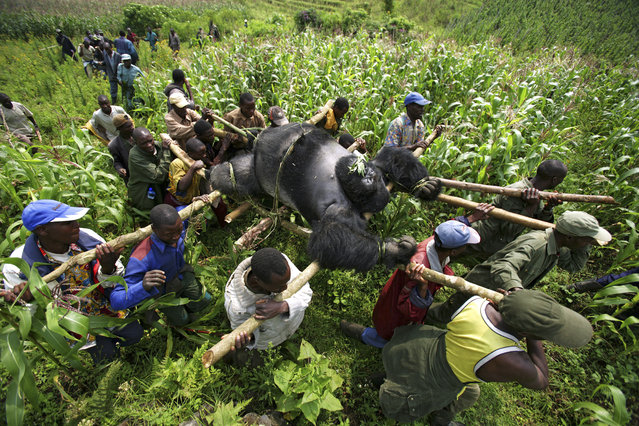
2008 Visa d'or Feature: Brent Stirton. Conservation Rangers from an Anti-Poaching unit work with locals to evacuate the bodies of four Mountain Gorrillas killed in mysterious circumstances in the park,  July 24, 2007, Virunga National Park, Eastern Congo. (Photo by Brent Stirton/Exclusive by Getty Images)

Jean-François Leroy launched Visa Pour l’Image, the international photojournalism festival, in Perpignan in 1989. Before heading up the festival, Leroy was shooting reportage for the agency Sipa Press and also working for Photo-Reporter, Le Photographe, Photo-Revue and Photo Magazine. He is the chairman of the company Images Evidence. Photo: 2008 Visa d'or Feature: Brent Stirton. Conservation Rangers from an Anti-Poaching unit work with locals to evacuate the bodies of four Mountain Gorrillas killed in mysterious circumstances in the park, July 24, 2007, Virunga National Park, Eastern Congo. (Photo by Brent Stirton/Exclusive by Getty Images)
Details
27 Aug 2013 10:42:00
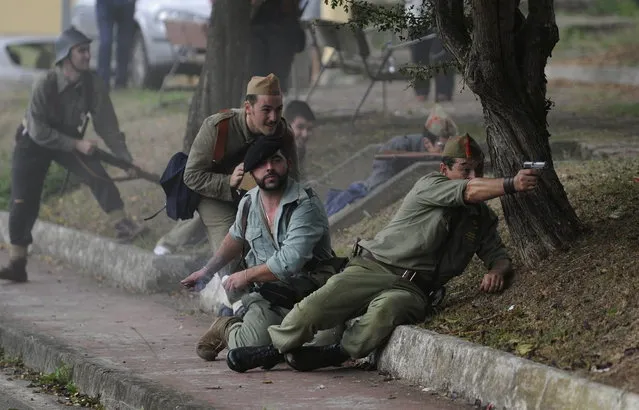
Actors take part in a re-enactment of the "Battle of Areces" that took place during the Spanish Civil War, in Grullos, north of Spain, September 14, 2013. The re-enactment of the historic 1937 battle was organised by the Frente del Nalon Association. (Photo by Eloy Alonso/Reuters)

“The Spanish Civil War (The Crusade among Nationalists, Fourth Carlist War among Carlists, The Rebellion or Uprising among Republicans) was a major conflict fought in Spain from 17 July 1936 to 1 April 1939. An estimated total of 500,000 people lost their lives as a consequence of the War”. – Wikipedia. Photo: Actors take part in a re-enactment of the “Battle of Areces” that took place during the Spanish Civil War, in Grullos, north of Spain, September 14, 2013. The re-enactment of the historic 1937 battle was organised by the Frente del Nalon Association. (Photo by Eloy Alonso/Reuters)
Details
17 Sep 2013 09:06:00
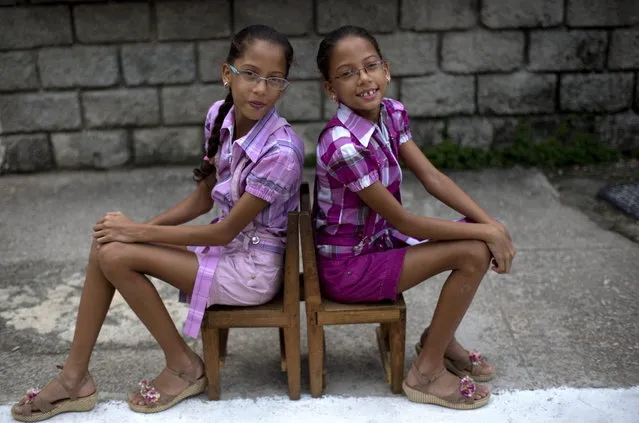
In this Sept. 29, 2013 photo, nine-year-old twin sisters Camila, left, and Carla Rodriguez pose for a portrait along their street in Havana, Cuba. 12 sets of twins live along two consecutive blocks in western Havana, ranging in age from newborns to senior citizens. “We love living on this block because we have twin friends”, said Carla. (Photo by Ramon Espinosa/AP Photo)

A street in the Cuban capital, Havana, is home to 12 sets of twins, ranging from toddlers to senior citizens. Some say it could be something in the water. Others point to a tree with mystical significance for locals. And maybe it's just chance. Photo: In this September 29, 2013 photo, nine-year-old twin sisters Camila, left, and Carla Rodriguez pose for a portrait along their street in Havana, Cuba. 12 sets of twins live along two consecutive blocks in western Havana, ranging in age from newborns to senior citizens. “We love living on this block because we have twin friends”, said Carla. (Photo by Ramon Espinosa/AP Photo)
Details
07 Oct 2013 06:44:00
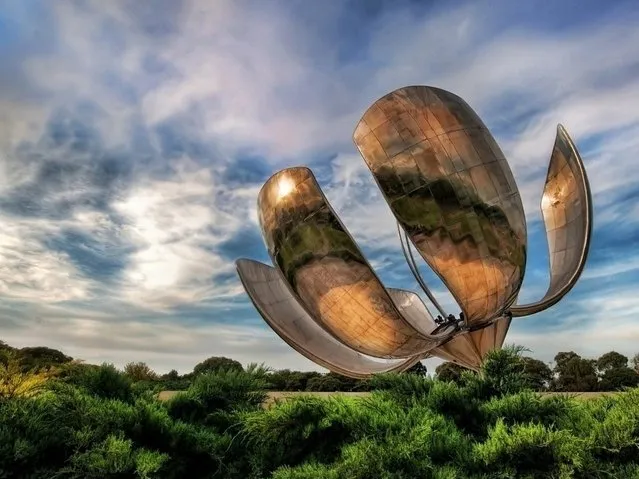
Floralis Generica - Buenos Aires

Floralis Genérica is a sculpture made of steel and aluminum located in Plaza de las Naciones Unidas, Avenida Figueroa Alcorta, Buenos Aires, a gift to the city by the Argentine architect Eduardo Catalano. Catalano once said that the flower "is a synthesis of all the flowers and is both a hope that is reborn every day to open." It was created in 2002. The sculpture moves closing its petals in the evening and opening them in the morning, although this mechanism is currently disabled. The sculpture is located in the center of a park of four acres of wooded boundaries, surrounded by paths that get closer and provide different perspectives of the monument, and placed above a reflecting pool, which apart from fulfilling its aesthetic function, protects it. It represents a large flower made of stainless steel with aluminum skeleton and reinforced concrete, which looks at the sky, extending to it its six petals. Weighs eighteen tons and is 23 meters high.
Details
20 Oct 2013 18:32:00
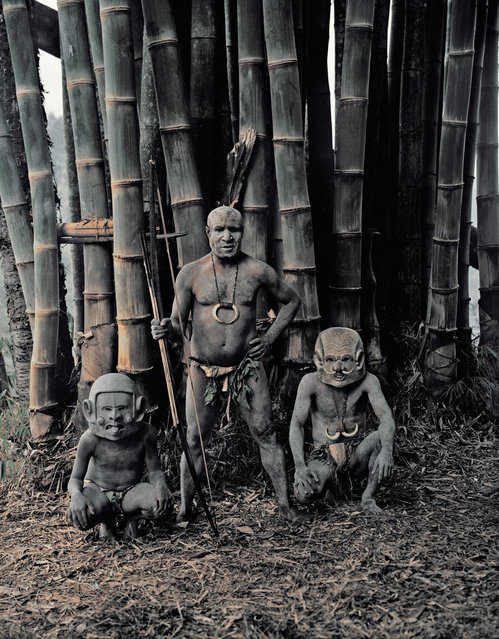
“Asaro from the Eastern Highlands”. The mudmen could not cover their faces with mud because the people of Papua New Guinea thought that the mud from the Asaro river was poisonous. So instead of covering their faces with this alleged poison, they made masks from pebbles that they heated and water from the waterfall, with unusual designs such as long or very short ears either going down to the chin or sticking up at the top, long joined eyebrows attached to the top of the ears, horns and sideways mouths. (Jimmy Nelson)

“Asaro from the Eastern Highlands”. The mudmen could not cover their faces with mud because the people of Papua New Guinea thought that the mud from the Asaro river was poisonous. So instead of covering their faces with this alleged poison, they made masks from pebbles that they heated and water from the waterfall, with unusual designs such as long or very short ears either going down to the chin or sticking up at the top, long joined eyebrows attached to the top of the ears, horns and sideways mouths. (Photo and caption by Jimmy Nelson)
Details
20 Oct 2013 08:54:00