Loading...
Done
Factory landlord Lawrence Taylor (L), portraying a Colour Sergeant from the King's Royal Rifle Corps, part of the Rifles Living History Society, performs a drill with Connor Young (R) of the Queen's Own Royal West Kent Regiment Living History Group as they recreate the life of a First World War soldier at the Eden Valley Museum in Edenbridge in southeast England May 10, 2014. (Photo by Luke MacGregor/Reuters)

Factory landlord Lawrence Taylor (L), portraying a Colour Sergeant from the King's Royal Rifle Corps, part of the Rifles Living History Society, performs a drill with Connor Young (R) of the Queen's Own Royal West Kent Regiment Living History Group as they recreate the life of a First World War soldier at the Eden Valley Museum in Edenbridge in southeast England May 10, 2014. Lawrence has always had an interest in military history and specifically “The Rifles” – his veteran father's WWII regiment. When he became a re-enactor he chose not to re-enact WWII as many of the veterans are still alive, and he felt uncomfortable as he remembers his father would have flashbacks and nightmares about the war. United by a fascination with military history and a fondness for dressing up, groups such as the Rifles Living History Society and the Queen's Own Royal West Kent Regiment Living History Group get together to recreate aspects of life during the First World War. Reuters photographer Luke MacGregor photographed members of the groups, both as they took part in living history events and at their day jobs. (Photo by Luke MacGregor/Reuters)
Details
26 Aug 2014 10:12:00
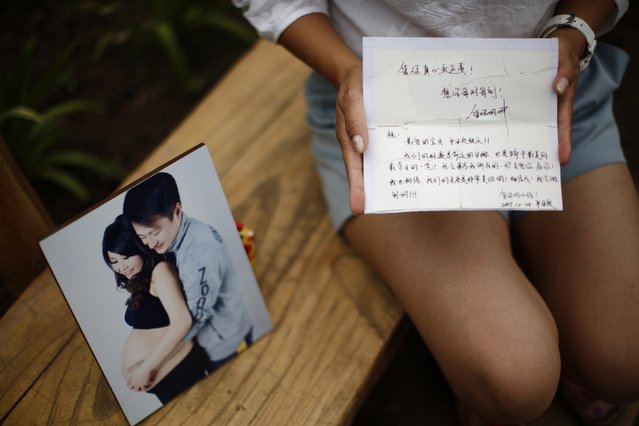
Cheng Liping, whose husband Ju was onboard Malaysia Airlines Flight MH370 which disappeared on March 8, 2014, shows a picture of she and her husband together and an old card with a message given by her husband, at a park near her house where she and her husband used to visit during an interview with Reuters in Beijing July 24, 2014. (Photo by Kim Kyung-Hoon/Reuters)

Cheng Liping, whose husband Ju was onboard Malaysia Airlines Flight MH370 which disappeared on March 8, 2014, shows a picture of she and her husband together and an old card with a message given by her husband, at a park near her house where she and her husband used to visit during an interview with Reuters in Beijing July 24, 2014. Cheng said her life has been totally changed since the incident. Their two little sons, who don't know about this incident, keep asking her when their dad is coming back. Six months after Malaysia Airlines Flight MH370, with 239 mostly Chinese people on board, disappeared about an hour into a routine journey from Kuala Lumpur to Beijing March 8, loved ones of missing passengers derive what comfort they can from what's left behind after the world's greatest aviation mystery. More than two dozen countries have been involved in the air, sea and underwater search for the Boeing 777 but months of sorties failed to turn up any trace – even after narrowing the search area to the southern Indian Ocean – long after batteries on the black box voice and data recorders had gone flat. (Photo by Kim Kyung-Hoon/Reuters)
Details
05 Sep 2014 11:27:00
Google's vice president Alan Eustace looks out of his spacesuit into the stratosphere prior to a record-breaking skydive over New Mexico, in this still image taken from video October 24, 2014, a handout courtesy of the Paragon Space Development Corporation. Eustace was lifted up 135,890 ft (41,420 metres) by an enormous balloon while wearing a specially designed pressurized space suit, the Paragon Space Development Corporation said. (Photo by Reuters/Paragon Space Development Corporation)

Google's vice president Alan Eustace looks out of his spacesuit into the stratosphere prior to a record-breaking skydive over New Mexico, in this still image taken from video October 24, 2014, a handout courtesy of the Paragon Space Development Corporation. Eustace was lifted up 135,890 ft (41,420 metres) by an enormous balloon while wearing a specially designed pressurized space suit, the Paragon Space Development Corporation said. Eustace remained in a free fall for approximately 4.5 minutes before landing safely nearly 70 miles (43.4 kms) from his launch point, setting a world record for the highest skydive and breaking the sound barrier in the process. Eustace landed safely on the ground just 15 minutes after he was lifted into the air. (Photo by Reuters/Paragon Space Development Corporation)
Details
26 Oct 2014 12:16:00
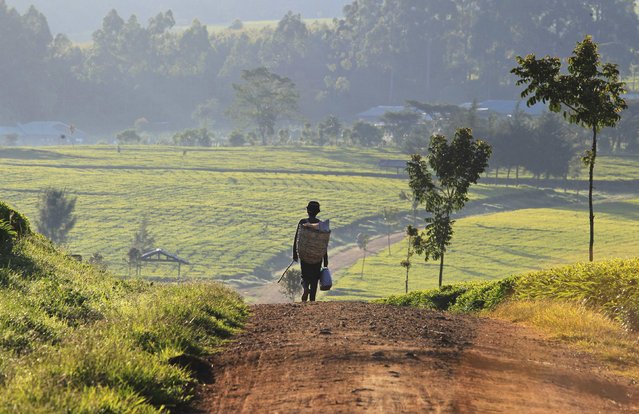
A man walks in the early morning to start his day picking tea leaves at a plantation in Nandi Hills, in Kenya's highlands region west of capital Nairobi, November 5, 2014. Emerald-coloured tea bushes blanketing the rolling hills of Nandi County have long provided a livelihood for small-scale farmers, helping make Kenya one of the world's biggest tea exporters. But ideal weather and bigger harvests, instead of producing bumper earnings, have led to a glut of Kenya's speciality black tea. (Photo by Noor Khamis/Reuters)

A man walks in the early morning to start his day picking tea leaves at a plantation in Nandi Hills, in Kenya's highlands region west of capital Nairobi, November 5, 2014. Emerald-coloured tea bushes blanketing the rolling hills of Nandi County have long provided a livelihood for small-scale farmers, helping make Kenya one of the world's biggest tea exporters. But ideal weather and bigger harvests, instead of producing bumper earnings, have led to a glut of Kenya's speciality black tea. (Photo by Noor Khamis/Reuters)

Details
17 Nov 2014 12:44:00
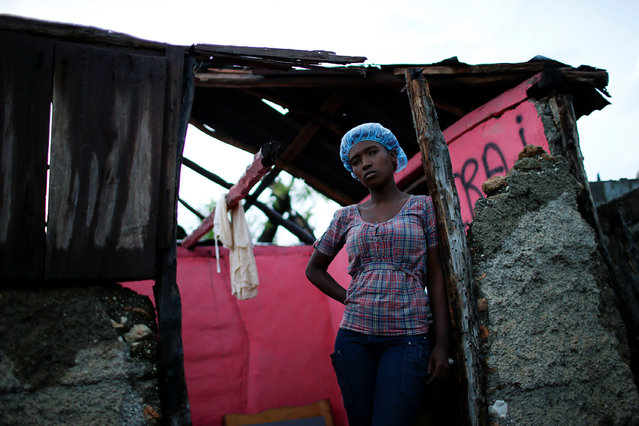
Carine Louis-Jean, 22, poses for a photograph in her destroyed house after Hurricane Matthew hit Jeremie, Haiti, October 17, 2016. “The roof of my house is completely gone and some of walls were destroyed. I have lost everything I had, but I thank God that I have a friend who is letting me stay at her house. I could say I'm lucky, because none of my family died during the hurricane, but I do not think I'm lucky”, said Louis-Jean. (Photo by Carlos Garcia Rawlins/Reuters)

Carine Louis-Jean, 22, poses for a photograph in her destroyed house after Hurricane Matthew hit Jeremie, Haiti, October 17, 2016. “The roof of my house is completely gone and some of walls were destroyed. I have lost everything I had, but I thank God that I have a friend who is letting me stay at her house. I could say I'm lucky, because none of my family died during the hurricane, but I do not think I'm lucky”, said Louis-Jean. (Photo by Carlos Garcia Rawlins/Reuters)
Details
11 Nov 2016 08:23:00
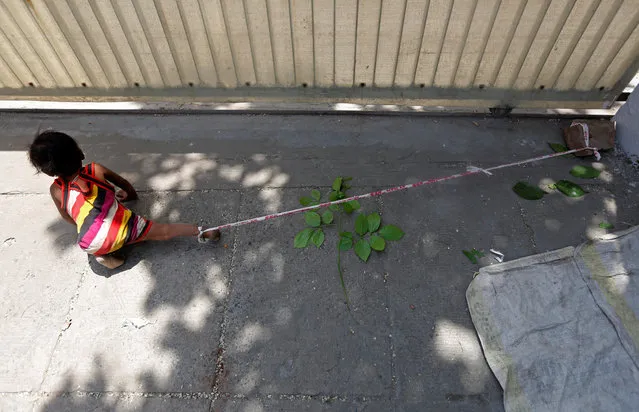
Barrier tape is tied around 15-month-old Shivani's ankle to prevent her from running away, while her mother Sarta Kalara works at a construction site nearby, in Ahmedabad, India, April 19, 2016. Kalara says she has no option but to tether her daughter Shivani to a stone despite her crying, while she and her husband work for 250 rupees ($3.8) each a shift digging holes for electricity cables in the city of Ahmedabad. There are about 40 million construction workers in India, at least one in five of them women, and the majority poor migrants who shift from site to site, building infrastructure for India's booming cities. Across the country it is not uncommon to see young children rolling in the sand and mud as their parents carry bricks or dig for new roads or luxury houses. (Photo by Amit Dave/Reuters)

Barrier tape is tied around 15-month-old Shivani's ankle to prevent her from running away, while her mother Sarta Kalara works at a construction site nearby, in Ahmedabad, India, April 19, 2016. Kalara says she has no option but to tether her daughter Shivani to a stone despite her crying, while she and her husband work for 250 rupees ($3.8) each a shift digging holes for electricity cables in the city of Ahmedabad. There are about 40 million construction workers in India, at least one in five of them women, and the majority poor migrants who shift from site to site, building infrastructure for India's booming cities. Across the country it is not uncommon to see young children rolling in the sand and mud as their parents carry bricks or dig for new roads or luxury houses. (Photo by Amit Dave/Reuters)
Details
14 Dec 2016 07:39:00
These girls are scantily dressed as they head out for a night out in Portsmouth, Hampshire on September 21, 2016 in matching outfits. Thousands of Portsmouth University students enjoy freshers week. Teenagers enjoy their first taste of freedom in bars and clubs near Portsmouth Guildhall which on a midweek alcohol fuelled night of fun in the early hours of Wednesday morning much to the despair of local residents who get disturbed up to 4am when they eventually wander home. Girls dressed in “Dirty Disco” outfits with “Don't tell daddy” on their bums. (Photo by Paul Jacobs/PictureExclusive.com)

These girls are scantily dressed as they head out for a night out in Portsmouth, Hampshire on September 21, 2016 in matching outfits. Thousands of Portsmouth University students enjoy freshers week. Teenagers enjoy their first taste of freedom in bars and clubs near Portsmouth Guildhall which on a midweek alcohol fuelled night of fun in the early hours of Wednesday morning much to the despair of local residents who get disturbed up to 4am when they eventually wander home. Girls dressed in “Dirty Disco” outfits with “Don't tell daddy” on their bums. (Photo by Paul Jacobs/PictureExclusive.com)
Details
22 Sep 2016 10:11:00
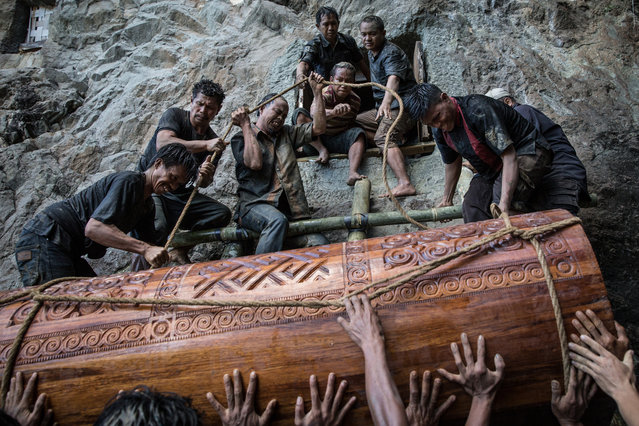
It is said that Torajans are people who “live to die”. For this Indonesian ethnic group, funerals are such extravagant events that they sometimes attract tourists. Families can postpone burials years (and the deceased are considered sick and hosted at home until the funeral) until the family can raise enough money and gather as many relatives as possible. And then it’s a jubilant multiday social event with a parade, dances and animal sacrifices. Agung Parameswara photographed these funerary practices when he traveled to South Sulawesi province, where the Torajans live. But often, their funeral isn’t the last time the dead are seen. In August, crypts are opened, coffins are slid back out and bodies delicately unsheathed. This tender ritual is known as Ma’Nene, which is customarily performed every few years. (Photo by Agung Parameswara/The Washington Post)

It is said that Torajans are people who “live to die”. For this Indonesian ethnic group, funerals are such extravagant events that they sometimes attract tourists. Families can postpone burials years (and the deceased are considered sick and hosted at home until the funeral) until the family can raise enough money and gather as many relatives as possible. And then it’s a jubilant multiday social event with a parade, dances and animal sacrifices. Agung Parameswara photographed these funerary practices when he traveled to South Sulawesi province, where the Torajans live. (Photo by Agung Parameswara/The Washington Post)
Details
06 Oct 2016 09:15:00