Loading...
Done
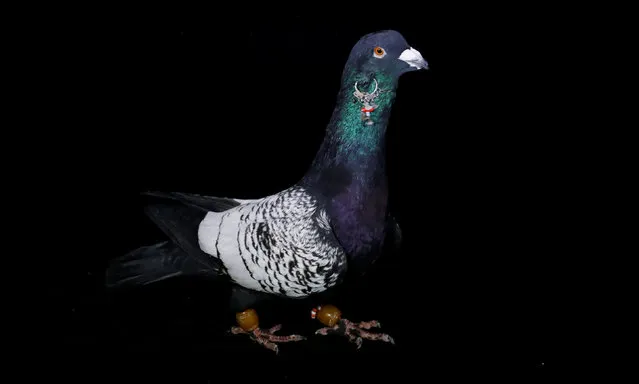
A pigeon, known as Siyah Kinifirli, with an approximate market value of 1000 Turkish Lira ($263), bred by 23-year-old Ismail Ozbek, is pictured in Sanliurfa, Turkey, December 23, 2016. As night-time approaches in Sanliurfa, southeastern Turkey, most of the alleyways of the city's old bazaar are emptying out of buyers and vendors, except for one. The bustle of daytime trading has died down, but on this little street, a stream of men carry cardboard boxes filled with pigeons to a cluster of three teahouses. Here, they sell the birds at Sanliurfa's famed auctions to a dedicated band of pigeon keepers and breeders, a pastime that has been thriving for hundreds of years across the region and over the nearby border into war-torn Syria. In a country where the minimum wage is about 1,400 Liras ($367) a month, enthusiasts regularly easily spend hundreds of dollars for one bird. “I once sold a pair of pigeons for 35,000 Turkish Lira”, says auctioneer Imam Dildas. “This is a passion, a hobby you cannot quit. I've been known to sell the fridge and my wife's gold bracelets to pay for pigeons”. (Photo by Umit Bektas/Reuters)

A pigeon, known as Siyah Kinifirli, with an approximate market value of 1000 Turkish Lira ($263), bred by 23-year-old Ismail Ozbek, is pictured in Sanliurfa, Turkey, December 23, 2016. As night-time approaches in Sanliurfa, southeastern Turkey, most of the alleyways of the city's old bazaar are emptying out of buyers and vendors, except for one. (Photo by Umit Bektas/Reuters)
Details
17 Jan 2017 12:05:00
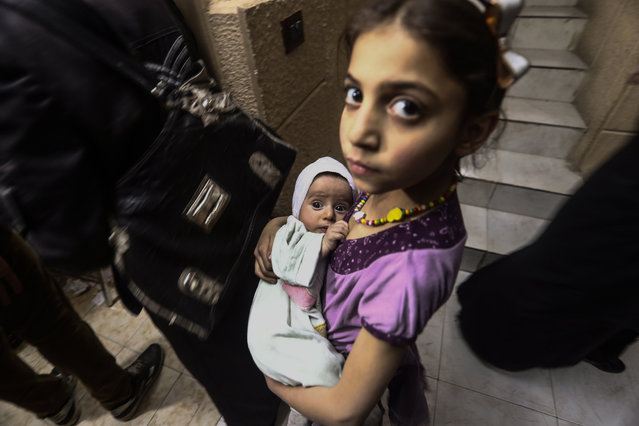
A little girl holding her newborn sister waits for their turn in a queue during a vaccination campaign under the supervision of the Syrian Arab Red Crescent (SARC) humanitarian nonprofit organization, in the besieged Syrian town of Douma, Syria, 23 May 2017. According to a statement from SARC, in the city of Douma some 12,809 children under the age of five were immunized in a vaccination campaign to prevent measles and poliomyelitis. The campaign was the first of its kind with the participation of 100 volunteers. SARC has been delivering vaccines to 17 health centers approved for vaccination campaigns in towns and villages in the Eastern Ghouta area. (Photo by Mohammed Badra/EPA)

A little girl holding her newborn sister waits for their turn in a queue during a vaccination campaign under the supervision of the Syrian Arab Red Crescent (SARC) humanitarian nonprofit organization, in the besieged Syrian town of Douma, Syria, 23 May 2017. According to a statement from SARC, in the city of Douma some 12,809 children under the age of five were immunized in a vaccination campaign to prevent measles and poliomyelitis. The campaign was the first of its kind with the participation of 100 volunteers. SARC has been delivering vaccines to 17 health centers approved for vaccination campaigns in towns and villages in the Eastern Ghouta area. (Photo by Mohammed Badra/EPA)
Details
13 Jun 2017 07:55:00
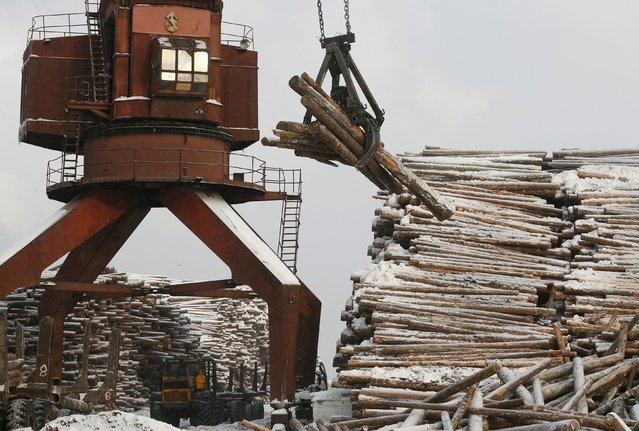
A crane loads logs at the Novoyeniseisk wood processing plant, with the air temperature at about minus 20 degrees Celsius (minus 4 degrees Fahrenheit), in the town of Lesosibirsk in Krasnoyarsk Region, Siberia, Russia, February 16, 2016. The plant exports timber to Europe, Northern Africa and Asia. The Taiga, also known as the boreal forest, on the coast of the Angara River and Yenisei River is one of the main areas for the industrial cutting of wood thanks to the high quality of the Angara pine. (Photo by Ilya Naymushin/Reuters)

A crane loads logs at the Novoyeniseisk wood processing plant, with the air temperature at about minus 20 degrees Celsius (minus 4 degrees Fahrenheit), in the town of Lesosibirsk in Krasnoyarsk Region, Siberia, Russia, February 16, 2016. The plant exports timber to Europe, Northern Africa and Asia. The Taiga, also known as the boreal forest, on the coast of the Angara River and Yenisei River is one of the main areas for the industrial cutting of wood thanks to the high quality of the Angara pine. Open air work continues all year around regardless to temperatures which can drop to minus 52 degrees Celsius (minus 61.6 degrees Fahrenheit), according to employees. (Photo by Ilya Naymushin/Reuters)
Details
18 Feb 2016 13:10:00
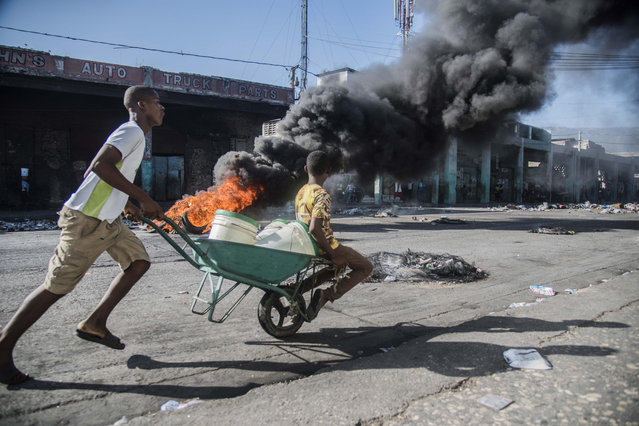
A man carries a child in a wheelbarrow near a burning tire barricade in the framework of the protests of the last three days due to the increase in fuel prices, in Port-au-Prince, Haiti, 09 July 2018. Haiti was today practically paralyzed by a transport strike after three days of violent riots due to an increase in fuel prices, which the Government left without effect shortly after the announcement. The Prime Minister, Jack Guy Lafontant, today heads a meeting with representatives of Parliament to assess the situation created after the violent protests, which have left at least three dead and several injured. (Photo by Jean Marc Hervé Abelard/EPA/EFE)

A man carries a child in a wheelbarrow near a burning tire barricade in the framework of the protests of the last three days due to the increase in fuel prices, in Port-au-Prince, Haiti, 09 July 2018. Haiti was today practically paralyzed by a transport strike after three days of violent riots due to an increase in fuel prices, which the Government left without effect shortly after the announcement. The Prime Minister, Jack Guy Lafontant, today heads a meeting with representatives of Parliament to assess the situation created after the violent protests, which have left at least three dead and several injured. (Photo by Jean Marc Hervé Abelard/EPA/EFE)
Details
22 Oct 2018 00:03:00
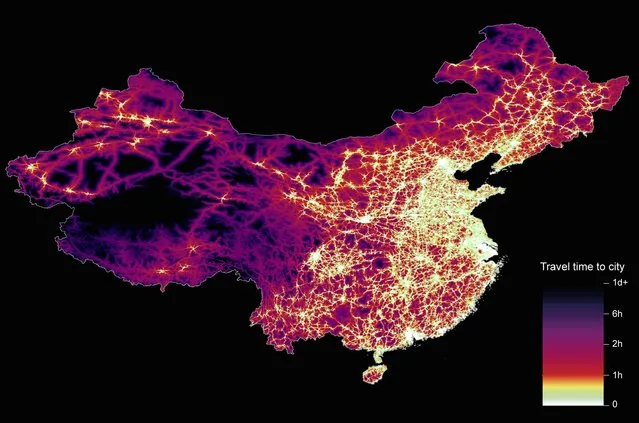
From Britain to China to Mali, new maps showing travel times to the nearest urban centre reveal huge differences between countries. Using Open Street Map and Google, a University of Oxford team have created a visual breakdown that suggests major inequalities when it comes to commuting. Here: China. The dataset used for China was unique as it relied solely on Open Street Map, due to restrictions on accessing Google data. The population is densely concentrated in the east and accessibility is increased, whereas rural provinces in the west remain remote. (Photo by Daniel Weiss/Jennifer Rozier/Malaria Atlas Project/University of Oxford )

From Britain to China to Mali, new maps showing travel times to the nearest urban centre reveal huge differences between countries. Using Open Street Map and Google, a University of Oxford team have created a visual breakdown that suggests major inequalities when it comes to commuting. Here: China. The dataset used for China was unique as it relied solely on Open Street Map, due to restrictions on accessing Google data. The population is densely concentrated in the east and accessibility is increased, whereas rural provinces in the west remain remote. (Photo by Daniel Weiss/Jennifer Rozier/Malaria Atlas Project/University of Oxford)
Details
12 Jan 2018 06:43:00
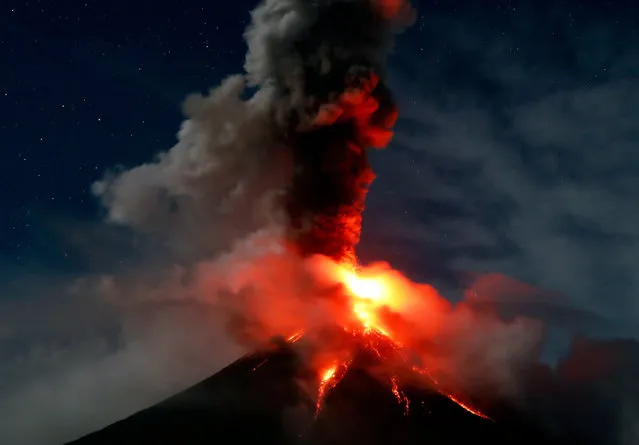
Mayon Volcano spews ash and lava in the town of Daraga, Albay province, Philippines, 25 January 2018. Mayon volcano located in eastern Philippines and active over the last 10 days spewed fresh lava and ash while the number of evacuees exceeded 60 thousand in the face of the threat of an even more potent explosion. The Philippines, which currently has 23 active volcanoes, is situated on the so-called 'Pacific Ring of Fire', an area known for its intense seismic activity which extends from the west coast of the American continent to New Zealand, Japan, the Philippines and Indonesia. (Photo by Francis R. Malasig/EPA/EFE)

Mayon Volcano spews ash and lava in the town of Daraga, Albay province, Philippines, 25 January 2018. Mayon volcano located in eastern Philippines and active over the last 10 days spewed fresh lava and ash while the number of evacuees exceeded 60 thousand in the face of the threat of an even more potent explosion. The Philippines, which currently has 23 active volcanoes, is situated on the so-called 'Pacific Ring of Fire', an area known for its intense seismic activity which extends from the west coast of the American continent to New Zealand, Japan, the Philippines and Indonesia. (Photo by Francis R. Malasig/EPA/EFE)
Details
27 Jan 2018 06:36:00
These girls are scantily dressed as they head out for a night out in Portsmouth, Hampshire on September 21, 2016 in matching outfits. Thousands of Portsmouth University students enjoy freshers week. Teenagers enjoy their first taste of freedom in bars and clubs near Portsmouth Guildhall which on a midweek alcohol fuelled night of fun in the early hours of Wednesday morning much to the despair of local residents who get disturbed up to 4am when they eventually wander home. Girls dressed in “Dirty Disco” outfits with “Don't tell daddy” on their bums. (Photo by Paul Jacobs/PictureExclusive.com)

These girls are scantily dressed as they head out for a night out in Portsmouth, Hampshire on September 21, 2016 in matching outfits. Thousands of Portsmouth University students enjoy freshers week. Teenagers enjoy their first taste of freedom in bars and clubs near Portsmouth Guildhall which on a midweek alcohol fuelled night of fun in the early hours of Wednesday morning much to the despair of local residents who get disturbed up to 4am when they eventually wander home. Girls dressed in “Dirty Disco” outfits with “Don't tell daddy” on their bums. (Photo by Paul Jacobs/PictureExclusive.com)
Details
22 Sep 2016 10:11:00
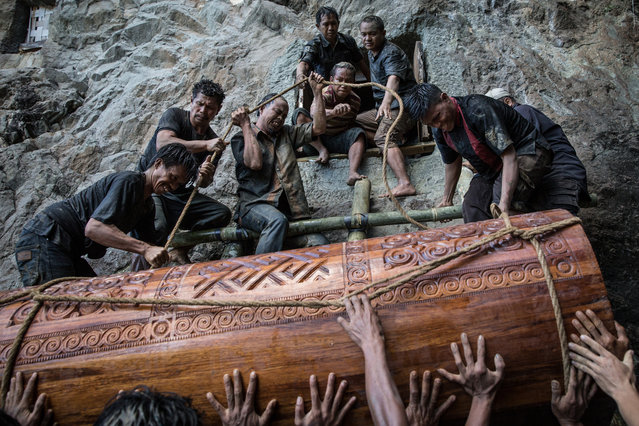
It is said that Torajans are people who “live to die”. For this Indonesian ethnic group, funerals are such extravagant events that they sometimes attract tourists. Families can postpone burials years (and the deceased are considered sick and hosted at home until the funeral) until the family can raise enough money and gather as many relatives as possible. And then it’s a jubilant multiday social event with a parade, dances and animal sacrifices. Agung Parameswara photographed these funerary practices when he traveled to South Sulawesi province, where the Torajans live. But often, their funeral isn’t the last time the dead are seen. In August, crypts are opened, coffins are slid back out and bodies delicately unsheathed. This tender ritual is known as Ma’Nene, which is customarily performed every few years. (Photo by Agung Parameswara/The Washington Post)

It is said that Torajans are people who “live to die”. For this Indonesian ethnic group, funerals are such extravagant events that they sometimes attract tourists. Families can postpone burials years (and the deceased are considered sick and hosted at home until the funeral) until the family can raise enough money and gather as many relatives as possible. And then it’s a jubilant multiday social event with a parade, dances and animal sacrifices. Agung Parameswara photographed these funerary practices when he traveled to South Sulawesi province, where the Torajans live. (Photo by Agung Parameswara/The Washington Post)
Details
06 Oct 2016 09:15:00