Loading...
Done
This composite image shows a sequence, from bottom left to top left, of the moon's transition during a total lunar eclipse on April 15, 2014 in Miami, Florida. People in most of north and south America should be able to witness this year's first total lunar eclipse, which will cause a “blood moon” and is the first of four in a rare Tetrad of eclipses over the next two years. (Photo by Joe Raedle/Getty Images)

This composite image shows a sequence, from bottom left to top left, of the moon's transition during a total lunar eclipse on April 15, 2014 in Miami, Florida. People in most of north and south America should be able to witness this year's first total lunar eclipse, which will cause a “blood moon” and is the first of four in a rare Tetrad of eclipses over the next two years. (Photo by Joe Raedle/Getty Images)
Details
15 Apr 2014 14:28:00
Members of Brazil's Movimento dos Sem-Teto (Roofless Movement) stand in the hallway of one of the 11 empty buildings that the movement took over recently, in the centre of Sao Paulo, November 6, 2012. According to City Hall, there are some 400,000 people in need of stable housing, including the 4,000 families of the Roofless Movement who are squatting in abandoned or vacant buildings that range from apartment blocks to hotels, in Sao Paulo, the largest city in South America. Picture taken November 6, 2012

Members of Brazil's Movimento dos Sem-Teto (Roofless Movement) stand in the hallway of one of the 11 empty buildings that the movement took over recently, in the centre of Sao Paulo, November 6, 2012. According to City Hall, there are some 400,000 people in need of stable housing, including the 4,000 families of the Roofless Movement who are squatting in abandoned or vacant buildings that range from apartment blocks to hotels, in Sao Paulo, the largest city in South America. (Photo by Nacho Doce/Reuters)
Details
18 Dec 2012 09:40:00
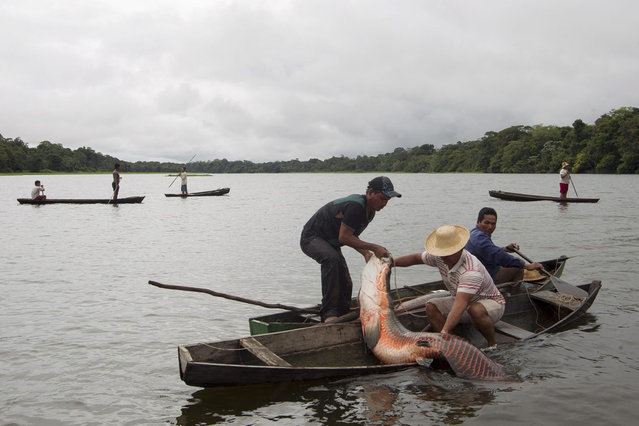
Villagers from the Porto Novo community load into their canoes arapaima or pirarucu, the largest freshwater fish species in South America and one of the largest in the world, while fishing in Poco Fundo lake along a branch of the Solimoes river, one of the main tributaries of the Amazon, in the Mamiraua nature reserve near Fonte Boa about 600 km (373 miles) west of Manaus, November 26, 2013. (Photo by Bruno Kelly/Reuters)

Villagers from the Porto Novo community load into their canoes arapaima or pirarucu, the largest freshwater fish species in South America and one of the largest in the world, while fishing in Poco Fundo lake along a branch of the Solimoes river, one of the main tributaries of the Amazon, in the Mamiraua nature reserve near Fonte Boa about 600 km (373 miles) west of Manaus, November 26, 2013. Catching the arapaima, a fish that is sought after for its meat and is considered by biologists to be a living fossil, is only allowed once a year by Brazil's environmental protection agency. The minimum size allowed for a fisherman to keep an arapaima is 1.5 meters (4.9 feet). (Photo by Bruno Kelly/Reuters)
Details
17 Dec 2013 08:03:00
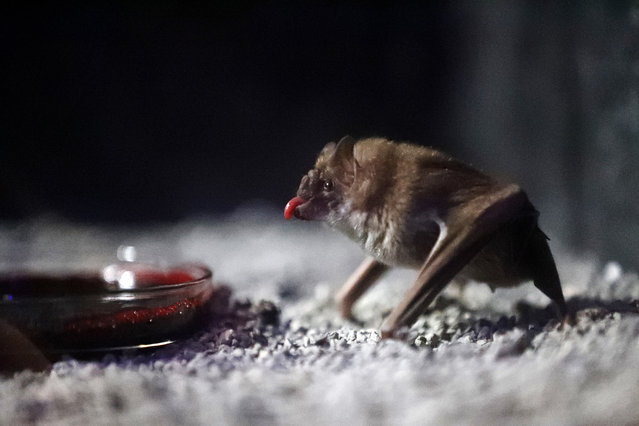
In this Tuesday, March 20, 2018 photo, a Vampire Bat drinks bovine blood in the Criaturas de la Noche (Creatures of the Night) Bat House, the Audubon Zoo's new night house in New Orleans. The various species are all from Central and South America, and the building's interior simulates an abandoned warehouse set up to protect Mayan artifacts during a dig. (Photo by Gerald Herbert/AP Photo)

In this Tuesday, March 20, 2018 photo, a Vampire Bat drinks bovine blood in the Criaturas de la Noche (Creatures of the Night) Bat House, the Audubon Zoo's new night house in New Orleans. The various species are all from Central and South America, and the building's interior simulates an abandoned warehouse set up to protect Mayan artifacts during a dig. (Photo by Gerald Herbert/AP Photo)
Details
25 Mar 2018 00:03:00
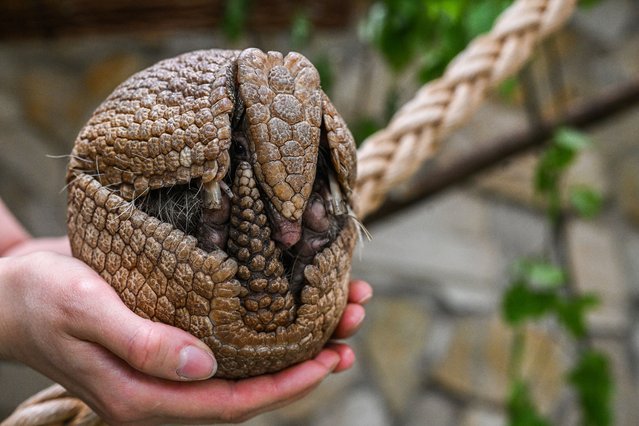
Zookeeper Agata holds a rare newborn Brazilian three-banded armadillo inside its enclosure at the Wroclaw Zoo in Wroclaw, Poland on May 11, 2023. The Tolypeutes matatus, or the southern armor also known as bolita or tatu-bola, is a fairly popular animal in South America but is increasingly rare. The new zoo child was born on March 23. The species is listed as vulnerable by the International Union for the Conservation of Nature (IUCN) and threatened by habitat loss and hunting. (Photo by Omar Marques/Anadolu Agency via Getty Images)

Zookeeper Agata holds a rare newborn Brazilian three-banded armadillo inside its enclosure at the Wroclaw Zoo in Wroclaw, Poland on May 11, 2023. The Tolypeutes matatus, or the southern armor also known as bolita or tatu-bola, is a fairly popular animal in South America but is increasingly rare. The new zoo child was born on March 23. The species is listed as vulnerable by the International Union for the Conservation of Nature (IUCN) and threatened by habitat loss and hunting. (Photo by Omar Marques/Anadolu Agency via Getty Images)
Details
28 May 2023 04:09:00
Two dancers pass each other as they compete in a heat during the All Scotland Championships in Irish Dancing at the Royal Concert Hall in Glasgow, Scotland February 23, 2013. The championships, which continue until Monday, attract over 2000 dancers from more than 300 dance schools, from countires such as North America, South Africa, Australia and Russia. (Photo by David Moir/Reuters)

Two dancers pass each other as they compete in a heat during the All Scotland Championships in Irish Dancing at the Royal Concert Hall in Glasgow, Scotland. The championships attract over 2000 dancers from more than 300 dance schools, from countires such as North America, South Africa, Australia and Russia. (Photo by David Moir/Reuters)
Details
11 Oct 2013 07:40:00
This photo taken on February 10, 2025 shows a captured green iguana being held by hunters after it was brought down by a slingshot in Pingtung. Taiwan's iguana population has exploded since the spikey-backed giant lizards were introduced from Central and South America more than 20 years ago as exotic pets. Many escaped or were dumped by their owners and have bred rapidly in the warm climate of southern Taiwan, invading neighbourhoods and ravaging farmers' crops. (Photo by I-Hwa Cheng/AFP Photo)

This photo taken on February 10, 2025 shows a captured green iguana being held by hunters after it was brought down by a slingshot in Pingtung. Taiwan's iguana population has exploded since the spikey-backed giant lizards were introduced from Central and South America more than 20 years ago as exotic pets. Many escaped or were dumped by their owners and have bred rapidly in the warm climate of southern Taiwan, invading neighbourhoods and ravaging farmers' crops. (Photo by I-Hwa Cheng/AFP Photo)
Details
02 Mar 2025 04:03:00
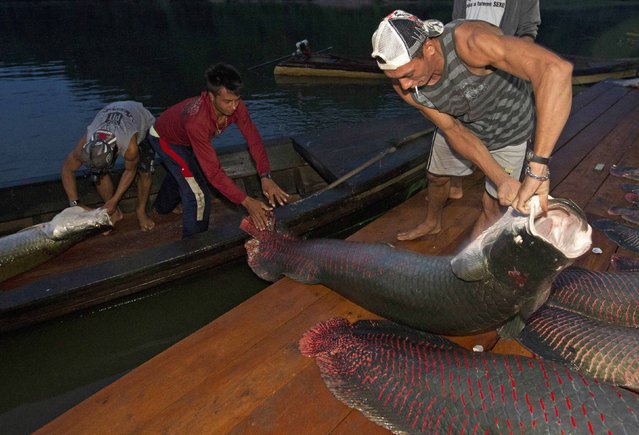
Villagers from the Medio Jurua nature reserve of Brazil's Amazon rainforest arrive with their catch of pirarucus, the largest freshwater fish in South America, after a night of fishing in Manaria Lake, Carauari municipality, September 3, 2012. Catching the pirarucu, a fish that is sought after for its meat and is considered by biologists to be a living fossil, is only allowed once a year by Brazil's environmental protection agency. (Photo by Bruno Kelly/Reuters)

Villagers from the Medio Jurua nature reserve of Brazil's Amazon rainforest arrive with their catch of pirarucus, the largest freshwater fish in South America, after a night of fishing in Manaria Lake, Carauari municipality, September 3, 2012. Catching the pirarucu, a fish that is sought after for its meat and is considered by biologists to be a living fossil, is only allowed once a year by Brazil's environmental protection agency. (Photo by Bruno Kelly/Reuters)
Details
19 Jul 2013 08:53:00