Loading...
Done
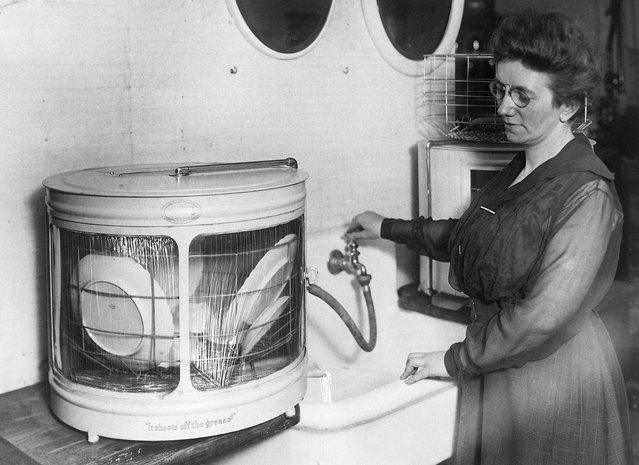
All the drugery of dishwashing in this three-times -a day task, which comes to the house wife who does her own house work, has been eliminated by the new dish washer shown in the photograph on April 25, 1921. It is the invention of a Cincinnati school teacher, who sought to make things a bit more pleasant for his wife. Incedently, his idea was worth 12,00 to him, for a manufacturing concern thought so much of the “dish-washer” they purchased the rights and will seek to add a little joy to thousands of other housewives. With the aid of only hot water, dishes placed in a wire rack and set into the drum are made clean and spotless in two minutes. (Photo by Bettmann Archive/Getty Images)

All the drugery of dishwashing in this three-times -a day task, which comes to the house wife who does her own house work, has been eliminated by the new dish washer shown in the photograph on April 25, 1921. It is the invention of a Cincinnati school teacher, who sought to make things a bit more pleasant for his wife. Incedently, his idea was worth 12,00 to him, for a manufacturing concern thought so much of the “dish-washer” they purchased the rights and will seek to add a little joy to thousands of other housewives. With the aid of only hot water, dishes placed in a wire rack and set into the drum are made clean and spotless in two minutes. (Photo by Bettmann Archive/Getty Images)
Details
08 Jul 2021 10:25:00
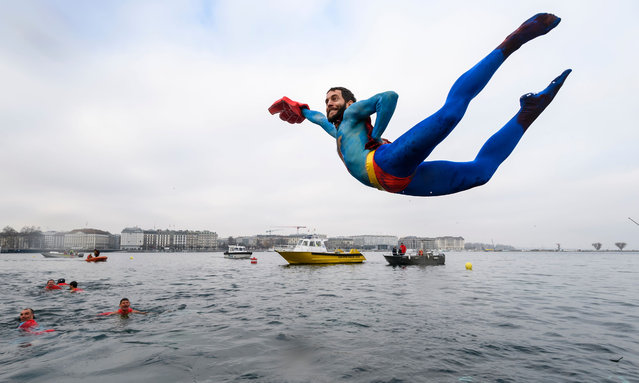
A swimmer disguised as Superman dives into the lake during the 78th “Coupe de Noel” (Christmas cup) swimming race in the Lake Geneva, on December 18, 2016 in Geneva. (Photo by Fabrice Coffrini/AFP Photo)

A swimmer disguised as Superman dives into the lake during the 78th “Coupe de Noel” (Christmas cup) swimming race in the Lake Geneva, on December 18, 2016 in Geneva. More than 1800 participants took part in the event, a 12-meter-long swimming off the Geneva's bank in the 7 degrees Celsius cold water. (Photo by Fabrice Coffrini/AFP Photo)
Details
19 Dec 2016 10:13:00
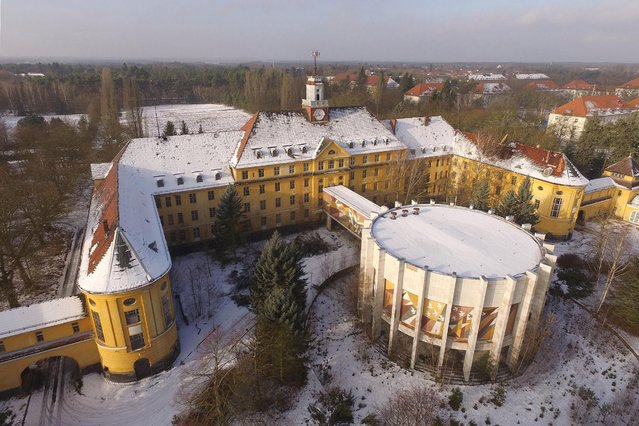
In this aerial view the officers' building and an auditorium stand at the former Soviet military base on January 26, 2017 in Wuensdorf, Germany. (Photo by Sean Gallup/Getty Images)

In this aerial view the officers' building and an auditorium stand at the former Soviet military base on January 26, 2017 in Wuensdorf, Germany. Wuensdorf, once called “The Forbidden City”, was the biggest base for the Soviet armed forces in communist East Germany from 1945 until the last Soviet troops left in the early 1990s following the end of the Cold War and the reunification of Germany. (Photo by Sean Gallup/Getty Images)
Details
01 Feb 2017 06:02:00
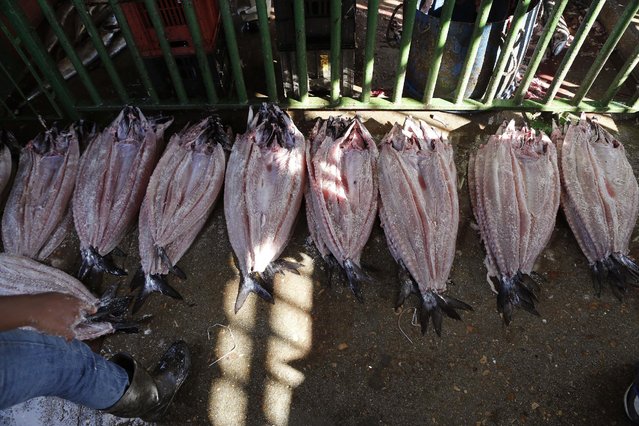
In this photo taken on Saturday, May 16, 2015, Snoek fish with salt on them after they were cleaned  in Lambert's Bay, South Africa. (Photo by Schalk van Zuydam/AP Photo)

In this photo taken on Saturday, May 16, 2015, Snoek fish with salt on them after they were cleaned in Lambert's Bay, South Africa. The boats line up along the jetty, bobbing in the cold south Atlantic waters, bringing in the day's catch in the early afternoon. The long silver snoek fish is one of South Africa's traditional foods, and a main source of income for the town of Lambert's Bay. (Photo by Schalk van Zuydam/AP Photo)
Details
25 May 2015 09:28:00
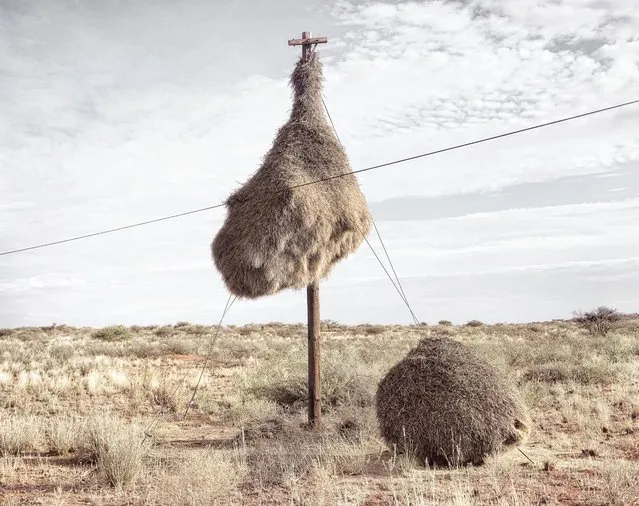
Assimilation By Dillon Marsh

Captured by South African photographer Dillon Marsh, these fantastic photographs depict the many designs employed by sociable weavers to build sturdy nests that are safe from intruders such as cobras and tree snakes. They are also nice cool during the day, and stay warm during cold desert nights. A University of Stellenbosch graduate, Marsh is currently interested in landscape photographer who seeks out anomalies that can be arranged in a photographic series. Assimilation depicts scores of intricate weaver’s nests atop utility poles in Southern Africa. Colonies of sociable weavers have been known to stay attached to one particular nest for up to 100 years, according to The San Diego Zoo.
Details
15 Feb 2014 14:47:00
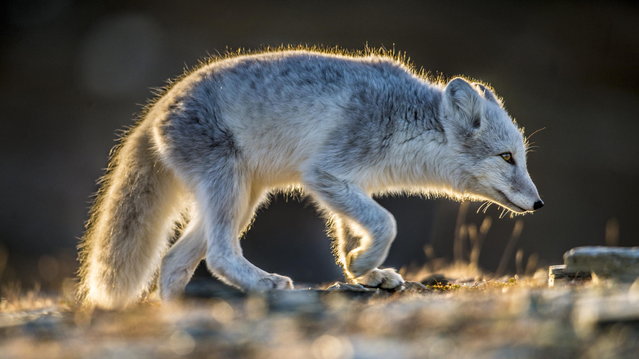
Arctic Fox. (Photo by Trond Eriksen)

“The arctic fox (Vulpes lagopus), also known as the white fox, polar fox, or snow fox, is a small fox native to the Arctic regions of the Northern Hemisphere and is common throughout the Arctic tundra biome. It is well adapted to living in cold environments. It has a deep thick fur which is brown in summer and white in winter. It averages in size at about 85.3 cm (33.6 in) in body length, with a generally rounded body shape to minimize the escape of body heat. – Wikipedia. (Photo by Trond Eriksen)
Details
26 May 2014 14:09:00
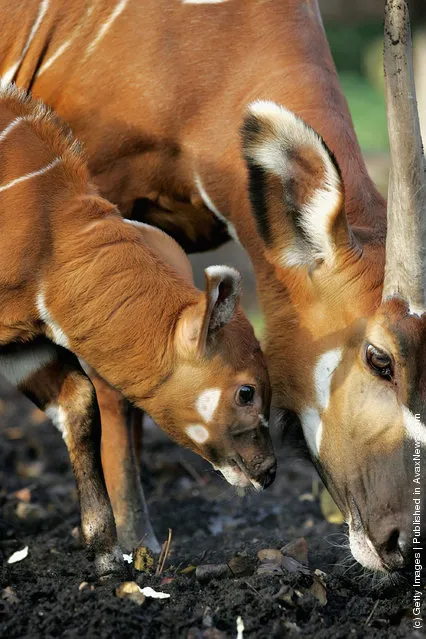
The one month old newborn Bongo Antelope

“The western or lowland bongo is a herbivorous, mostly nocturnal forest ungulate and among the largest of the African forest antelope species. Bongos are characterised by a striking reddish-brown coat, black and white markings, white-yellow stripes and long slightly spiralled horns”. – Wikipedia

Photo: The one month old newborn Bongo Antelope Calf ventures out in the cold with his mother in their enclosure at London Zoo on December 9, 2005 in London, England. (Photo by Christopher Lee/Getty Images)
Details
21 Feb 2012 12:17:00

A military band prepares to play the national anthems before Cuban President Raul Castro welcomes U.S. President Barack Obama at the Palacio de la Revolucion in Havana March 21, 2016. (Photo by Jonathan Ernst/Reuters)

A military band prepares to play the national anthems before Cuban President Raul Castro welcomes U.S. President Barack Obama at the Palacio de la Revolucion in Havana March 21, 2016. Barack Obama on Sunday became the first US president in 88 years to visit Cuba, touching down in Havana for a landmark trip aimed at ending decades of Cold War animosity. (Photo by Jonathan Ernst/Reuters)
Details
22 Mar 2016 11:16:00